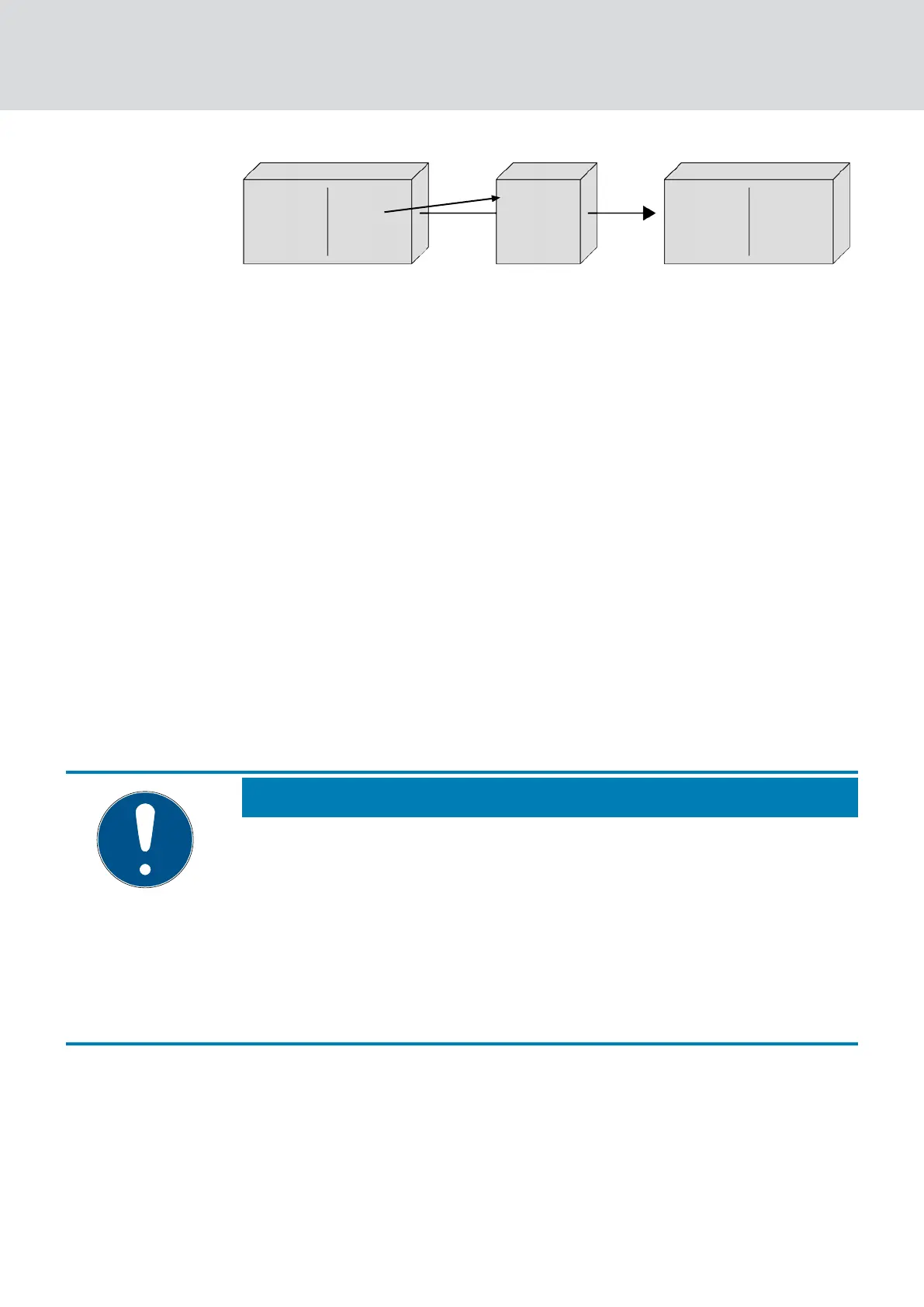
Input 3: 12
Input 2: 6
Input 1: 10
RN2-3
RN2-4
Target partner To: RN2-4
Input 1: 10
2. Try (5s) with radio, if
Ethernet on RN2.ER.IO fails
RN2-3
Input 1: 9
Input 2: 6
Input 3: 12
Target partner
RN2-5
Conditions that must be met for forwarding and broadcast:
1. Actual target partner: The RouterNode checks whether it is listed
in the target partners of the data packet.
2. Input counter reading in data package > currently stored
input counter reading: The initiator counts how often it has forwar-
ded the input signal via the RingCast after an input event and increases
the counter reading each time it is sent again. The transmitted data
packet contains this counter reading. When a RouterNode receives a
data packet, there are two possibilities.
The counter reading of the received packet is higher than the own
counter reading: The received packet is new and has not yet been
processed (otherwise the stored counter reading would be the same).
The counter reading of the received packet is less than or equal to the
own counter reading: The received packet has already been processed.
If the initiator receives a data packet with an input counter reading equal to
its own counter reading, the RingCast is considered complete.
NOTE
Signal distribution after RingCast termination detection
The termination detection means that the shortest possible intact path of
the RingCast has been passed and all RouterNodes on this path have re-
ceived the input signal.
If not all paths are intact in case of redundant paths, the RingCast is still re-
cognized as terminated.
The terminal detection therefore does not indicate whether all router
nodes involved have received the input signal.
WaveNet (Manual)
5. WaveNet Manager
97 / 210


 To Next Page