SITA Messtechnik GmbH – Operating Instructions SITA ConSpector
8.2 Cleaning the Immersion Probe
Contamination of the immersion probe by show a higher contamination level. As a result minute
contaminations in the process bath can no longer be reliably recorded.
Heavy contamination may cause an overrange of the sensor. In such a case a corresponding fault
message appears on the display of the SITA ConSpector. If you are not sure whether you have to
clean the immersion probe, carry out a test as an empty measurement in the beaker (see section
8.2).
In most cases it is sufficient to rinse the outside of the immersion probe after the measurements.
When measuring aqueous samples, water is suitable for rinsing. When measuring solvent samples,
rinse and clean with the clean solvent.
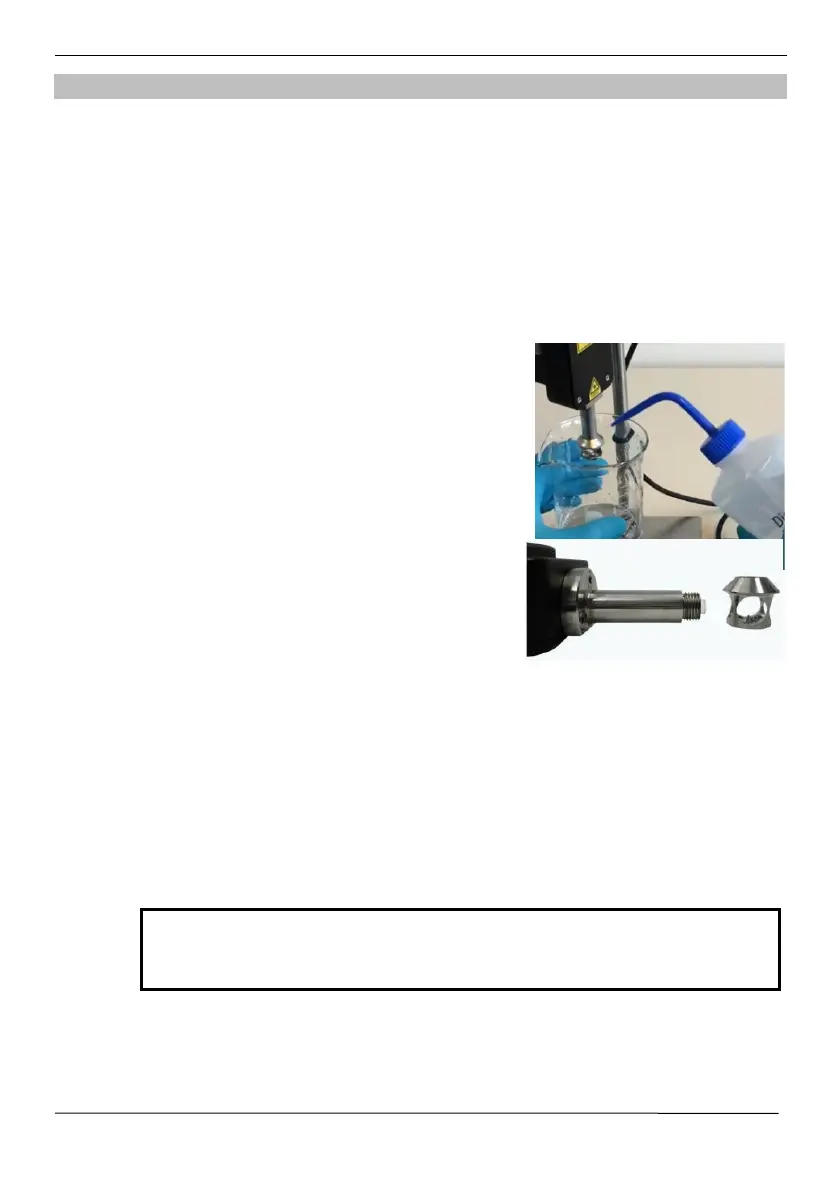
For more thorough cleaning, the immersion probe can be pre-
cleaned in a mild cleaning solution. To do this, prepare the
measuring assembly with the limiter screwed on and the clean-
ing solution instead of a sample.
After cleaning, rinse off any cleaning agent and other residues
with fully deionised water. Check the result (8.1) and repeat
the cleaning if necessary.
For extensive cleaning, e.g. after repeatedly failed test/empty
measurement, you can carefully unscrew the limiter of the im-
mersion probe. Then clean the end of the glass rod. Cotton
swabs soaked in alcohol or water are suitable for this pur-
pose. Avoid damaging the glass rod.
To clean the visible part of the light conductor, proceed as
follows:
• Carefully unscrew the limiter (see figure).
• Gently wipe the visible part of the light conductor with a cleaning swab soaked in alcohol a lint-
free cloth.
• Carefully rinse the visible part of the light conductor using distilled water from a spray bottle.
Make sure no water splashes on the sensor head.
• Clean the limiter following the same procedure.
• Screw the limiter on the immersion probe. Take care not to touch the light conductor.
Clean the stainless steel beaker after use.
If the measuring device is used to measure both aqueous samples and non-polar solvents, rinse
or clean with an alcohol (e.g. isopropanol) before switching from one to the other kind of samples.
In case of minor soiling the visible part of the light conductor and the lim-
iter can be cleaned, if necessary, using the cleaning swab without disas-
sembling the two parts.


 To Next Page