41
APPENDIX D - Remote BUS Interface: RS-232
This section provides information on the proper use and configuration of bus remote interface. The RS-232
remote interface is optional on all 4320/4520 models. Please see the OPTIONS section of the manual for
details.
RS-232 Interface
This interface provides all of the control commands and parameter setting commands. All commands can be
found in the command list of this manual.
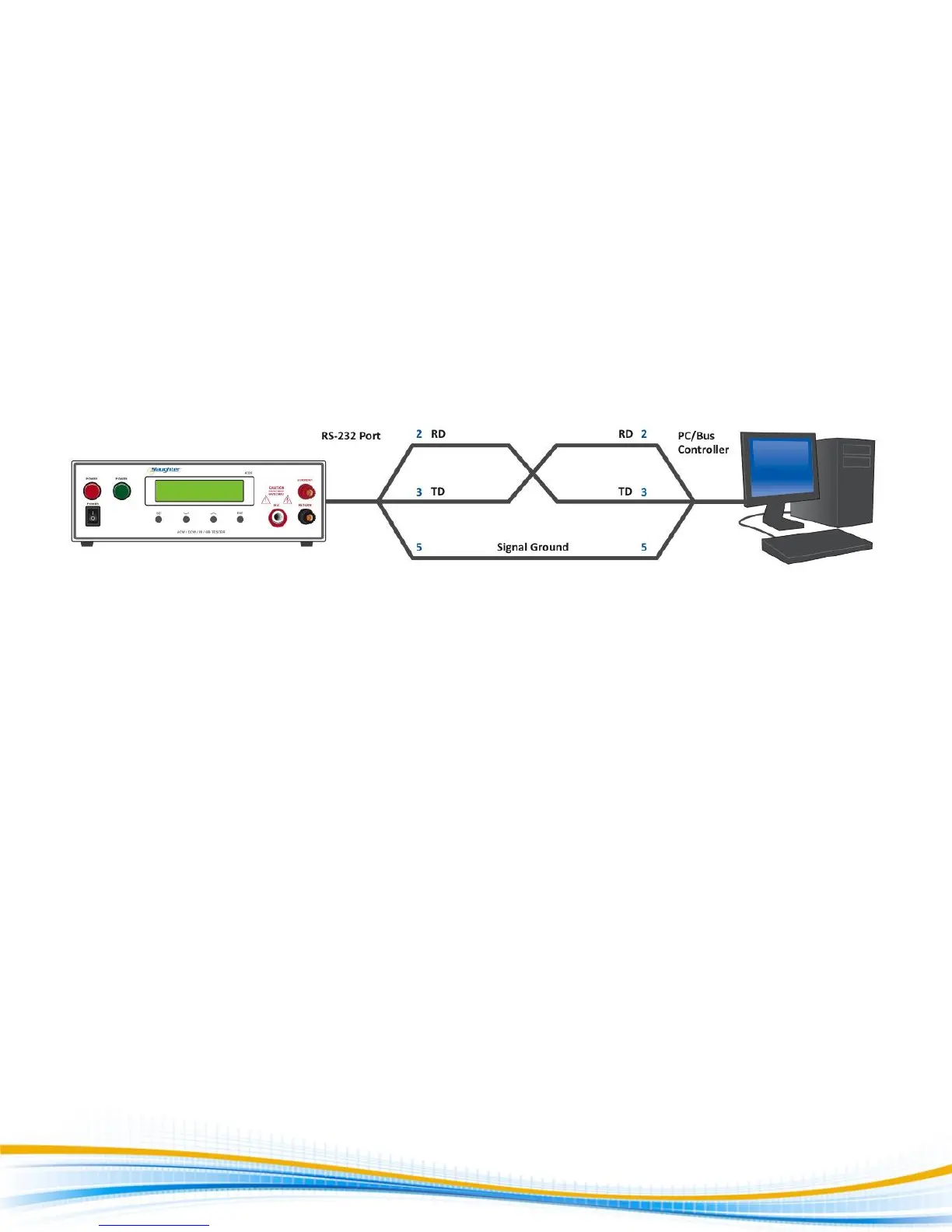
The RS-232 cabling should be configured as follows for a 9-pin serial port interface:
The COM port should have the following configuration. 9600 baud, 8 data bits, 1 stop bit, no parity. This
interface does not support XON/XOFF protocol or any hardware handshaking. The controller should be
configured to ignore the handshaking lines DTR (pin 4), DSR (pin 6), CTS (pin 8) and RTS (pin 7). If the port
cannot be configured through software to ignore the lines then the handshake lines should be jumpered
together in two different sets. Pins 4 and 6 jumpered together and pins 7 and 8 jumpered together at the
controller end of the cable.
When sending command over the RS232 bus, the tester will send a response string of 06 hex or 6 decimal, the
Acknowledge (ACK) ASCII control code if the transfer was recognized and completed by the tester. If there is
an error with the command string that is sent, the tester will respond with 15 hex or 21 decimal, the Not
Acknowledge (NAK) ASCII control code. The ACK or NAK response allows for software handshaking, to monitor
and control data flow. When requesting data from the tester, it will automatically send the data back to the
controller input buffer. The controller input buffer will accumulate data being sent from the tester including
the ACK and NAK response strings, until it has been read by the controller.
RS-232 Interface Command List
The RS-232 bus will automatically send any response back to the controller's input buffer. Note that the
commands are case sensitive and must be typed in capital letters. Each command string should be terminated
by the ASCII control code, New Line <NL>, or OAh.


 To Next Page