TT301 – Operation and Maintenance Instruction Manual
2.8
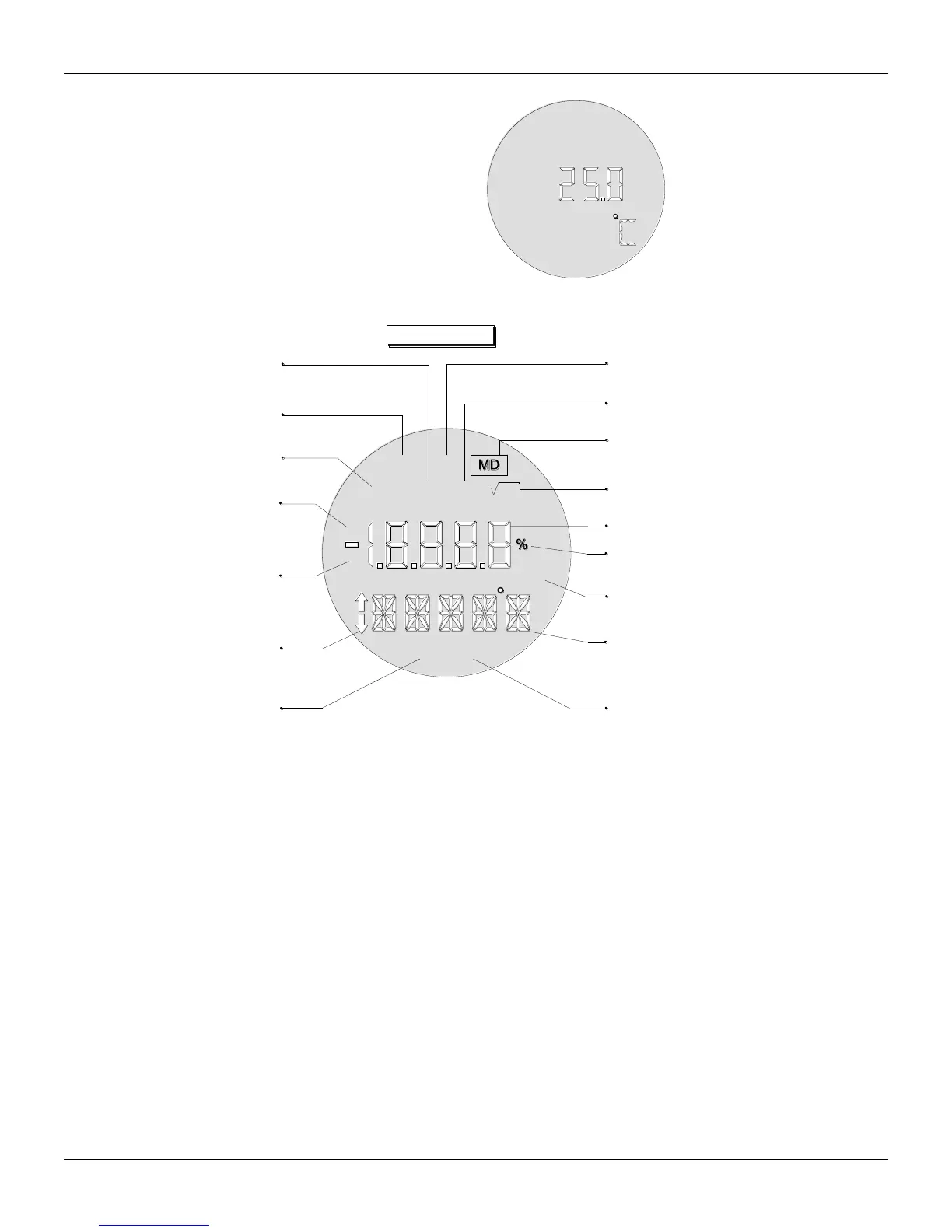
Figure 2.7 – Display
* PID IS OPTIONAL
M
A
Fix
F(t)
PID
SP
F(x)
35
PV
min
ACK
INDICATES THAT THE DISPLAYED
ALARM HAS NOT YET BEEN ACKNOWLEDGED
INDICATES ACTIVE SPECIAL
SENSOR LINEARIZATION
( NOT USED ON TT301 )
VARIABLE FIELD
UNIT PERCENT
UNIT MINUTES
UNIT AND FUNCTION FIELD
INDICATES THAT THE PROCESS
VARIABLE IS NOW DISPLAYED
INDICATES ACTIVE
MULTIDROP MODE
INDICATES ACTIVE
SETPOINT GENERATOR *
INDICATE PID
CONTROLLER MODE *
INDICATES ACTIVE
CONSTANT OUTPUT MODE
INDICATES CONTROLLER
IN AUTOMATIC *
INDICATES CONTROLLER
IN MANUAL *
INDICATES POSSIBILITY
TO ADJUST / CHANGE
VARIABLE / MODE
INDICATES THAT
THE SETPOINT
IS NOW DISPLAYED *
Figure 2.8 – Typical Monitoring Mode Display
Alarm
The two alarms are software alarms and have no contacts available on the transmitter. The alarms are
acknowledged by using the Local Adjustment or the Configurator, which can view and configure alarms
as well - see further Section III. During an alarm, the display will indicate which alarm has been
activated and if it has been acknowledged or not.
The transmitter display also indicates the alarms status as shown in Figure 2.9.
AL H means High Alarm, AL L means Low Alarm and ALO indicates Burnout failure. The ACK indicates
that the alarm has not yet been acknowledged.
When the alarm condition disappears, the "ACK" is switched off and the display returns to monitoring
mode.
For further information on alarm configuration, see Section III - Programming Using Terminal.


 To Next Page