27
MAN_Sigma_16_GB_00
03/2016
Manuel d'entretien et d'utilisation
user maintenance guide
● We recommend that you drain and rell the
brake circuit after every brake pad change.
This will allow you to maintain optimum
braking performance.
● To bleed your brake system more rapidly,
especially for a big eet, we recommend the
priming system SODIKART (Ref. OU951.002).
● Store the used brake uid in labelled
containers until it is collected by a specialist
waste disposal company.
● The brake liquid doesn’t contain petrol, so
never pour the liquid into a using oil tank.
● Brake uid absorbs water Make sure the
replacement brake uid comes from a
container that has been stored in good
conditions and is recent.
● Check that the pedal is rm after each bleed.
► An air bubble in the brake system can lead to
a partial or total lost of brakes and may lead to
a serious or even fatal injury.
► Leaks in the brake system may lead to a
serious or even fatal injury.
► Moisture in the brake uid may cause vapour
lock and a sudden loss of braking power, may
lead to a serious or even fatal injury.
► Use brake uid DOT 4 only
► Test the brake after each bleed.
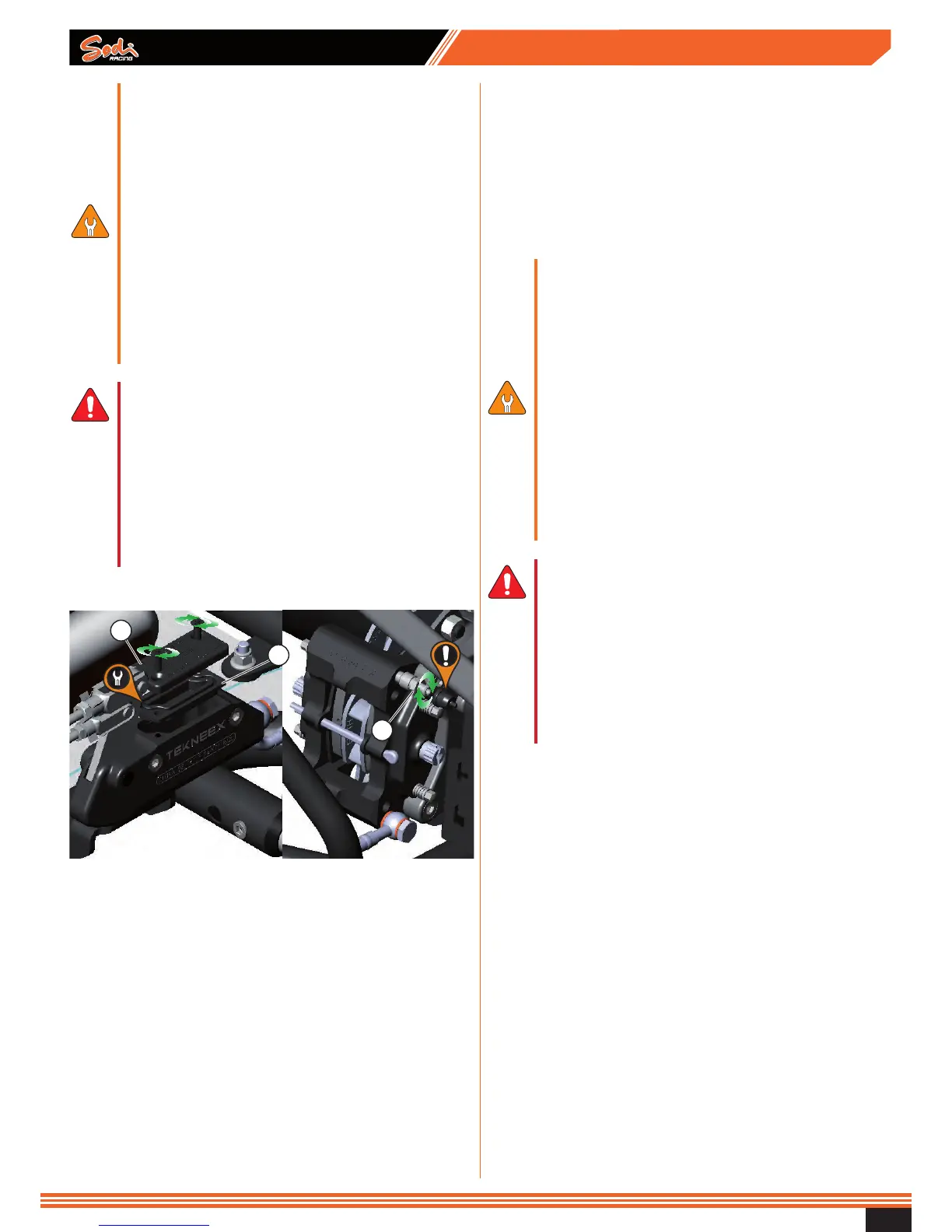
6.1.8 - Bleeding the rear brake circuit
2
3
1
Legend
1 Bleeder screw
2 Cap
3 Diaphragm
● Use a pipe and a container to collect the used uid.
● Remove the bleeder screw (1) protective cover and
connect the hose to the bleed nipple with the free end in
the receptacle.
● Gently unscrew the bleeder screw (1) and the ller cap (2).
● Repeatedly press the brake pedal until all the uid has
drained out.
● When all the uid has been drained, remove the cap (2),
the diaphragm (3) and top up to the maximum level with
brake uid. Tighten the bleed screw (1), and then press the
brake pedal three or four times.
● Loosen the bleeder screw (1) of the calliper. Brake uid
should ow out. Retighten the bleed screw, and repeat this
step several times to feed the circuit properly. Remember
to add brake uid to the master cylinder as required. Bleed
the circuit so that the brake uid owing out of the hose
contains no air bubbles.
● Retighten the calliper bleed screw (1), remove the pipe and
reapply the protective cap.
● Top up the uid in the master cylinder to its maximum level,
and retighten the cap (2) and the diaphragm (3).
● We recommend that you drain and rell the
brake circuit after every brake pad change.
This will allow you to maintain optimum
braking performance.
● To bleed your brake system more rapidly,
especially for a big eet, we recommend the
priming system SODIKART (Ref. OU951.002).
● Store the used brake uid in labelled
containers until it is collected by a specialist
waste disposal company.
● The brake liquid doesn’t contain petrol, so
never pour the liquid into a using oil tank.
● Brake uid absorbs water Make sure the
replacement brake uid comes from a
container that has been stored in good
conditions and is recent.
● Check that the pedal is rm after each bleed.
► An air bubble in the brake system can lead to
a partial or total lost of brakes and may lead to
a serious or even fatal injury.
► Leaks in the brake system may lead to a
serious or even fatal injury.
► Moisture in the brake uid may cause vapour
lock and a sudden loss of braking power, may
lead to a serious or even fatal injury.
► Use brake uid DOT 4 only
► Test the brake after each bleed.


 To Next Page