Manuel d'entretien et d'utilisation
user maintenance guide
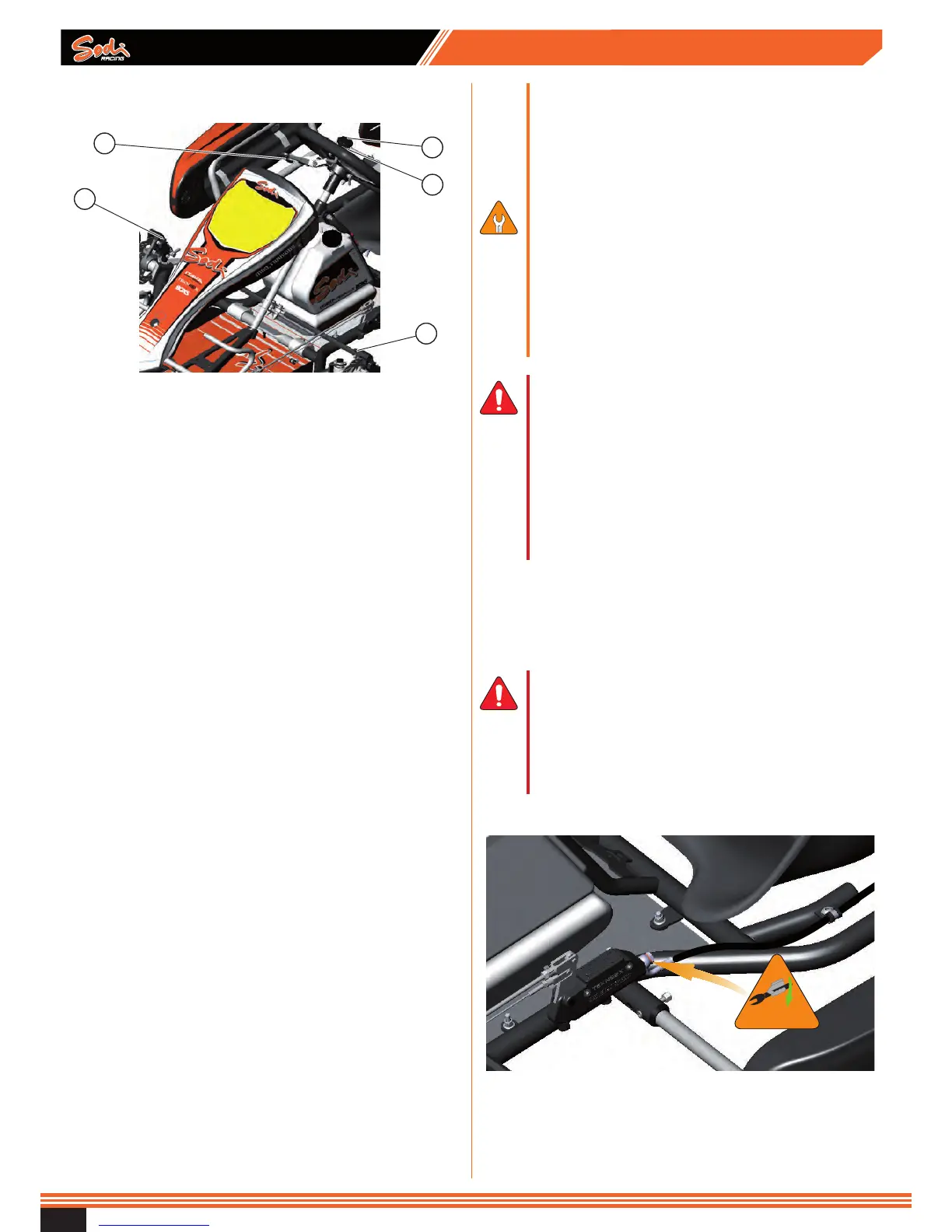
6.1.9 - Bleeding the steering wheel controlled front
brake circuit
3
2
4
1
1
Legend
1 Bleeder screw
2 Cap
3 Brake lever
4 Reservoir
● Use a pipe and a container to collect the used uid.
● Remove the protective caps from the bleed screws (1) on
each front calliper, and then place a hose on the bleed
screw. The other end of the hose should be placed in an
empty container.
● Gently unscrew the bleeder (1) screw and the ller cap (2).
● Apply the brake lever (3) repeatedly until all the brake uid
has drained out.
● When all the uid has been drained, remove the ller
cap (2) and top up to the maximum level with brake uid.
Tighten the bleed screw (1), and then press the brake lever
(3) three or four times.
● Loosen the bleeder screw (1) of the front right calliper.
Brake uid should ow out. Retighten the bleed screw, and
repeat this step several times to feed the circuit properly.
Remember to add brake uid to the reservoir (4) as
required. Bleed the circuit so that the brake uid owing
out of the hose contains no air bubbles.
● Retighten the calliper bleed screw (1), remove the pipe and
reapply the protective cap.
● Repeat the operation for the front left calliper.
● Top up the brake uid in the reservoir (4) to its maximum
level, and retighten the cap (2).
● We recommend that you drain and rell the
brake circuit after every brake pad change.
This will allow you to maintain optimum
braking performance.
● To bleed your brake system more rapidly,
especially for a big eet, we recommend the
priming system SODIKART (Ref. OU951.002).
● Store the used brake uid in labelled
containers until it is collected by a specialist
waste disposal company.
● The brake liquid doesn’t contain petrol, so
never pour the liquid into a using oil tank.
● Brake uid absorbs water Make sure the
replacement brake uid comes from a
container that has been stored in good
conditions and is recent.
● Check that the pedal is rm after each bleed.
► An air bubble in the brake system can lead to
a partial or total lost of brakes and may lead to
a serious or even fatal injury.
► Leaks in the brake system may lead to a
serious or even fatal injury.
► Moisture in the brake uid may cause vapour
lock and a sudden loss of braking power, may
lead to a serious or even fatal injury.
► Use brake uid DOT 4 only.
► Test the brake after each bleed.
6.1.10 - Cleaning
Brakes should be cleaned using a dry cloth and brake cleaner
only.
Do not use WD40 or other greasy products to clean the
callipers and brake discs.
► If WD-40 or a similar cleaning product is
splashed on the brake disc or calliper, braking
will be less efcient or possibly totally
ineffective for a few revolutions. This could
cause a serious or fatal accident.
► Do not apply WD-40 or other cleaning
products to the brake pump.
6.1.11 - Tightness of the brake hose screew
20 Nm


 To Next Page