rvppei iuia r\
For example:
(a) in the
case of a 1 10V
supply choose the "100V" setting
or (b) in
the
case of a 230V
supply choose
the "220V" setting.
Should
you need to change
the line voltage
setting it is a simple
matter to lift the
selector flap with
a thin-bladed
screwdriver and turn
the roller block so that
the
correct
voltage appears
in the window
when the flap is closed. Figure
A.l shows
the line voltage
selector flap
open to reveal the roller
block inside.
Changing the
line voltage selector
setting sometimes
necessitates inserting
a.c.
supply fuses of a different
value. There
are two fuses, one in
the line and one in
the neutral. Both
fuses must
be the correct rating for
the voltage supply. These
fuses
are located below
the roller block,
as shown in Figure A.l.
The fuse values
are:
1
.6
A,
SLO-BLO for
220V or 240V
operation
2
A,
SLO-BLO
for 100V or
120V operation
These fuses
must be 20mm x
5mm cartridge
type.
2.2
POWER CABLE
Connect the
SI 1287 to the
a.c. supply with the power
cord provided. At
one end
the
power cord has an
IEC socket, which
fits into a mating
connector on the
SI1287, and
at the other
end is a power plug
appropriate to the country
of
destination.
Some countries have
no fixed
preference of power plug and
for these the power
cord
is
provided
only with
an IEC socket.
The
wires
at the
other end of the cord
should be connected to
the
user’s power source, via
a suitable connector,
according to the following
color code:
BROWN
=
LIVE
BLUE =
NEUTRAL
GREEN/YELLOW =
GROUND
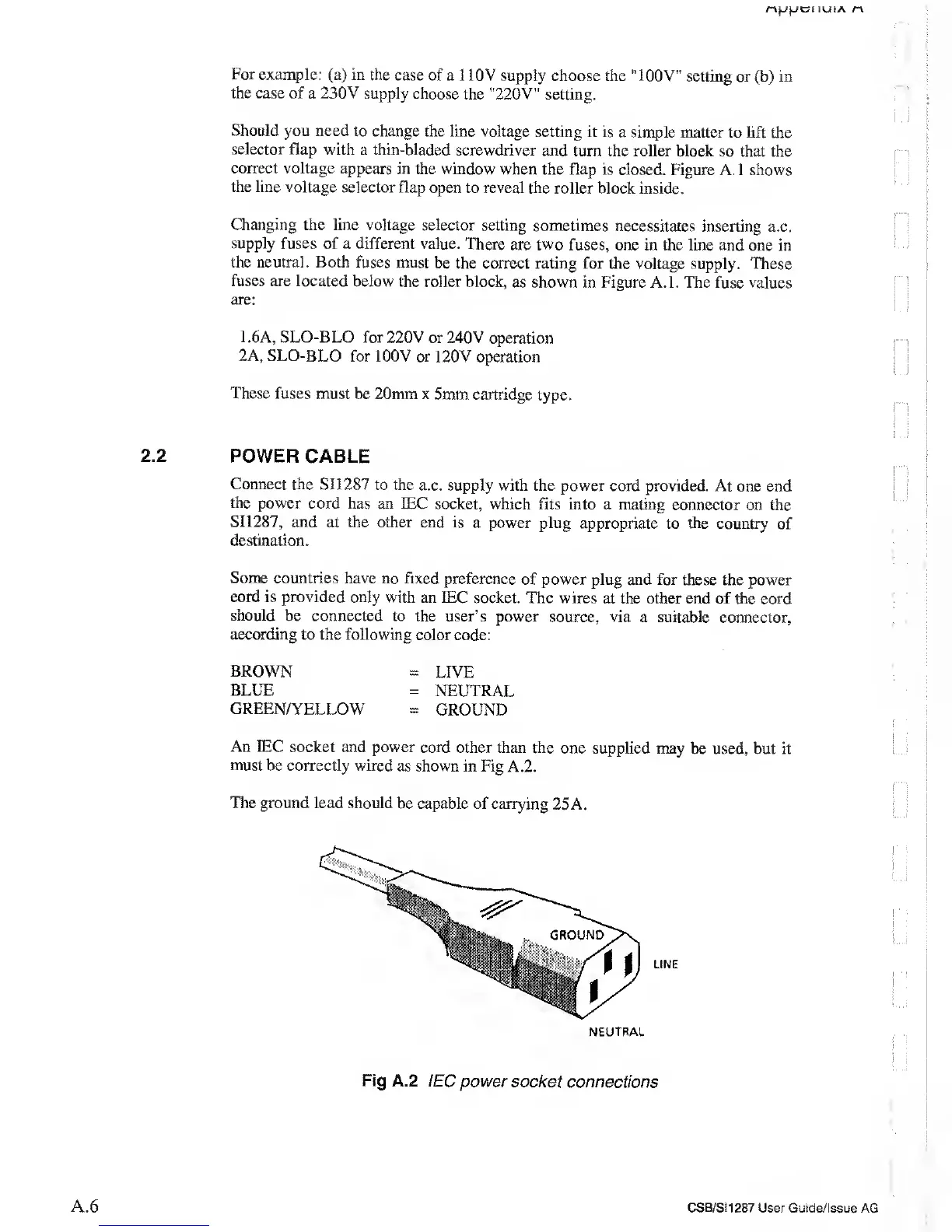
An IEC socket and
power cord
other than the one
supplied may be used,
but it
must
be correctly wired
as shown in Fig
A.2.
The ground
lead should
be capable of carrying
25A.
NEUTRAL
Fig
A.2 IEC
power socket connections
A.6 CSB/SI1287 User Guide/Issue
AG



 To Next Page