EasyManua.ls Logo

Solartron 1287 - Rpc Q

Default Icon
134 pages
Print Icon
To Next Page IconTo Next Page
To Previous Page IconTo Previous Page
Loading...
Ul
IQptGI
4.2
{RPC
Q}
>
>
The remote
commands
are CC1 for selecting
RPC on/off and RPF for
the
value
of the parasitic
resistance
R
p
. Refer to Chapter
4,
Section
6.11.
Real part correction
is an alternative
to 1R compensation
and it is applicable
both
to potentiostatic
and galvanostatic
measurements. Whereas IR
compensation
is
applied to
the cell itself
(via the polarization
control loop), real part correction
simply adjusts the
measured cell voltage
to offset the effect of parasitic
resistance
(R
p
).
Real
part correction is thus
a post-measurement
function and does not
effect
polarization
stability.
To set
up
real
part correction
you are required to
enter an estimated value
for R
p
,
with
the command RPF.
For three terminal
measurements this value
is multiplied
by the measured
value of cell
current to obtain
the IR
p
drop and the
result
subtracted
from the measured cell
voltage. For
two-terminal measurements
the
same approach is
used to eliminate the
voltage drop across
the electrolyte
resistance
R
p
.
Real part
correction is useful when
measuring a.c. impedance
in cases where
the
voltage across
the parasitic resistance
is significant
compared to the
double-layer
voltage
being measured.
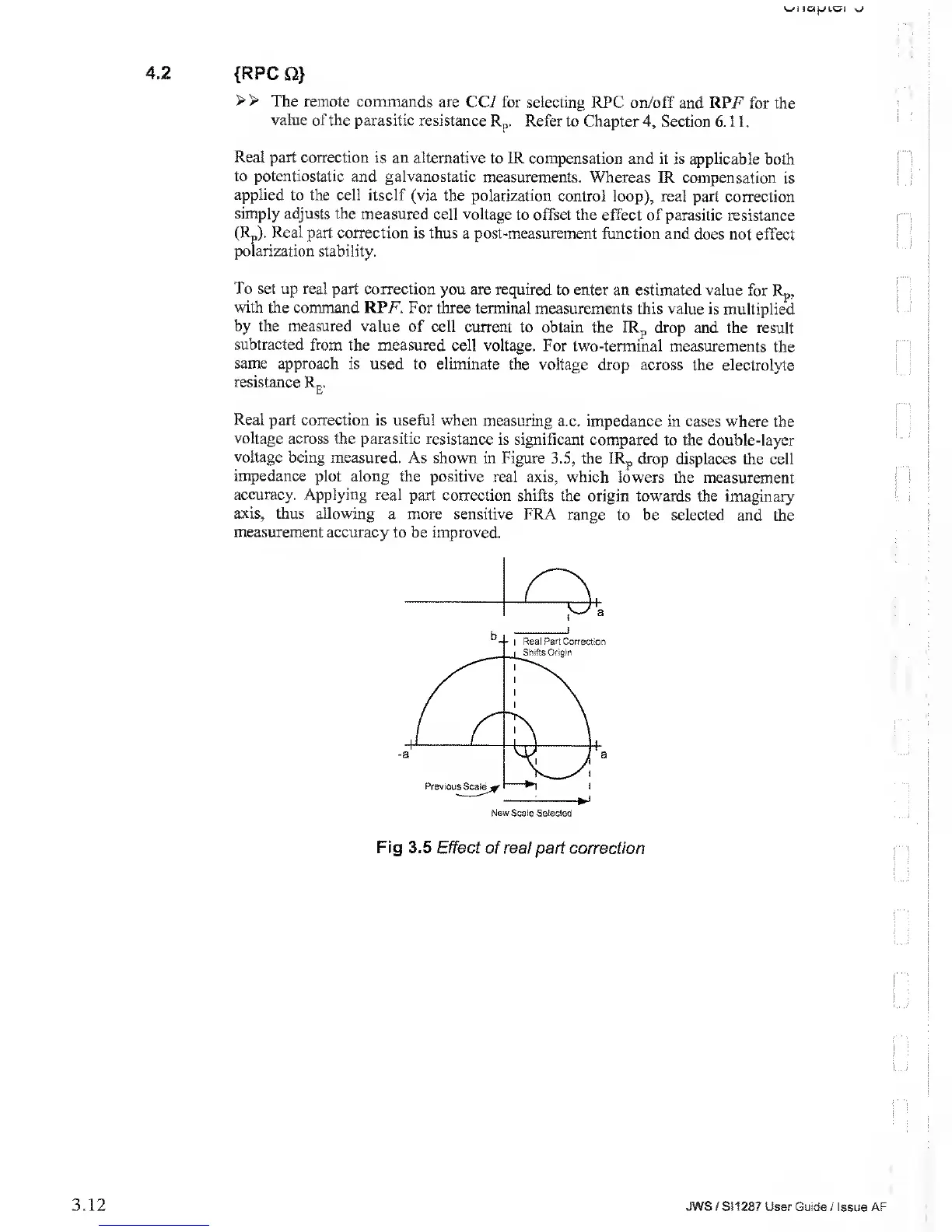
As shown in Figure
3.5,
the lR
p
drop
displaces the cell
impedance
plot along the positive
real axis, which
lowers the measurement
accuracy. Applying real
part correction shifts
the origin towards
the imaginary
axis, thus
allowing a more
sensitive FRA
range to be selected and
the
measurement
accuracy to be improved.
Fig
3.5 Effect of real
part correction
3.12
JWS
/ St 1 287 User Guide
/
Issue AF