1 INTRODUCTION
This chapter
describes all the facilities of the SI 12 87 Advanced
Electrochemical
Interface.
The facilities appear under
the names
given
to them on the front panel.
The
set-up parameters are detailed
first, followed by the direct action keys.
There
is also
a
reference
to the equivalent remote commands in Chapter 4.
In the following
sections, as in Chapter
2,
the
{ }
brackets denote
a choice via the
SELECT
{}
keys, e.g. {RESISTOR}. The
[ ]
brackets denote choice via
the
RANGE/}
]
keys, or the rotary knob,
e.g. [autoj.
2 I MEASURE
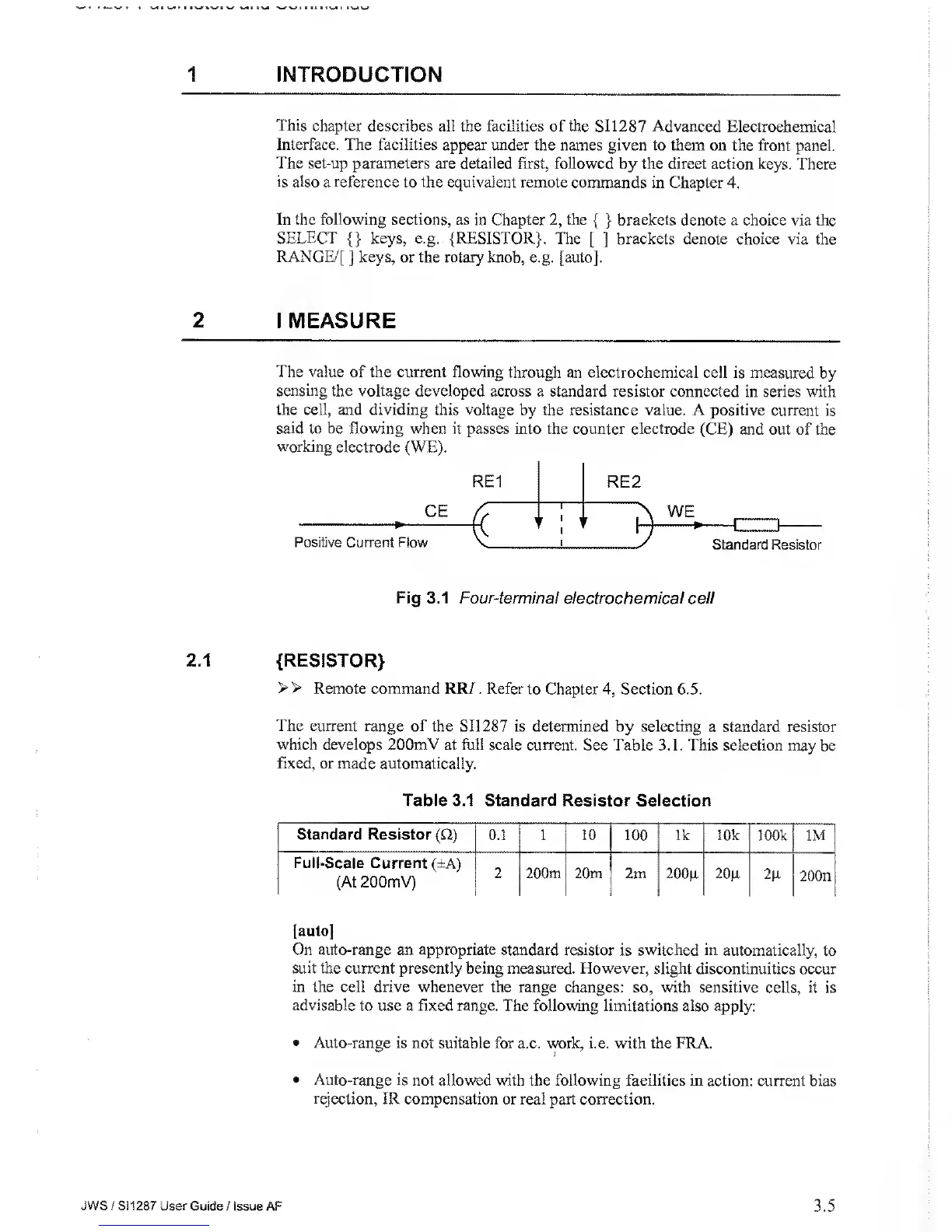
The value of the current flowing
through an electrochemical cell is measured
by
sensing
the voltage developed across a standard resistor
connected in series with
the cell, and dividing this voltage
by the resistance value. A positive
current is
said
to be flowing when it passes into the counter electrode
(CE) and out of the
working
electrode (WE).
RE1
RE2
CE
»
Positive Current Flow
WE
1 I
Standard Resistor
Fig 3.1 Four-terminal electrochemical
cell
2.1
{RESISTOR}
> >
Remote
command RR/ . Refer to Chapter
4,
Section
6.5.
The current range of
the SI1287 is determined by selecting a standard resistor
which develops
200mV at full scale current. See Table 3.1. This
selection may be
fixed, or made automatically.
Table 3.1 Standard Resistor Selection
Standard
Resistor
(£2)
10
100 Ik 10k 100k 1M
|
Full-Scale
Current (±A)
(At 200mV)
200m 20m
2m
200p
20ji
2p
200n
;
(auto]
On auto-range an appropriate standard resistor
is
switched
in automatically,
to
suit the current presently being measured. However,
slight discontinuities occur
in the cell drive whenever the
range changes: so, with sensitive
cells,
it
is
advisable
to use a fixed range. The following limitations also
apply:
•
Auto-range is not suitable for
a.c. work, i.e. with the FRA.
•
Auto-range is
not allowed with the following facilities in action:
current bias
rejection, IR compensation or real part correction.
JWS / S1 1287
User Guide / Issue AF
3.5



 To Next Page