3.4 SERIAL POLL/PARALLEL POLL
The instrument can be configured to request
service
from a GPIB controller when
a particular
event
has occurred,
e.g.
on end of operation, or measurement ready.
The controller
may then poll the devices on
the GPIB
to
find
the source of the
request. Two types of polling can
be
used, serial or parallel.
3.4.1 Serial Poll
A serial poll interrogates each device in
turn,
to
examine
its status byte. The
status byte holds the status of all events for which it is possible to request service.
Status Byte
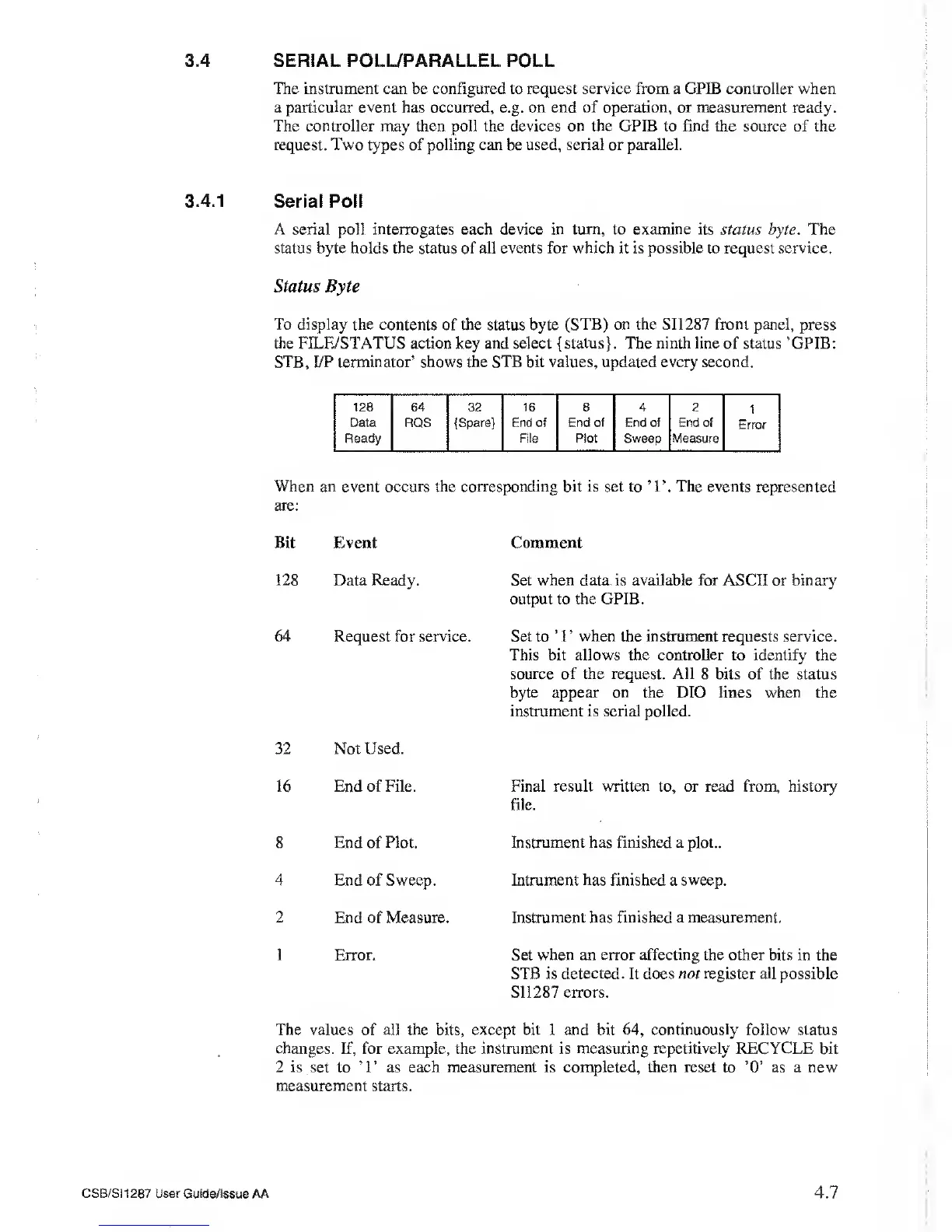
To display
the contents of the status byte
(STB) on the SI1287 front
panel, press
the FILE/STATUS action key and select {status}. The ninth line of status ’GPIB:
STB, I/P terminator’ shows the STB bit values, updated every second.
128 64 32 16 8 4 2
1
Data
Ready
RQS {Spare} End of
File
End
of
Plot
End of
Sweep
End of
Measure
Error
When an
event occurs
the corresponding bit
is
set to
’
1\
The events
represented
are:
Bit Event Comment
128 Data Ready. Set when
data,
is
available
for ASCII or binary
output to
the GPIB.
64 Request
for
service. Set to
’
V when the instrument requests service.
This bit
allows
the
controller
to identify the
source of the request. All 8 bits of the
status
byte
appear on
the
DIO lines when
the
instrument is serial polled.
32 Not Used.
16 End of File. Final result
written
to,
or
read from, history
file.
8 End of Plot. Instrument has finished a plot..
4 End of Sweep. Intrument has finished a sweep.
2 End of Measure. Instrument has finished a measurement.
1
Error. Set
when an error affecting the
other bits in the
STB is detected. It does not register all possible
SI 1287 errors.
The values of all the bits, except bit 1 and bit
64,
continuously follow status
changes. If, for example, the instrument is measuring repetitively RECYCLE bit
2
is set to
’1’
as
each measurement
is
completed, then reset
to ’O’ as a new
measurement starts.
CSB/S1
1 287
User Guide/Issue AA 4.7



 To Next Page