5.4.1
CSB/S11287 User Guide/Issue AA
4
-
Byte
Floating Point Format
:
Dump
Mode
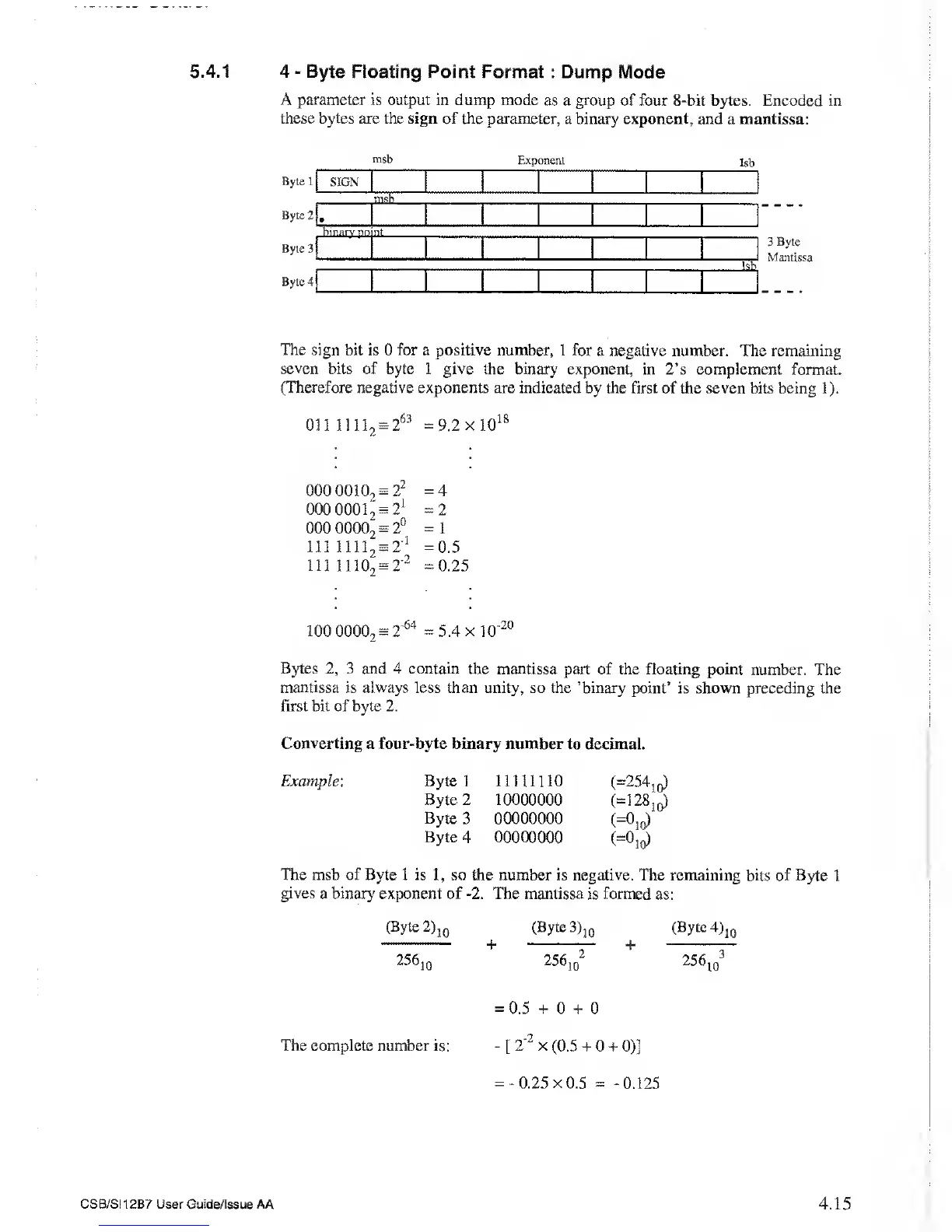
A parameter
is output in dump mode
as
a group of four 8-bit
bytes. Encoded in
these bytes are the sign of the parameter,
a
binary
exponent, and a mantissa:
msb
Exponent
lsb
Byte
2
8
Jflsh
Byte 3
Byte 4
3 Byte
Mantissa
The sign bit is 0 for a positive number, 1 for
a
negative
number. The remaining
seven bits of byte
1
give
the
binary
exponent, in
2’s
complement
format.
(Therefore
negative exponents are indicated
by
the
first of the seven bits being
1).
Oil
1 1 11
2
=
2
63
=
9.2 x 10
18
000
0010,
=
2
2
=
4
000 000i;
=
2
1
=2
000 0000
^
=
2
°
=1
111
1111
2
=
2'
3
=
0.5
1111110;=2'
2
=0.25
100 0000
2
=
2‘
64
=
5.4 x
10~
2°
Bytes
2,
3 and 4 contain
the
mantissa
part of the floating point number. The
mantissa is always less
than unity, so the ’binary point’ is shown
preceding the
first bit of byte 2.
Converting
a
four-byte
binary number to decimal.
Example
: Byte 1
Byte 2
Byte
3
Byte 4
11111110
10000000
00000000
00000000
(=254
10
)
(=128
]0
)
(=<w
(=°.0>
The msb of Byte 1 is
1,
so the number is negative. The remaining
bits of Byte 1
gives a binary exponent of
-2.
The mantissa
is
formed
as:
(Byte
2)
10
(Byte
3)
10
(Byte
4)
10
256
10
256
10
2
256,
o
3
=
0.5 + 0 + 0
The complete number is:
-
[
2‘
2
x
(0.5
+ 0 +
0)]
= -
0.25
x
0.5
=
-0.125
4.15



 To Next Page