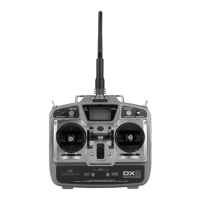
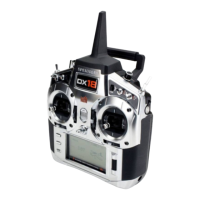
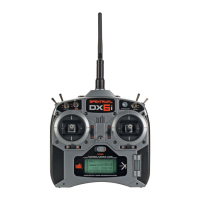
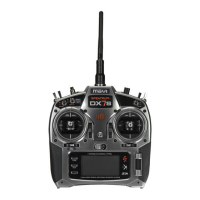
SPEKTRUM DX8 • RADIO INSTRUCTION MANUAL•Avoid operating your model
in the street where injury or damage can occur. •Never operate the model out into
the street or populated areas for any reason. •Never operate your model with low
transmitter batteries.
•Carefully follow the directions and warnings for this and any optional support equipment
(chargers, rechargeable battery packs, etc.) that you use. •Keep all chemicals, small parts and
anything electrical out of the reach of children. •Moisture causes damage to electronics. Avoid
water exposure to all equipment not specifically designed and protected for this purpose.
Do not operate more than 40 DSM transmitters simultaneously.
Safety Do's and Don'ts for Pilots
•Ensure that your batteries have been properly charged prior to your initial flight. •Keep track of
the time the system is turned on so you will know how long you can safely operateyour system.
•Perform a ground range check prior to the initial flight of the day. See the "Daily Flight
Checks Section" for information.
•Check all control surfaces prior to each takeoff.
•Do not fly your model near spectators, parking areas or any other area that could result in
injury to people or damage of property.
•Do not fly during adverse weather conditions. Poor visibility can cause disorientation and loss
of control of your aircraft. Strong winds can cause similar problems. •Do not point the
transmitter antenna directly toward the model. The radiation pattern from the tip of the antenna
is inherently low.
•Do not take chances. If at any time during flight you observe any erratic or abnormal operation,
land immediately and do not resume flight until the cause of the problem has been ascertained
and corrected. Safety can never be taken lightly.
Federal Aviation Administration
Purpose
This advisory outlines safety standards for operations of model aircraft. We encourage
voluntary compliance with these standards.
Background
Attention has been drawn to the increase in model aircraft operation. There is a need for added
caution when operating free flight and radio controlled craft in order to avoid creating a noise
nuisance or a potential hazard to full-scale aircraft and persons and/or property on the surface.
Operating Standards
Modelers generally are concerned with safety and exercise good judgment when flying model
aircraft. However, in the interest of safer skies, we encourage operators of radio controlled and
free flight models to comply with the following standards:
a.Exercise vigilance in locating full-scale aircraft (get help if possible) so as not to create a
collision hazard.
b.Select an operating
site at sufficient
distance from populated
areas so you do not
create a noise problem
or a potential hazard.
c.Do not fly higher than
400 feet above the
surface.
d.Always operate more
than three miles from
the boundary of an
airport unless you are
given permission to be
closer by the
appropriate air traffic
control facility in the
case of an airport for
which a control zone
has been designated or
by the airport manager
in the case of other
airports.
e.Do not hesitate to ask for assistance in complying with these guidelines at the airport traffic
control tower or air route traffic control center nearest the site of your proposed operation.
Information Provided by
Director, Air Traffic Service Federal Aviation Administration, Washington, D.C. Daily Flight Checks
1 .Check the battery voltage on both the transmitter and the receiver battery packs. Do not fly
below 4.3V on the transmitter or below 9V on the receiver. To do so can crash your aircraft.
Note: When you check these batteries, ensure that you have the polarities correct on your
expanded scale voltmeter.
2.Check all hardware (linkages, screws, nuts, and bolts) prior to each day's flight. Be sure that
binding does not occur and that all parts are properly secured.
3.Ensure that all surfaces are moving in the proper manner.
4.Perform a ground range check before each day's flying session.
5.Prior to starting your aircraft, turn off your transmitter, then turn it back on. Do this each time
you start your aircraft. If any critical switches are on without your knowledge, the transmitter
alarm will warn you at this time.
6.Check that all trim levers are in the proper location.
7.All servo pigtails and switch harness plugs should be secured in the receiver. Make sure that
the switch harness moves freely in both directions.
WARRANTY AND REPAIR POLICY
Warranty period
Exclusive Warranty- Horizon Hobby, Inc., (Horizon) warranties that the
Products purchased (the "Product") will be free from defects in materials and
workmanship for 1 year from the date of purchase by the Purchaser.
1-Year Limited Warranty
Horizon reserves the right to change or modify this
warranty without notice and disclaims all other warranties,
express or implied.
(a)This warranty is limited to the original Purchaser ("Purchaser") and is not
transferable. REPAIR
OR REPLACEMENT AS PROVIDED UNDER THIS WARRANTY IS THE
EXCLUSIVE REMEDY OF THE PURCHASER. This warranty covers only
those Products purchased from an authorized Horizon dealer. Third party
transactions are not covered by this warranty.
Proof of purchase is required for all warranty
claims.
(b)Limitations- HORIZON MAKES NO
WARRANTY OR REPRESENTATION,
EXPRESS OR IMPLIED, ABOUT NON-
INFRINGEMENT, MERCHANTABILITY OR
FITNESS FOR A PARTICULAR PURPOSE OF
THE PRODUCT. THE PURCHASER
ACKNOWLEDGES THAT THEY ALONE HAVE
DETERMINED THAT THE PRODUCT WILL
SUITABLY MEET THE REQUIREMENTS OF
THE PURCHASER'S INTENDED USE.
(c)Purchaser Remedy- Horizon's sole
obligation hereunder shall be that Horizon will,
at its option, (i) repair or (ii) replace, any
Product determined by Horizon to be defective.
In the event of a defect, these are the
•Do not lubricate servo gears or motors.
drain.
a battery pack in a matter of minutes.
grommets.
they become "yellowed" or discolored. Such servo arms may be brittle and can snap at any
time, possibly causing the aircraft to crash. 12



 To Next Page