15
© 2017 Stenograph
Chapter 2, Understanding the Shorthand Machine, provides an overview of the machine shorthand
keyboard. It also describes machine shorthand and how an individual uses the writer.
The shorthand machine is designed to accurately make a written record of spoken words at high speeds.
Using sounds instead of spelling out each letter, a machine shorthand writer presses down several keys
at once to record a word. This is much faster than a typewriter or computer keyboard where you can only
press one key at a time. This means that the machine shorthand writer, using sounds, can write whole
words or even a phrase in just one downward motion of their fingers.
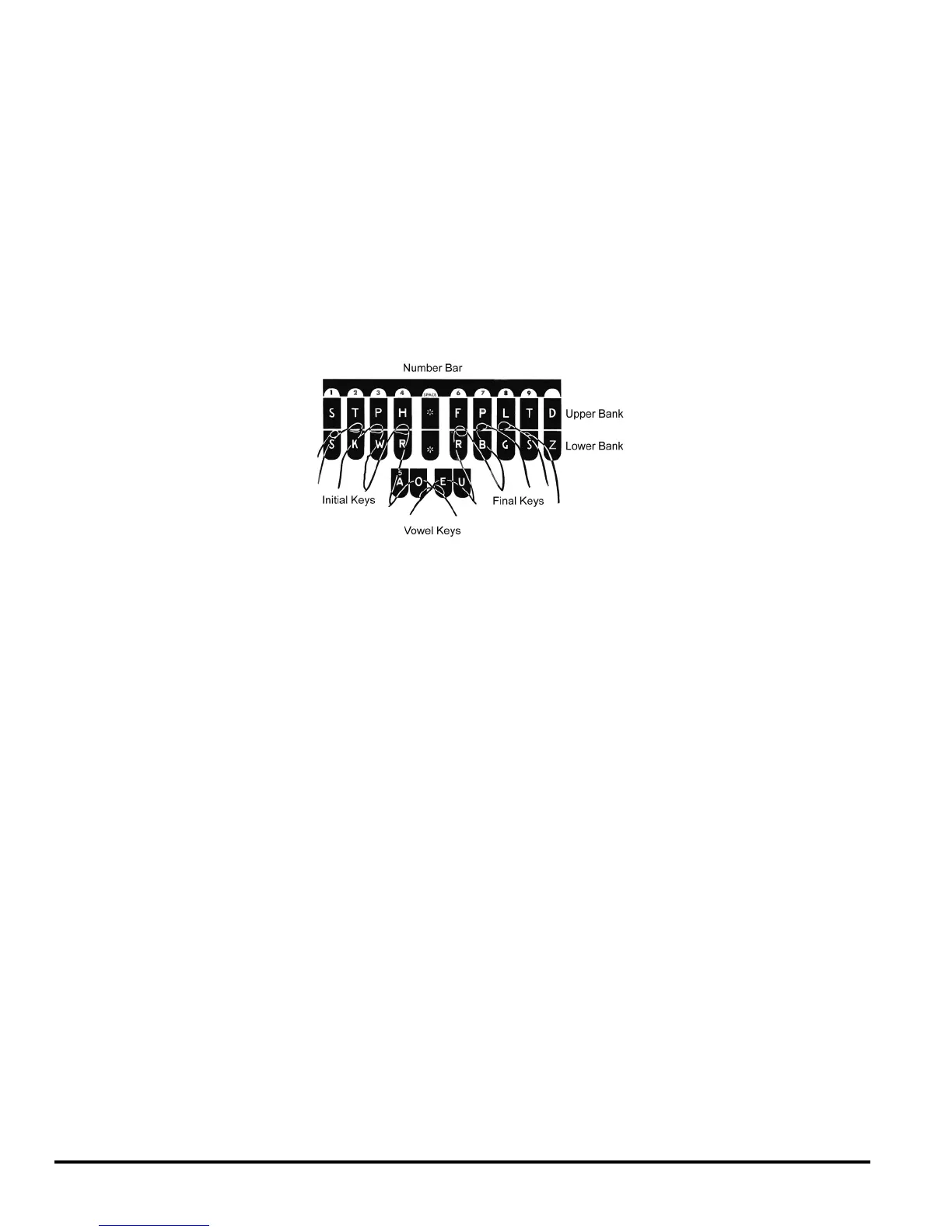
As you look at the front of your writer, notice that the keyboard is divided into four sets, or banks, of keys:
• Number Bar—the long solid bar at the top of the keyboard.
• Upper Bank—the row of 10 keys just below the number bar.
• Lower Bank—the remaining consonant keys located below the Upper Bank.
• Vowel Keys—the four keys at the front of the keyboard.
The Upper and Lower banks of keys to the left of the asterisk are the Initial keys. These consonants are
generally used to begin a word. The Upper and Lower bank of keys to the right of the asterisk are the
Final keys. These constants are generally used following the vowels to end a word or abbreviated
phrase.
The Number Bar is used in conjunction with the upper bank of keys to write numbers. When the Number
Bar is depressed along with the initial "S" on the left side of the keyboard, it produces the number 1.
When the Number Bar is depressed with the initial "T" it produces the number "2" and so on. The
Number Bar depressed with the asterisk key produces a space in the steno notes.
The asterisk key produces an asterisk. The asterisk symbol is generally used to denote a mistake,
indicate a correction, or to distinguish homonyms.
Similar to a typewriter, your fingers have a home position on the keyboard as shown in the previous
diagram. Notice that the Vowel keys are slightly lower than the other three banks of keys. This allows for
the natural position of your thumbs.
Chapter 2
Understanding the Shorthand Machine


 To Next Page