28
Keep the manual for future reference - For more information visit www.sulzer.com
8. DECOMISSIONING AND DISPOSAL
At the end of the operating life of the pump/electropump or any of its parts, it must be disposed of in observance of current regulations.In case you need
to return the material to the supplier :
− completely empty the pump from the liquid and wash it carefully
− if necessary, provide for a complete decontamination of the product,
− remove any liquids or grease residues (lubricants etc …)
− protect the pump from corrosion and pack it carefully
− indicate to the supplier any security measure applied
It is the responsibility of who returns the materials to take all measures necessary to ensure the safety of the product and
that the return is in accordance with the regulations of applicable law.
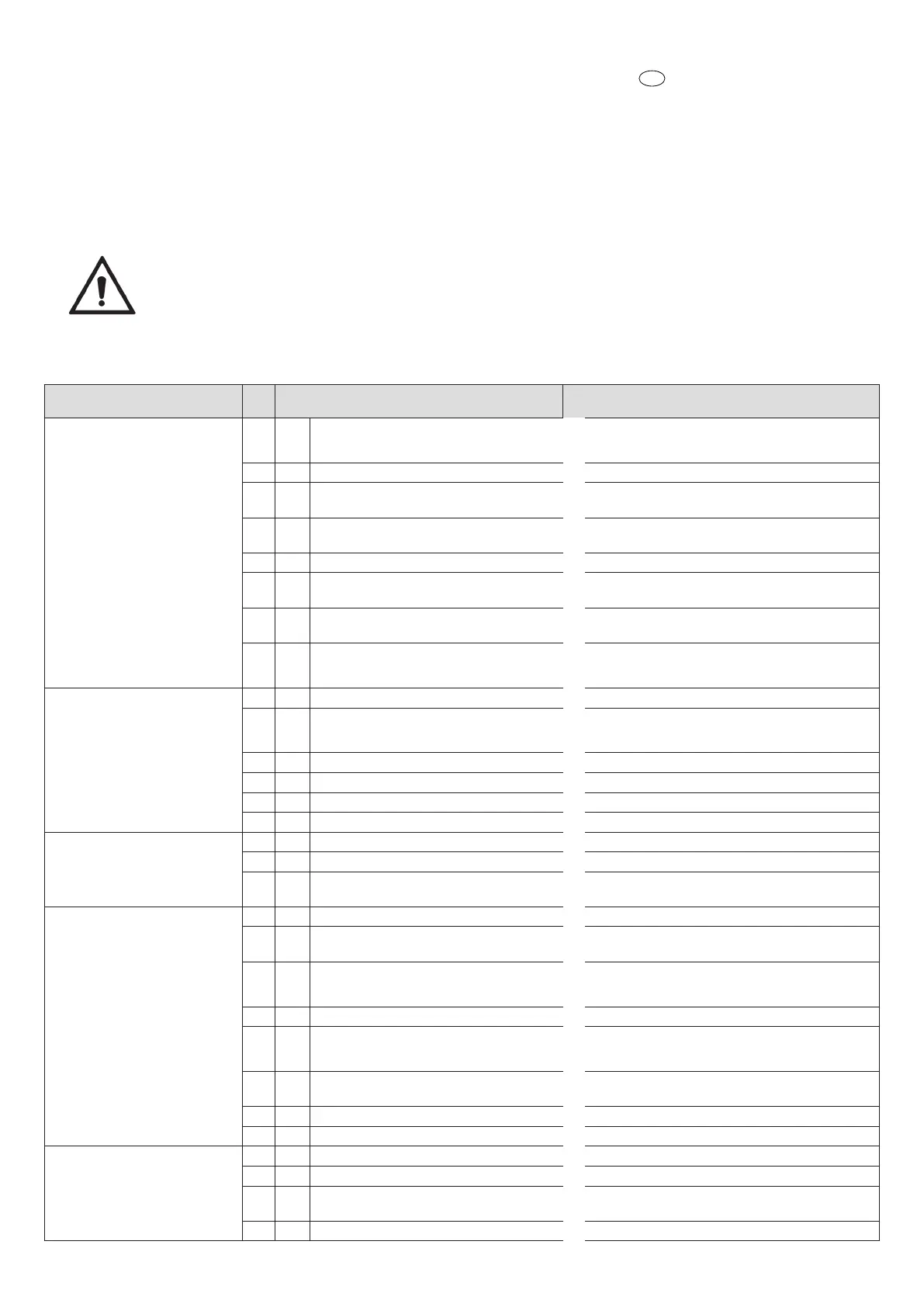
9. TROUBLESHOOTING
FAILURES OR
MALFUNCTIONS
ID PROBABLE REASONS REMEDY ACTIONS
! No ow
A.1 → Wrong direction of rotation
Verify the rotation direction of the motor. If correct,
verify the right assembly of the impeller with the pump
body.
A.2 → Pump not lled with the uid
Fill the pump and the suction pipe, with the uid.
A.3 →
Air presence in the pump or in the suction
pipeline
Verify the possible losses of the pipeline. Breathe the
pump in order to get out the air.
A.4 → Suction pipeline not enought immersed.
Increase the immersion of the suction, that is
sublevelled
A.5 → Suction head too raised
Low the level of the pump
A.6 → Impeller or suction line clogged.
Check any eventual obstuction of the sucton lters and
of the impeller. Remove the obstruction.
A.7 → Isucience of the motor rotation speed.
Check the motor rotation speed. For motors powered
by inverter, check the feed frequency.
A.8 → Head of the pumping plant too hight.
Check the outlet valves holes. Make a calculation of
the pumping plant and compare it whit the one of the
pump. Use a pump with higher head.
! Insucient ow rate
Reasons already listed on previous points
Consider points: from A.1 to A.7
B.1 → Cavitation functioning. NPSHa insucient.
Icrease the pumping plant NPSHa, reducing the
suction losses, or approaching the pump to the uid
that has to be aspirated.
B.2 → Losses from the seals.
Replace the seals
B.3 → Demaged impellers.
Replace the impeller.
B.4 → Demaged wear rings.
Replace the wear rings.
B.5 → Foot valve too slim
Replace the foot valve .
! Outlet pressure too low
Reasons already listed on previous points
Consider points: A.1, A.3 ÷ A.7,B.2 ÷ B.4
C.1 → Outlet line ostructions
Remove the ostructions
C.2 → Pressure gauge wrong positioning
Position the outlet pressure gauge on the outlet and the
inlet pressure gauge on the inlet
! High absorbtion
Reasons already listed on previous points.
Consider points: A.1, B.1 ÷ B.3
D.1 → Usury or mechanical seizure
Check and, where necessary, replace seals, bearings
and wear rings.
D.2 →
Functioning out of performance curves.
The head is lower than the minimum head
allowed
Act on the outlet regulation valve to increase the head
and low the ow rate.
D.3 → Excessive tightening of the soft packing.
Relax the tightening of the soft packing.
D.4 → Excessive speed of the motor speed rotation.
Check the corrispondence between motor speed and
pump. When the motor is powered by inverter, low the
frequency
D.5 →
Fluid density / viscosity higher then of the
contractual ones
Low the ow rate. Call the technical assistance
D.6 → Misalignment between pump and motor
Check and realign pomp and motor.
D.7 → Motor problems
Refer to motor information.
! Vibrations or high noise
Reason already listed on previous points.
Consider points: a3-a6, b1,b3-b4,d1,d2,d3, d5,d6, d7
E.1 → Pump, motor o basament not properly setted
Check the tightening of all anchor bolts
E.2 → Pipeline misaligned or imposed on the pump
Support the pipes checking their alignment with the
pump.
E.3 → Damaged bearings
Replace the bearings
- Translation of the original instructions
EN




 To Next Page