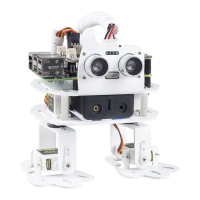
SunFounder PiCrawler Kit
(continued from previous page)
if __name__ == "__main__":
main()
How it works?
In this code, you need to pay attention to this part:
def twist(speed):
## [right front],[left front],[left rear],[right rear]
new_step=[[50, 50, -80], [50, 50, -80],[50, 50, -80], [50, 50, -80]]
for i in range(4):
for inc in range(30,60,5):
rise = [50,50,(-80+inc*0.5)]
drop = [50,50,(-80-inc)]
new_step[i]=rise
new_step[(i+2)%4] = drop
new_step[(i+1)%4] = rise
new_step[(i-1)%4] = drop
crawler.do_step(new_step,speed)
Simply put, it uses two layers of for loops to make the new_step array produce continuous and regular changes, and
at the same time, crawler.do_step() executes the posture to form a continuous action.
You can intuitively get the coordinate value array corresponding to each pose from Adjust Posture.
In addition, the example also played background music. The implementation method is as follows.
Play music by importing the following libraries.
from robot_hat import Music
Declare a Music object.
music = Music()
Play the background music in the picrawler/examples/musics directory and set the volume to 20. You can also
add music to the musics folder via Filezilla Software.
music.music_play('./musics/sports-Ahjay_Stelino.mp3')
music.music_set_volume(20)
Note: You can add different sound effects or music to musics or sounds folder via Filezilla Software.
Note: Hello, welcome to the SunFounder Raspberry Pi & Arduino & ESP32 Enthusiasts Community on Facebook!
Dive deeper into Raspberry Pi, Arduino, and ESP32 with fellow enthusiasts.
Why Join?
• Expert Support: Solve post-sale issues and technical challenges with help from our community and team.
• Learn & Share: Exchange tips and tutorials to enhance your skills.
• Exclusive Previews: Get early access to new product announcements and sneak peeks.
• Special Discounts: Enjoy exclusive discounts on our newest products.
3.14. Twist 79



 To Next Page