© Copyright Mission Critical Energy Inc, 2019 Version 1-2019
www.superwind.com
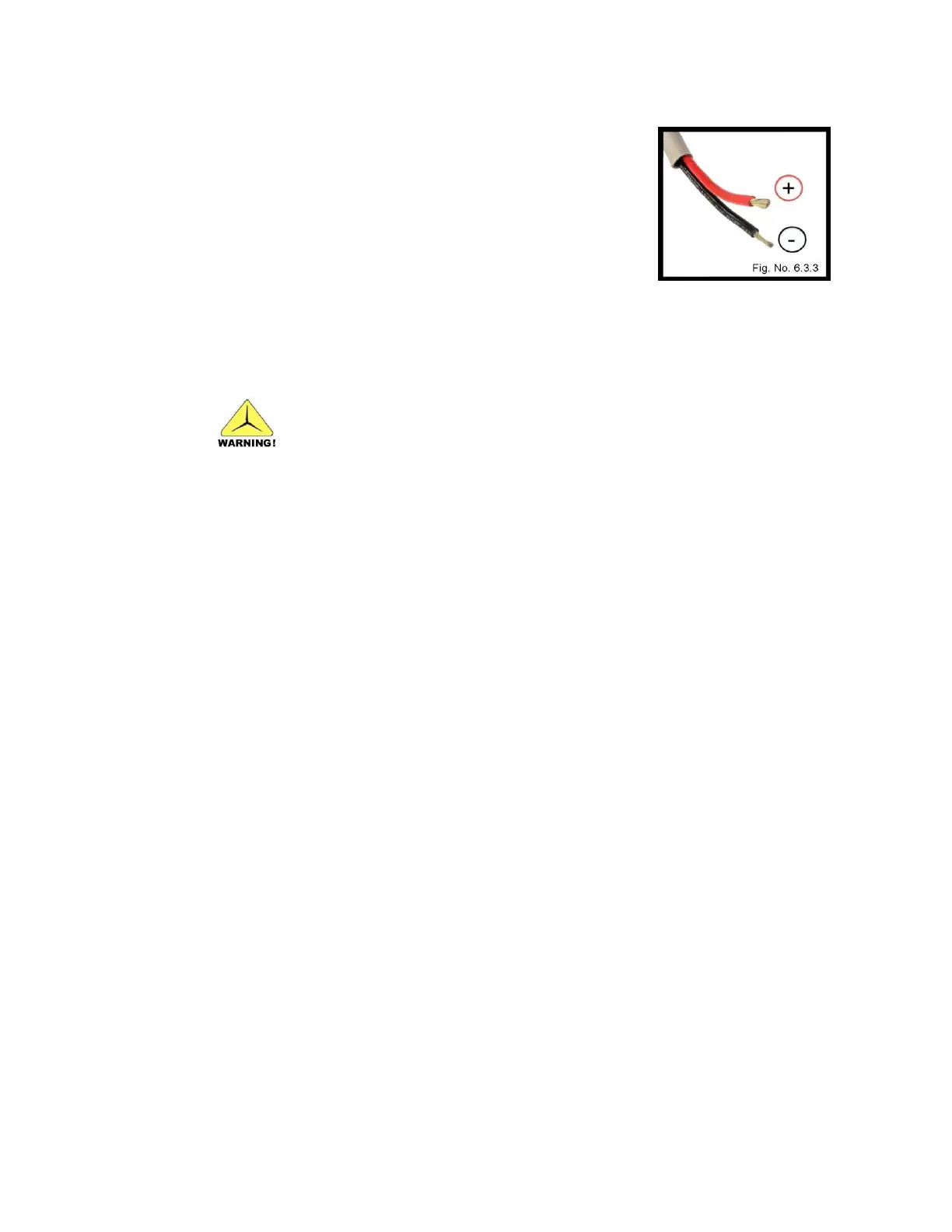
6.3.3. Polarity
Always pay attention to the correct polarity of the wires.
Reversing polarity at the battery connections or anywhere in
the system will destroy the electronic rectifier of your
Superwind 350/48V. During installation or when changing
out batteries, clearly mark all wire ends as POSITIVE (+) or
NEGATIVE (-) to prevent connection errors. Fig. No. 6.3.3.
Marking of the connecting wires at the Superwind 350/48V:
POSITIVE Line (+) RED
NEGATIVE Line (-) BLACK
The internal electronic rectifier of the Superwind 350/48V will be
destroyed by the application of reverse polarity anywhere within the
system.
Rectifiers damaged due to reverse polarity are not covered under
warranty!
6.3.4 Batteries
6.3.4.1 Charging the batteries
The Superwind 350/48V is primarily used to charge batteries. For
proper battery protection, installation of the provided Superwind SCR 48V
Charge regulator and diversion load power resistor is mandatory.
The SCR 48V Charge Regulator allows the Superwind 350/48V to
operate automatically and completely unsupervised. The SCR 48V
Charge Regulator is suitable for use with all battery types and its use
ensures batteries are charged optimally and protected against overcharging
and damage.
6.3.4.2 Selecting the batteries
When selecting batteries, always ensure their voltage matches the rated
voltage of the system (48 volts in this case). The rated voltage of your
Superwind is specified on the data label located on the yaw shaft.
Flooded lead-acid batteries are the most commonly used battery type world-
wide. They work well in a wide variety of applications and are very cost
effective, however they require periodic maintenance (electrolyte level checks,
etc).
The use of AGM (Absorbent Glass Matt) batteries has many advantages.
AGM batteries are sealed, virtually maintenance free, have a long service life
and can better survive the occasional deep discharge.
All batteries should be ‘deep cycle’ rated. Automobile type ‘starting batteries’
are not suitable for use as storage batteries and will fail rapidly due to the
cyclic operations associated with renewable energy-based charging.



 To Next Page