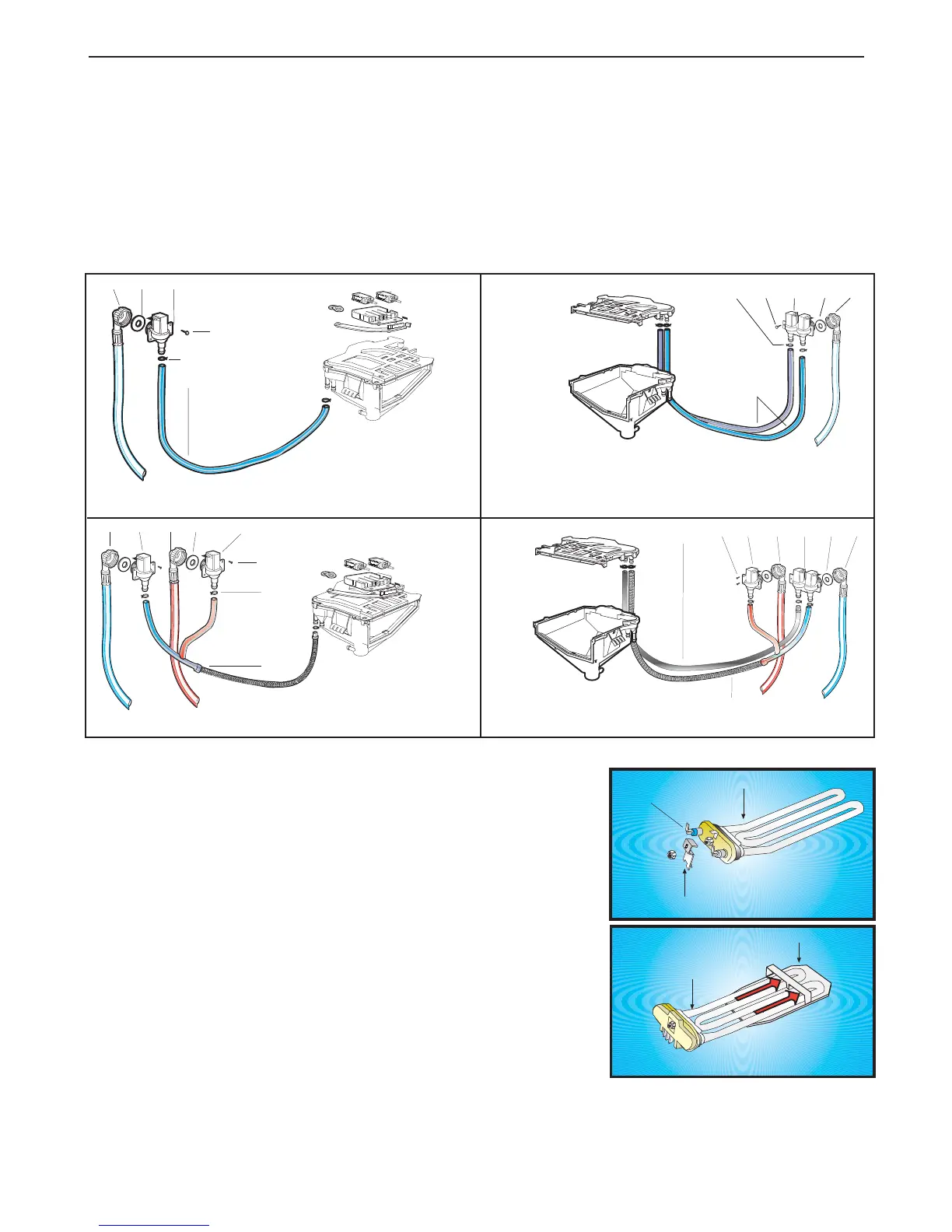
G140
G003
Version for polypropylene tubs
D050
D010
D200
D040
C070
D220
D300
D010
D050
C130
D220
D290
D040
D008
Version with hot and
cold water feed
C450
D010
D050
D300D220 D290 D040
C460
Step 14 Removing the solenoid valve (D010 and/or D300) and/or the internal water system
of the washing machine:
(a) Remove the top cover (Step 1).
(b) Disconnect the wiring (for solenoid valve replacement only).
(c) Remove the water feed hose (D040) and washer (D050).
(d) Remove the two screws (D220) securing the solenoid valve from the back of the cabinet.
(e) Remove the solenoid valve, then use a pair of pliers to slacken pipe spring clips (D200 or C130)
and remove the pipes (C070 or D008).
(f) To re-assemble, follow the same procedure in reverse order. It is advisable to wet the ends of new
solenoid valves with a solution of soap and water to make it easier to slide the pipes on.
Step 15 Removing and/or replacing the wash water heater element (G140):
(a) Remove the rear cover (Step 2).
(b) Remove the V drive belt (G170) (Step 9).
(c) Disconnect the wiring, noting the position of each wire.
(d) In the case of washing machines with stainless steel tubs,
remove the locknut on the galvanised plate (G007) using a
10 mm box spanner.
(Important: these plates are not fitted to washing machines
with enamelled tubs).
(e) Slacken the nut of the heater element completely without
removing it from the thread.
(f) Use a rubber headed mallet or similar to gently strike the
nut and push the threaded rod into the body of the element,
then remove it. If the element is difficult to remove, use a flat
screwdriver as a lever between the slot in the tub and the
element itself (G140).
(g) To re-assemble, follow the same procedure in reverse order,
ensuring that the heater element does not touch the drum.
On washing machines with enamelled tubs, make sure that
the element is inserted in the fixing bracket on the bottom
of the inside of the tub. Arrange the wiring so that none of the
wires touch any moving parts of the appliance.
On washing machines with polypropylene tubs, make sure
that the heater element does not touch the drum by inserting
it in the slot of the heater element protection plate (G003).
N.B.: The blue coloured contact of the heater element indicates
the overheat fuse and corresponds to the wire marked TF.
D050
D010
C070
D220
C130
D040
Version with dual
solenoid valve
hot and cold water feed
Version with dual
solenoid valve
cold water feed
Version with cold
water feed
G140
G007
N.B. contact TF


 To Next Page