3-I ENGINE
COMPRESSION CHECK
The compression of a cylinder is good indicator of its internal condition. The decision to overhaul the
cylinders is often based on the results of a compression test. Periodic maintenance records kept at your
dealership should include compression readings for each maintenance service.
COMPRESSION
I
Standard
Limit
(Difference in cylinders
1300 - 1600 kPa
13 - 16 kg/cm’
184 - 227 psi
1100 kPa 200 kPa
Low compression pressure can indicate any of the following conditions:
Excessively worn cylinder wall
Worn-down piston or piston rings
Piston rings stuck in the grooves
Poor seating of valves
Ruptured or otherwise defective cylinder head gasket
Valve clearance out of adjustment
Starter motor cranks too slowly
Overhaul the engine in the following cases:
*
Compression pressure in one of the cylinders is less than 1100 kPa (I 1 kg/cm’, 156 psi).
* Difference in compression pressure between two cylinders is more than 200 kPa (2 kg/cm2, 28 psi).
*
All
compression pressure are below 1300 kPa (13 kg/cm’,
184 psi) even when they measure more than
1100 kPa (11 kg/cm2, 156 psi).
COMPRESSION TEST PROCEDURE
NOTE:
Before testing the compression of the engine, make sure
that the cylinder head bolts and nuts are tightened to speci-
fied torque values.
Warm up the engine before testing.
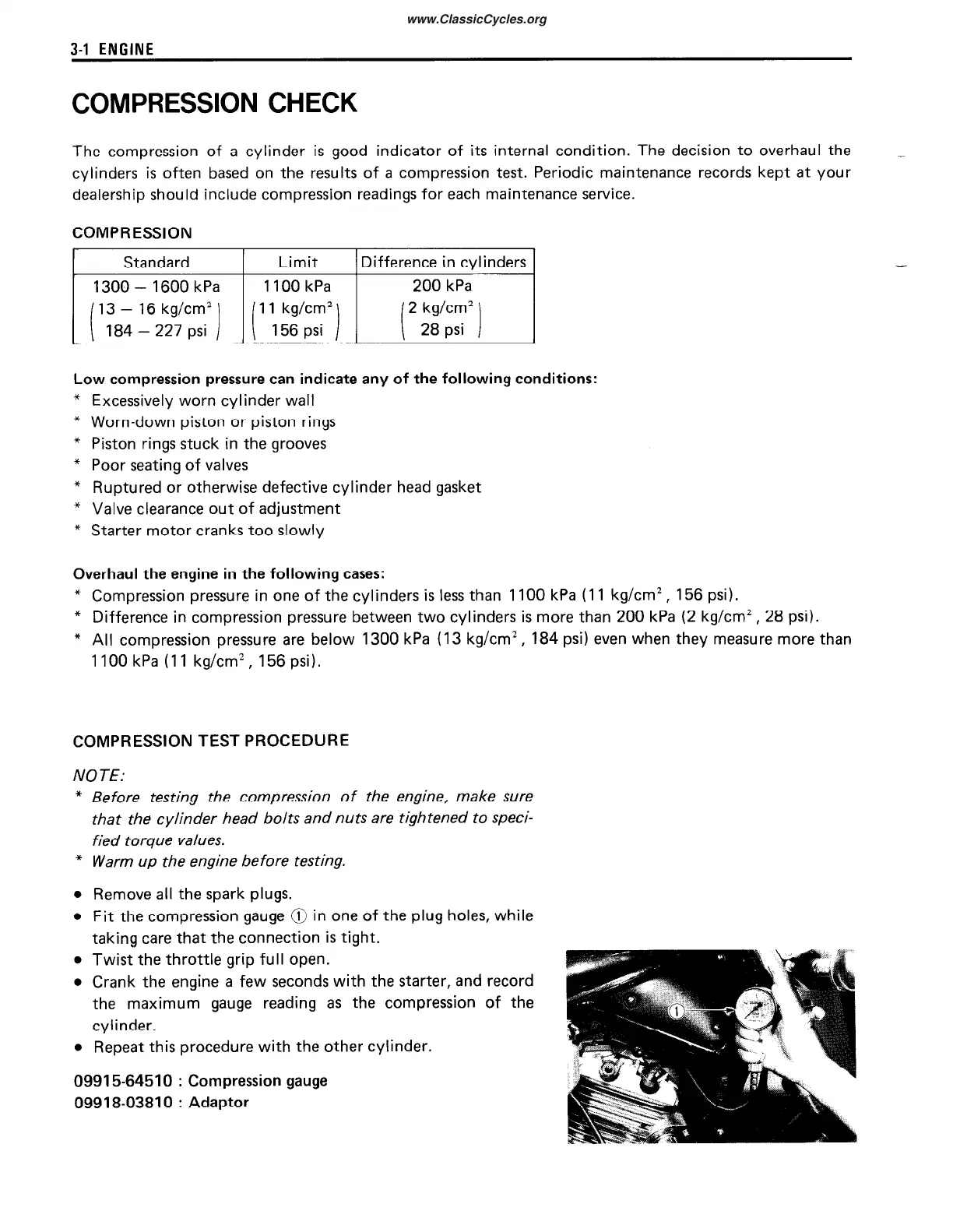
Remove all the spark plugs.
Fit the compression gauge 0 in one of the plug holes, while
taking care that the connection is tight.
Twist the throttle grip full open.
Crank the engine a few seconds with
the maximum gauge reading as th
cylinder.
the starter,
and record
re compress ion of the
Repeat this procedure with the other
cylinder.
09915-64510
:
Compression gauge
09918-03810
:
Adaptor


 To Next Page