TECHNICAL AND MAINTENANCE MANUAL
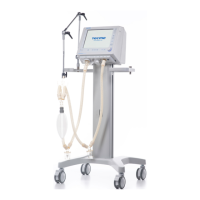
Graph VENTILATOR
Review : 04
Date:
1. Diaphragm of the expiratory
Obstruction of the patient’s
circuit.
3. Defective PEEP
1. Replace the diaphragm of the
expiratory valve.
2. Check the patient’s circuit.
3. Check the operation of the
electrovalve.
1. Leaks in the patient’s circuit.
3. Leaks in the internal
pneumatic circuit.
4. Defective PEEP
1. Check the patient’s circuit.
2. Check expiratory valve.
3.
Check the internal pneumatic circuit.
4. Check the operation of the
electrovalve.
1. Inspiratory flow lower than 7
Disconnection in the internal
pneumatic circuit.
3. Obstruction in nebulizer.
4. Damaged solenoid valve.
1. Increase the inspiratory flow.
Check the internal pneumatic circuit.
Check permeability of the nebulizer
capillary.
4. Check operation of the solenoid
FiO2 different from
% FIO2
measurement
1. Decalibrated air or oxygen
proportional valves.
2. Decalibrated pressure
regulators.
3. Decalibrated oxygen
analyzer.
1. Recalibrate proportional valves, and
then recalibrate the measurement
parameters of the device.
2. Check the calibration of the
pressure regulators. Then,
recalibrate the device completely.
3. Calibrate oxygen analyzer.
1. Back fan disconnected or
blocked.
2. Damaged back fan.
1. Check fan and check connections.
2. Damaged battery.
3. Battery disconnected.
4. Electrical failure.
1. Charge the battery for 12 hours, and
if it does not become charged,
replace with new one.
2.
Replace the battery with a new one.
3. Check the battery connections.
4. Check charge voltage (13 0.5 V).
2. Bad contact in display
connections.
1. Replace the display with a new one.
Check and clean the contacts of the
different jacks of the display.
1. Failure of an electrical
Bad contact of an electronic
device.
4. Extremely high
electromagnetic interference
1. Check the condition of the electronic
ancillary board and CPU board.
2. Check soldering of wires and
electronic components.
3.
Clean all the inside of the device,
Check for the presence of electrical


 To Next Page