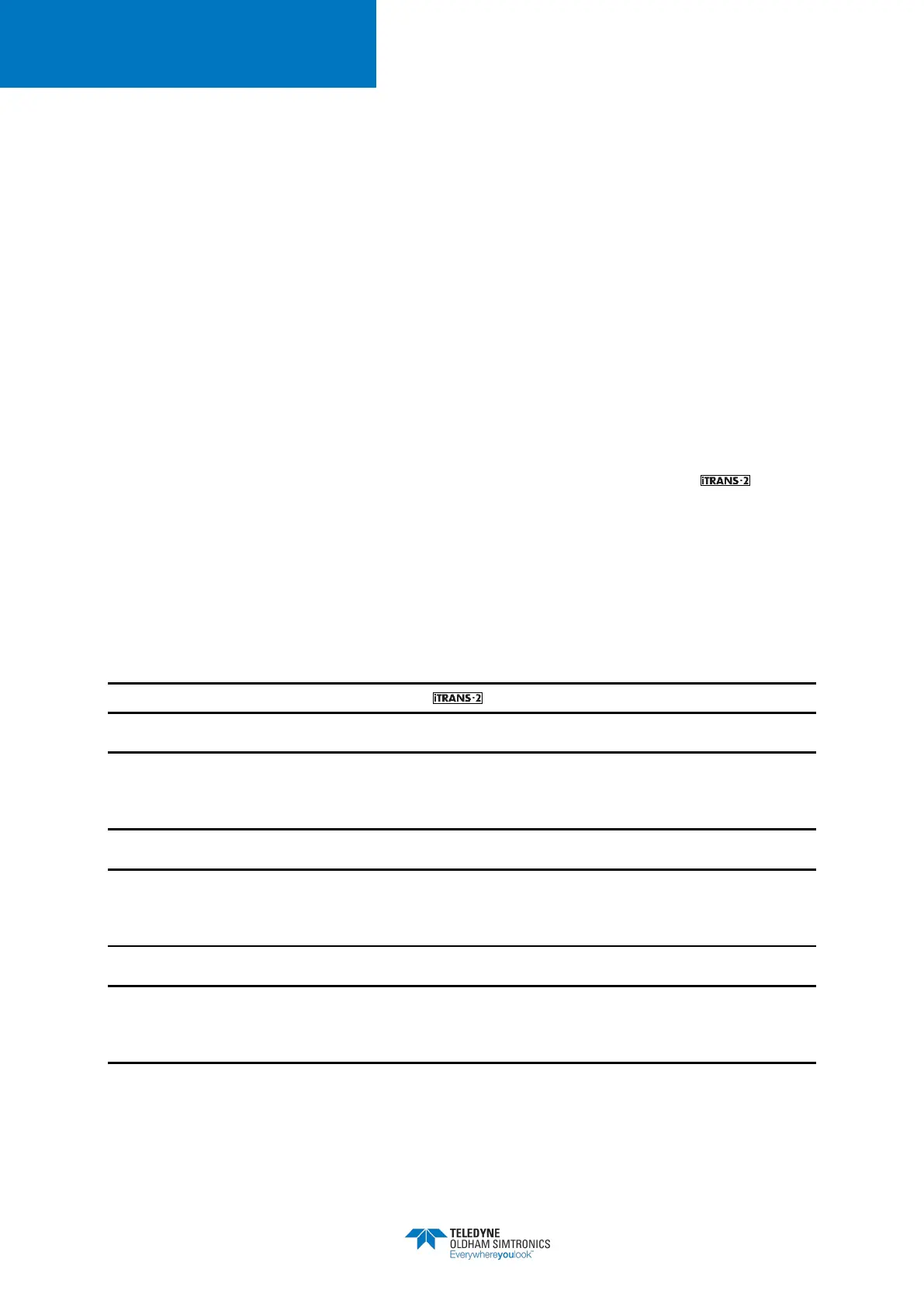
iTRANS 2
FIXED POINT SINGLE OR DUAL GAS MONITOR
WITH DUAL ANALOG OUTPUTS
USER MANUAL
Revision 7.0
7 Maintenance
7.1 Introduction
Sensors have a variable life dependent on the sensor and the environment in which they operate.
Oxygen sensor life is about 2 years and toxic gas sensor life is normally 2 years or greater. The
catalytic combustible gas sensors normally operate in excess of 3 years, while the infrared
sensors have a MTBF greater than 5 years.
Sensors have baseline drift and their characteristics change with time. Thus, the must be
calibrated on a regular basis. Gas detection instruments are potential life-saving devices. In
recognition of this fact, calibration for the toxic and catalytic LEL sensors should be at least at
quarterly intervals, while the Infrared sensor should be calibrated on an annual basis with
functional tests every 6 months.
Further, TELEDYNE OLDHAM SIMTRONICS recommends prudent testing and/or calibration
after a gas alarm. All calibration/service to the sensors should be recorded and accessible.
NOTE: Other than regular calibrations, the require no other routine maintenance.
NOTE: Take special care with handling and storing sensors. They are delicate and can be
damaged by storage in environments outside the specified temperature, pressure, and humidity
limits.
NOTE: Sensors are susceptible to damage from high pressure or low pressure, especially if the
change is sudden. Also, sensors should not be operated at pressures that are 10% above or
below atmospheric pressure.
NOTE: If sensors and the surrounding environment must be washed down at any time, cover the
opening of the sensor housing to protect it from water or excess moisture. Remove cover when
wash down is complete. An optional splashguard is available for continuous protection.


 To Next Page