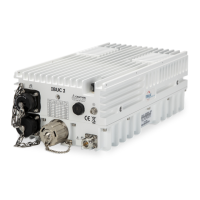
IBUC Operation Manual
Terrasat Communications, Inc.
Rev. A
7-20
Connect the DC cable between the outdoor PSUI’s J2 (DC Output), as appropriate, and
the IBUC A and B J3 (DC Input).
Connect the AC cable between the PSUI’s J1 (AC Input) and the AC power source.
Water Resistant Wrap
The application of moisture resistant wrap (mastic tape) to all outdoor connectors is
recommended to prevent water entry and resultant water damage. Apply the mastic
tape as follows:
- Ensure that all connectors are tight.
- Pre-cut the mastic tape to the desired size.
- Center the tape on the connector to be sealed and wrap the tape tightly around the
connector. Squeeze the tape tightly and ensure that both ends of the tape have
formed around the connector and the cable.
- Apply the tape to all connectors that may be exposed to moisture.
Grounding
Antenna Recommendations
Most antenna masts are encapsulated in concrete. Typically, the mast pipe is
submerged in a 4 (1.22m) to 5 foot (1.53m) deep augured hole. This provides a good
Ufer ground. An Ufer ground, in this case, is defined such that concrete retains
moisture for 15 to 30 days after rain or snow melt. Concrete absorbs moisture quickly,
yet retains moisture for a period of time. The concrete’s large volume and great area of
contact with the surrounding soil allows a good transfer to the ground.
In the concrete base, an Ufer ground can be established by running a #4 gauge solid
wire or rebar and connecting with pigtails to the base of the pedestal.
The Ufer ground is only one step in proper grounding. The Ufer ground should be
augmented with coupled pairs of 10 foot (3.05m) rods, placed 20 feet (6.1m) into the
ground, spaced 20 feet (6.1m) apart. The first rod should be placed close to the
antenna. The second rod should be placed towards the equipment enclosure. A #2
gauge wire should connect the rods and antenna mount. A ground rod should be
placed at the equipment enclosure as well. If it is virtually impossible to install the
ground rods, then radials are needed. This can be accomplished by laying 10 or more
lengths of 1 1/2-inch (3.81cm) copper strap, at least 50-feet (15.24m) long, in a radial
fashion around the antenna base. The straps should be buried, if possible. The hub
must be interconnected to the utility ground.
The ground configuration can vary from one location to another. It is best to measure
the soil conductivity and design a 5 ohm ground system. To protect the system from a
direct strike, a lightning rod placed 2 feet (61 cm) higher than the highest point of the
dish should be interconnected to the Ufer ground with #2 gauge copper wire.


 To Next Page