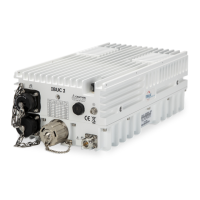
IBUC Operation Manual 3-2
Terrasat Communications, Inc.
Rev. A
In addition to the two possible connector inputs for the DC supply there are also
options for the DC supply voltage. For lower power units (10W and below), options for
24VDC or 48VDC supplies are available. The operating voltage range for the 24VDC
option is 20 to 28VDC whereas the operating voltage range for the 48VDC option is 37
to 60VDC. This option must be selected at the time of order. For all higher power units
(12W and above) the standard configuration is 48VDC.
Monitor and Control
The IBUC is equipped with extensive monitor and control (M&C) capabilities. There are
five ways to remotely access the M&C capabilities of the IBUC. First is via the M&C 19-
pin circular connector (J2) utilizing two wire RS485. In order to access the RS485, a
separate cable must be run and connected to J2. A second way to access the M&C is
through the same J2 connector using RS-232. In order to access the RS-232, a
separate cable must be run and connected to J2. A third way to access the M&C is
through the same J2 connector using TCP/IP. This method requires a separate
Ethernet cable. The fourth method is through the same J2 connector using an optional
handheld terminal. The fifth way to access the M&C capabilities remotely is through the
L-band input N-connector or F-connector (J1) utilizing Frequency Shift Keying (FSK).
Using this method requires no additional cable but does require that the FSK be
multiplexed onto the L-band cable. Certain modem manufacturers offer built in FSK
capabilities capable of communicating with the IBUC through the L-band IFL. Refer to
chapter 6 for specific information on command structure and commands.
RF Signal Flow
The L-band input to the IBUC is through the input N-connector or F-connector J1. The
required inputs to the IBUC consist of a 10MHz sinewave signal between +3 and –12
dBm as well as the L-band signal at less than or equals to –20 dBm. In addition to the
10MHz level requirements, the 10MHz signal must meet minimum phase noise
requirements (see chapter 9). The J1 input may also include a DC voltage and/or FSK
signal as described above. The input from J1 is routed to the demultiplexer circuitry
where the various signals are split off and routed to the appropriate circuits within the
IBUC. The DC voltage is routed to the DC/DC power supply and the FSK signal is
routed to the M&C card.
The 10MHz signal is routed to the multiplier circuitry where its level is first detected to
provide alarm when it’s low and then multiplied to a proper frequency used for phase-
locking purposes. The output of the multiplier is routed to the phase detector circuitry
where it is compared with the phase of the DRO (Dielectric Resonator Oscillator) signal
sample and consequently generates a voltage that is applied as a control voltage to the
DRO to adjust its frequency. The DRO has been optimized for phase noise at a single
frequency based on the frequency band of the IBUC that has been ordered. The output
of the DRO is amplified and routed to the mixer.


 To Next Page