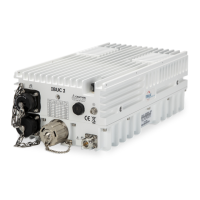
IBUC Operation Manual
Terrasat Communications, Inc.
Rev. A
5-2
Category A
At the wall outlets (and more than 30 feet from a distribution panel) the typical noise is a
0.5 microsecond rise time up to 6 kV peak, open circuit voltage 100 kHz ring wave with
200-ampere short circuit current capability.
Category B
At the distribution panel one can experience the 100 kHz ringwave above but with 500
ampere current capability and a unidirectional impulse up to 6 kV potential rising in 1.2
microseconds and decaying to half voltage in 50 microseconds. Accompanying this can
be a short circuit current up to 3000 amperes rising to peak in 8 microseconds and
decaying to half value in 20 microseconds.
To ensure uninterrupted service a line conditioner and/or UPS is recommended based
on the expected AC power at the site.
Site Related Problems
VSAT antennas are often fitted on top of buildings. Avoid close proximity to elevator
motors, etc. Also ensure that the satellite signal path is free and clear of obstructions.
M&C Checks
When troubleshooting the IBUC the first level of troubleshooting should be to check the
status through the M&C ports. Alarms and an alarm history are available in the IBUC
M&C. Refer to chapter 6 for specific information when using the RS232, RS485,
Ethernet or Handheld Terminal ports.
Power Supply Checks
Before starting the RF troubleshooting first verify that the proper voltages are being
supplied to the IBUC. Input DC Voltage and IBUC current consumption data are
available from the IBUC M&C. Verify that values are within limits. If M&C is not
available, use a multimeter to verify that the appropriate voltages (24VDC or 48 VDC)
are present at the IBUC. The labeling on the IBUC has the required voltage (24VDC or
48VDC). The IBUC DC supply may be through J1 or J3.
Transmit Power Setting
There have been several cases where the transmit power has been turned up to or near
saturation while transmitting a digital carrier. This most likely will result in spectral
distortion, i.e., "shoulders", "ears", etc.
When transmitting digital carriers, it is customary to operate the power amplifier system
with an Output Back Off (OBO) sufficient to meet the spectral density mask
requirements.


 To Next Page