Product Overview 1-3
How t h e 3 321 Oper a t e s
Aerodynamic diameter is the most important size parameter because it
determines a particle’s airborne behavior. The Model 3321 is specifically
engineered to perform aerodynamic size measurements in real time using
low particle accelerations.
Time-of-flight particle sizing technology involves measuring the
acceleration of aerosol particles in response to the accelerated flow of the
sample aerosol through a nozzle. The aerodynamic size of a particle
determines its rate of acceleration, with larger particles accelerating more
slowly due to increased inertia. As particles exit the nozzle, the time of
flight between the Model 3321s two laser beams is recorded and converted
to aerodynamic diameter using a calibration curve.
Previous time-of-flight spectrometers used two tightly focused laser beams,
resulting in two distinct signals for each particle.
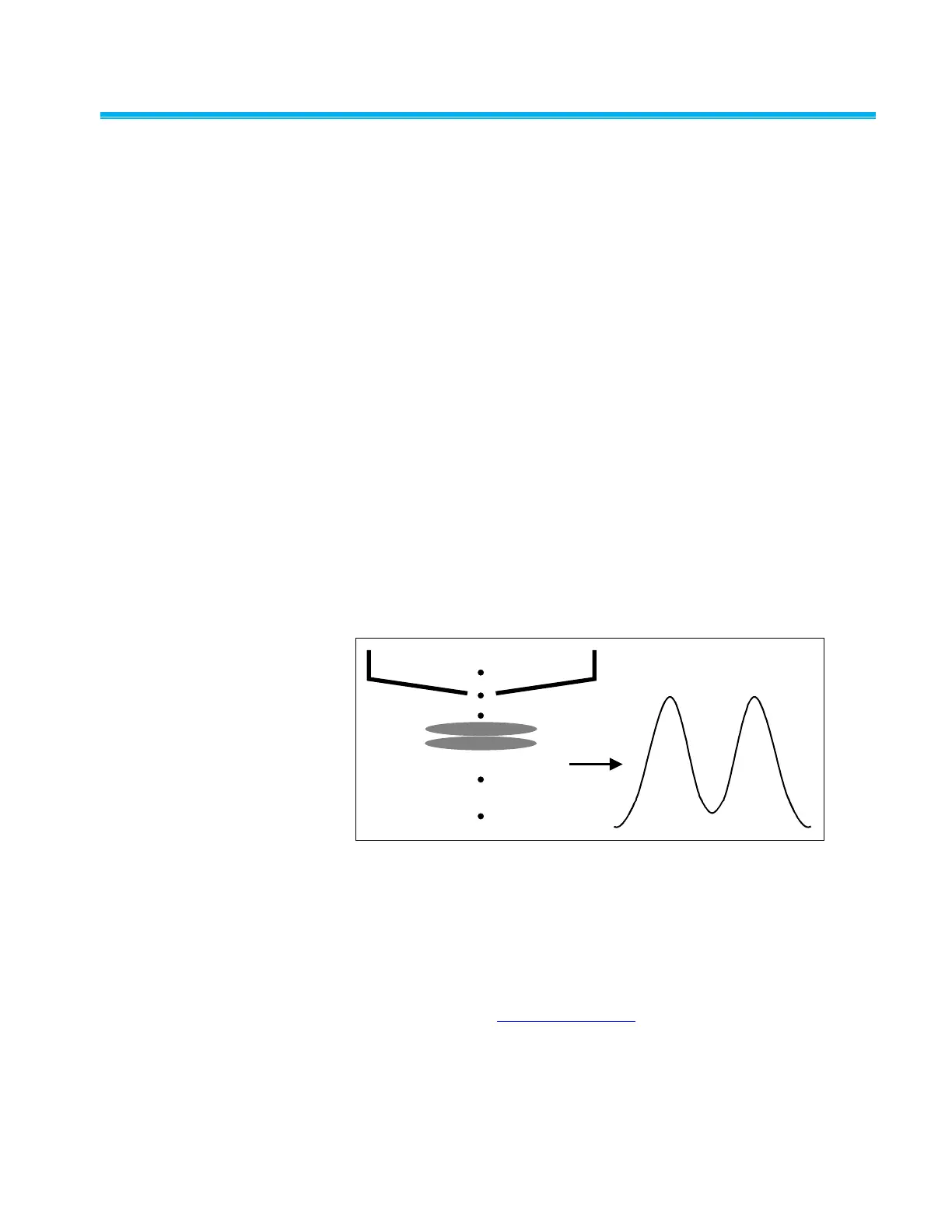
As shown in Figure 1-2, the Model 3321 overlaps the two laser beams,
producing one double-crested beam profile. Each particle creates a single,
continuous signal that has two crests. Particles with only one crest
(phantom particles) or more than two crests (coincidence error) are not
used in building size distribution calculations (they are logged for user-
defined post analysis concentration correction). The result is an extremely
accurate count distribution with almost no background noise to distort mass
distribution calculations.
Light Scatter
to Electrical
Pulse
Figure 1-2
Double-Crested Signal From Particles Passing Through Overlapping Beams
The Model 3321 also provides a light-scattering measurement by
examining each particle’s side-scatter signal intensity. This measurement
produces a second distribution that can be plotted against aerodynamic
size to gain additional information about the aerosol sample.
Refer to Chapter 5, “Theory of Operation,” for a detailed description.





 To Next Page