5-1
C H A P T E R 5
Theory of Operation
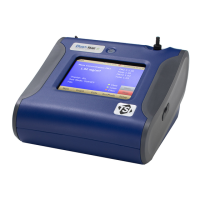
The Model 3321 is a time-of-flight spectrometer that measures the velocity
of particles in an accelerating airflow through a nozzle.
In the instrument, particles are confined to the centerline of an accelerating
flow by sheath air. They then pass through two broadly focused laser
beams, scattering light as they do so. Side-scattered light is collected by an
elliptical mirror that focuses the collected light onto a solid-state
photodetector, which converts the light pulses to electrical pulses. By
electronically timing between the peaks of the pulses, the velocity can be
calculated for each individual particle.
Velocity information is stored in 1024 time-of-flight bins. Using a
polystyrene latex (PSL) sphere calibration, which is stored in non-volatile
memory, the Model 3321 APS™ spectrometer converts each time-of-flight
measurement to an aerodynamic particle diameter. For convenience, this
particle size is binned into 52 channels (on a logarithmic scale).
The particle range spanned by the APS™ spectrometer is from 0.5 to
20 µm in both aerodynamic size and light-scattering signal. Particles are
also detected in the 0.3 to 0.5 µm range using light-scattering alone, and
are binned together in one channel.
The APS™ spectrometer is also capable of storing correlated light-
scattering-signal data and time-of-flight data.
Sample F l ow Path
The sample flow path in the Model 3321 APS™ spectrometer is illustrated
in Figure 5-1. Aerosol is drawn into the inlet and is immediately split into a
sample flow, through the inner nozzle, and a sheath flow, through the outer
nozzle.
The sheath flow is filtered and controlled by the sheath flow pump. The
sheath flow is controlled by measuring the pressure drop through a sharp-
edged sapphire orifice. This pressure drop is converted by the firmware to
a volumetric flow with compensation for absolute atmospheric pressure.





 To Next Page