UT25CL User Manual
27
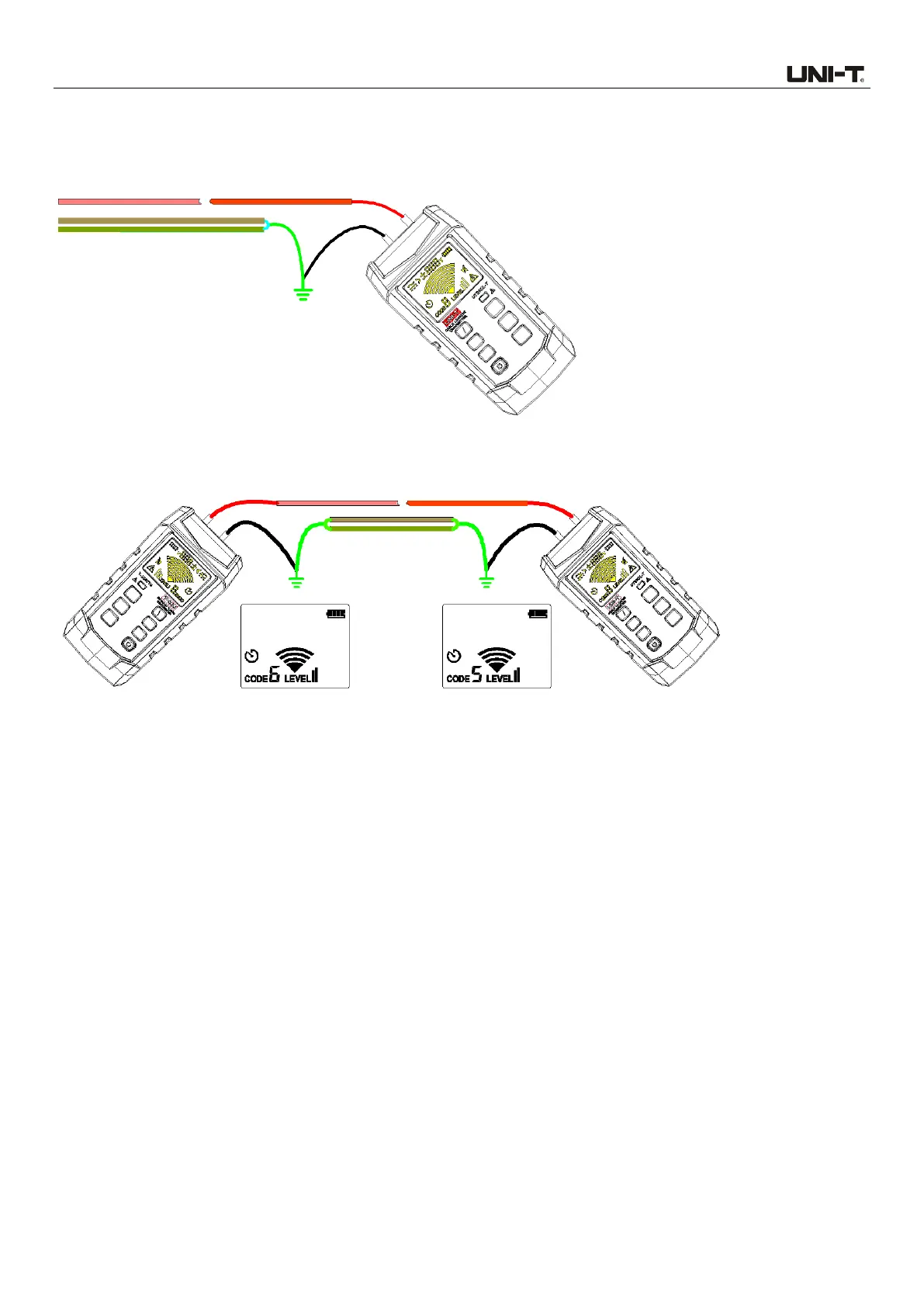
Alternatively, connect two UT25CL-T transmitters (set different codes for them) to both ends of the
cable respectively. If the signal is in the same location, the code is updated to the other receiver
after the receiver passes above the breakpoint, then the location of the fault is found. As shown in
Figures 8.2.1a and 8.2.1b.
Figure 8.2.1a Locate the breakpoint and the open
Figure 8.2.1b Locate the breakpoint and the open via multiple transmissions (with the codes set to
different values)
Note: If the location of the fault is not found, please decrease the LEVEL value of the
transmitter and then proceed as mentioned above. If not found yet after decreasing the
LEVEL, then the fault may be a high-resistance breakpoint (Cable is open-circuited partially.
According to actual experiences, the breakpoint can be found if the impedance is more than
50 kΩ.). Such breakpoints will impede large current, but the tracking signal can still be
transmitted through the breakpoint. Such breakpoints cannot be detected by instrument,
unless the cable is open-circuit wholly. To locate the breakpoint and the open via multiple
transmissions, please decrease the LEVEL value (i.e., set to level II or I to avoid mutual
interference) of the transmitter appropriately according to actual situation.
8.3 Identify Shorts
The shorted cable will trigger the circuit breaker. To correct the fault, please disconnect the cable,
and make sure that the conductors at the both ends of the cable are isolated mutually and are
isolated with other conductors or loads. If there are residual charges at the circuit, please
disconnect the power before test.
1. Connect the test lead of the transmitter to the circuit, as shown in Figure 8.3.1a.
2. Power on the transmitter and confirm the LEVEL value is set to III.



 To Next Page