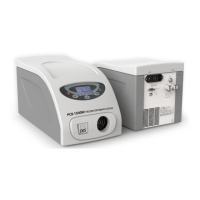
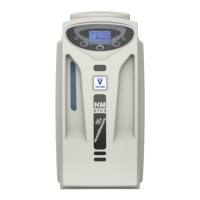
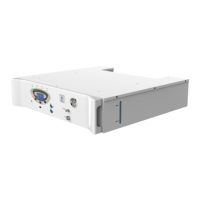
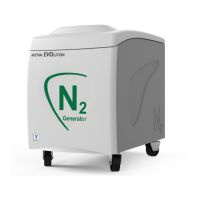
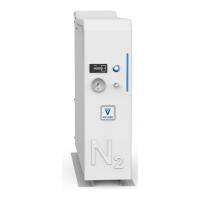
This document describes the VICI DBS PG Plus Rack + Zero Air & GC Plus Rack series of hydrogen and zero air generators, designed for laboratory use. The manual covers operation and maintenance for models PG-100, PG-160, PG-250, PG-300, PG-500, and PG-600 Plus hydrogen generators, as well as the optional zero air generator 1800/5000 and standalone zero air generator racks 1800, 5000, 10000, and 15000.
Function Description
The hydrogen generator produces pure hydrogen (and oxygen as a by-product) through the electrolysis of water. Its core component is an electrochemical cell containing a solid polymer electrolyte, which eliminates the need for free acids or alkalis. Only deionized or pure distilled water comes into contact with the cell and must be refilled periodically. Hydrogen passes through a hydrogen/water separator and a permeation drying tube, with pressure controlled by current, before exiting through the rear outlet port.
For the zero air option, air from an external compressed air source first passes through an external dust filter. It then goes through a catalytic oven to remove CO and CH4, and after cooling, the purified air is ready for use.
Important Technical Specifications
PG Plus Rack (Hydrogen Generators):
- Flow mL/min: Models range from 100 to 600 mL/min (e.g., PG Plus Rack 100, PG Plus Rack 600).
- Purity: >99.9996%.
- Dewpoint at 7 barg (100 psig): -25°C (-13°F).
- Outlet pressure barg (psig): 0.5 to 11 (7 to 160).
- Technology: PEM (Proton Exchange Membrane) - 100% Titanium cell.
- Drying system: Regenerative permeation membrane.
- Deionized water quality: Minimum < 1 µS/cm @25°C - 1 MΩ cm @25°C - ASTM II; Recommended < 0.2 µS/cm @25°C - 5 MΩ cm @25°C - ASTM II.
- External water tank: 10 liter bottle with an internal pump.
- Safety: Automatic shut down for internal/external hydrogen leak, overpressure, and low water.
- Display: Touch screen with operating parameters, system status, and safety alarms.
- LED indicators: Power on/off, system ready, errors.
- Interface: USB mod A.
- Electrical supply: 110-120V 60Hz / 220-240V 50Hz.
- Power consumption (watts): Ranges from 65W (PG Plus Rack 100) to 280W (PG Plus Rack 600).
- Dimensions: 19" Rack W x 3U H x 500D (19.6").
- Weight: Ranges from 17 kg (37.4 lbs) to 19 kg (41.9 lbs).
- Operating temp: 15 to 35°C (59 to 95°F).
- Outlet connection: 1/8" Compression.
- Certification: CE, FCC, MET (UL and CSA compliant).
Zero Air Option (DB-FH-1800/DB-FT-1800 and DB-FH-5000/DB-FT-5000):
- Flow mL/min: 1800 or 5000.
- Purity - hydrocarbons + CO: <0.1 ppm.
- Inlet pressure barg (psig): 4.5 to 10 (65 to 145).
- Inlet air quality: Clean dry compressed air ISO8573-1:2010 Class 1.2.1.
- Max outlet pressure barg (psig): 5 (73).
- Max HC in: 100 ppm.
- Max CO in: 50 ppm.
- Technology: Platinum catalyst.
- Warm up time: 45 minutes.
- Power consumption (watts): 200W (1800 mL/min) or 550W (5000 mL/min).
- Inlet connection: 1/4" Compression.
- Outlet connection: 1/8" Compression.
GC Plus Zero Air Rack (Standalone):
- Flow mL/min: Models range from 1800 to 15000 mL/min.
- Purity - hydrocarbons: <0.1 ppm.
- Purity - CO: <0.1 ppm.
- Max outlet pressure barg (psig): 1 (15) drop from inlet.
- Power consumption (watts): 200W (1800 mL/min) to 550W (5000, 10000, 15000 mL/min).
- Dimensions: 19"W x 3UH x 500D (19"W x 3UH x 19.6D).
- Weight: 15 kg (33 lbs).
Usage Features
Initial Start-Up:
- Placement: The generator must be placed on a flat, level, vibration- and shock-free surface, away from heat sources, with at least 30 cm of free space at the rear for ventilation. It should not be operated in sealed or unventilated rooms, near open flames, or easily flammable materials. Operating temperature range is +15°C to +35°C (59°F to 95°F).
- Water Tank Filling: Use distilled or deionized water with conductivity not exceeding 2µS/cm.
- Deionizer Bag Installation: A deionization bag is used to protect the cell from bad water quality. It should be inspected for damage, washed with deionized water, and inserted via the front panel, ensuring it doesn't block the tank outlet.
- Hydrogen Generator Start-up: Press the ON/OFF button to start. The touchscreen display shows current status, pressure information, hydrogen flow, and water quality. Users can adjust the desired outlet pressure via the menu.
- Zero Air Generator Start-up: Connect to an external compressed air source with a specific dust filter at the air inlet. The air flows through the generator even when OFF. Pressing the ON/OFF button (turns red) starts the heating process, indicated by a flashing yellow "Air Warm up" light. Once temperature is reached, a green "Air Ready" LED lights up.
Operation - Hydrogen Part:
- LCD Display: Provides real-time information on generator status (Normal, Pre-Alarm, Alarm), actual and set hydrogen pressure, hydrogen flow (indicating consumption), and water quality (conductivity levels).
- Buttons: Start/Stop-Reset button for normal operating mode and alarm reset. Exit-Menu button for navigation and parameter confirmation.
- Cascading Option: Allows up to 10 generators to operate in parallel using an RS-485 interface, controlled by an external pressure regulator. One generator acts as the master, with slaves taking over if the master fails. Requires an I/O board.
- Auto-Refill Option: Standard in rack versions with a filling pump. An optional valve can connect the generator to a pressurized deionizer water line (max 4.5 bar).
Special Functions:
- System Test: Includes internal and external leak tests, and flow tests to check generator integrity and performance.
- Diagnostic Display: Provides detailed metrics such as total hydrogen production, operating hours, water conductivity, cell voltage and current, power supply temperature, and pump flow.
Maintenance Features
Routine Maintenance - Hydrogen Part:
- Water Tank: Fill the external water tank with distilled or deionized water.
- Deionization Bag: Replace every 6 months or earlier if required.
- Water Filter: Replace the internal water filter (inside the external tank) every 3 years.
- General Inspection: The generator should be inspected approximately every 2 years by a supplier.
Routine Maintenance - Zero Air Part:
- Annual Maintenance Kit: Includes replacement cartridges for coalescent filters (AF20).
- Three-Year Catalyst Replacement Kit: Includes 1 oven/catalyst, 1 cooling coil, and replacement cartridge for coalescent filter. This is crucial to maintain CO and HC removal to 0.1 ppm level.
- Pre-Filter Element Replacement: The filter bowl can be removed by pressing and turning counter-clockwise. The filter element base is unscrewed to replace the element.
- Catalyst Chamber Replacement: Recommended every three years. Requires shutting down the unit, allowing it to cool for at least two hours, disconnecting air supply, depressurizing the system, opening the top cover, disconnecting air fittings and heater connections, and unscrewing the aluminum plate to extract the chamber. Only qualified staff should perform this service to avoid voiding the warranty.
Spare Parts:
The manual provides extensive lists of spare parts for both hydrogen and zero air components, including main boards, cells, power supplies, fans, filters, valves, and various fittings.
Returning the Unit:
Before returning a unit for service or repair, users must contact VICI DBS for an RMA number. All returned products must be accompanied by a completed "Decontamination Report," drained of fluids (except hydrogen cells, which need to be refilled with distilled water), securely packaged, and free of non-integral accessories. Chemical, biological, explosive, or radioactive contamination must be declared.

 Need help?
 General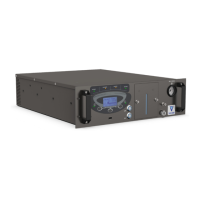

 To Next Page