– Maintain the boiler standby at all times, i.e. never allow a night or
weekend shutdown.
– Maintenance intervals may be shortened as biogas is frequently
contaminated. Regularly clean and service the boiler.
■ Alternative fuels on request.
10.6 Burners
Suitable burners
For matching the boiler and burner, an installation height of up to
250 m above sea level is applied
Pressure-jet oil burner
The burner must be checked and certified to EN 267.
Pressure-jet gas burner
The burner must be tested to EN 676 and be identified with the CE
designation in accordance with the Gas Appliances Directive.
Unit burner
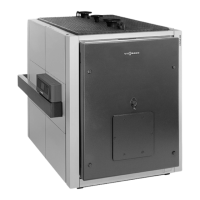
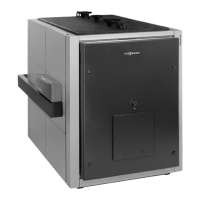
Viessmann pressure-jet oil or gas burners are offered for the Vitoplex
up to 300 kW and the Vitorond up to 270 kW.
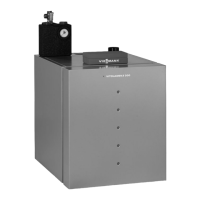
Vitoradial 300-T is available with the Viessmann pressure-jet oil
burner. Gas burner on site.
Elco and Weishaupt pressure-jet oil and gas burners are available for
the Vitoplex from 350 to 2000 kW and the Vitorond from 320 kW.
See pricelist.
Obtain these from the burner manufacturers.
Applications
The boiler operates with positive pressure in the combustion chamber.
Use a burner that is suitable for the pressure drop on the hot gas side
(see the datasheet for the boiler concerned).
Observe the pressure drop values of these additional devices when
using the Vitotrans 300 flue gas/water heat exchangers. You cannot
use the Viessmann pressure-jet oil and gas burners Vitoflame 100, 90
to 300 kW in conjunction with the Vitotrans 300 flue gas/water heat
exchangers installed downstream of the boiler.
The material of the burner head must be suitable for operating tem-
peratures of at least 500 °C.
Burner versions
You may use multi-stage or variable (modulating) burners.
Burner installation
See details in the datasheets of the respective boiler.
Burner settings
Adjust the maximum burner oil or gas throughput so that the stated
maximum boiler output will not be exceeded. Note that, for stepped or
modulating burners, the flue system must be suitable for the low flue
gas temperatures that may arise during partial load operation.
Maintain the minimum rated output specified under the relevant oper-
ating conditions when using the boilers together with the Vitotronic
control units.
10.7 Flue gas routing
Requirements in accordance with the Sample Combustion Order [Germany]
Observe the specific Building Regulations and Fire Regulations in your
country. We recommend you seek advice from your local flue gas
inspector.
1. The flue system must be sized in accordance with the clearance
diameter and height and if required also according to the heat
throughput resistance and the internal surface to ensure that the
flue gases will be extracted to the outside under all operating con-
ditions and so that no dangerous pressures can be created in any
rooms.
2. Flue gases from combustion equipment fired by liquid or gaseous
fuels can be piped into chimney stacks or into flue pipes.
3. For outlets from chimneys in combustion systems, the following
conditions apply:
■ For roofs with a slope of up to 20° inclusive, the outlets must be
at least 40 cm higher than the roof ridge or be at least 1m away
from the roof surface.
■ For roofs with a slope of more than 20°, the outlets must be at
least 40 cm higher than the roof ridge or have a horizontal clear-
ance from the roof surface of at least 2 m and 30 cm.
■ For combustion systems with a total output of up to 50 kW, the
outlets must be at least 1 m higher than the edges of ventilation
apertures, windows or doors within a radius of 15 m; the radius
increases by 2 m for every 50 kW begun, up to a maximum of 40
m.
4. As an alternative to section 3, for combustion systems with a com-
bustion output of 1 MW or more, the height of the outlet must be at
least 3 m above the highest point of the roof ridge and at least 10
m above ground level.
With a roof slope of less than 20°, relate the height of the outlet to
a fictitious roof ridge, the height of which should be calculated on
the assumption of a roof slope of 20°.
5. As an alternative to section 3, the flue gas from combustion systems
with >10 MW should be routed away via one or more chimneys, the
height of which should be calculated according to the regulations of
the TA-Luft [Germany] of 24 July 2002.
6. For combustion systems with a combustion output > 20 MW:
■ Observe the TA-Luft regulations [Germany]; obtain an emission
assessment.
■ Check with the appropriate local authority regarding regional
requirements.
■ Emission assessments will be provided by approved institutes.
7. Provide a sufficiently large and easily accessible test port in the flue
duct.
Design information
(cont.)
32
VIESMANN
OIL/GAS BOILERS
10
5822 426 GB







 To Next Page