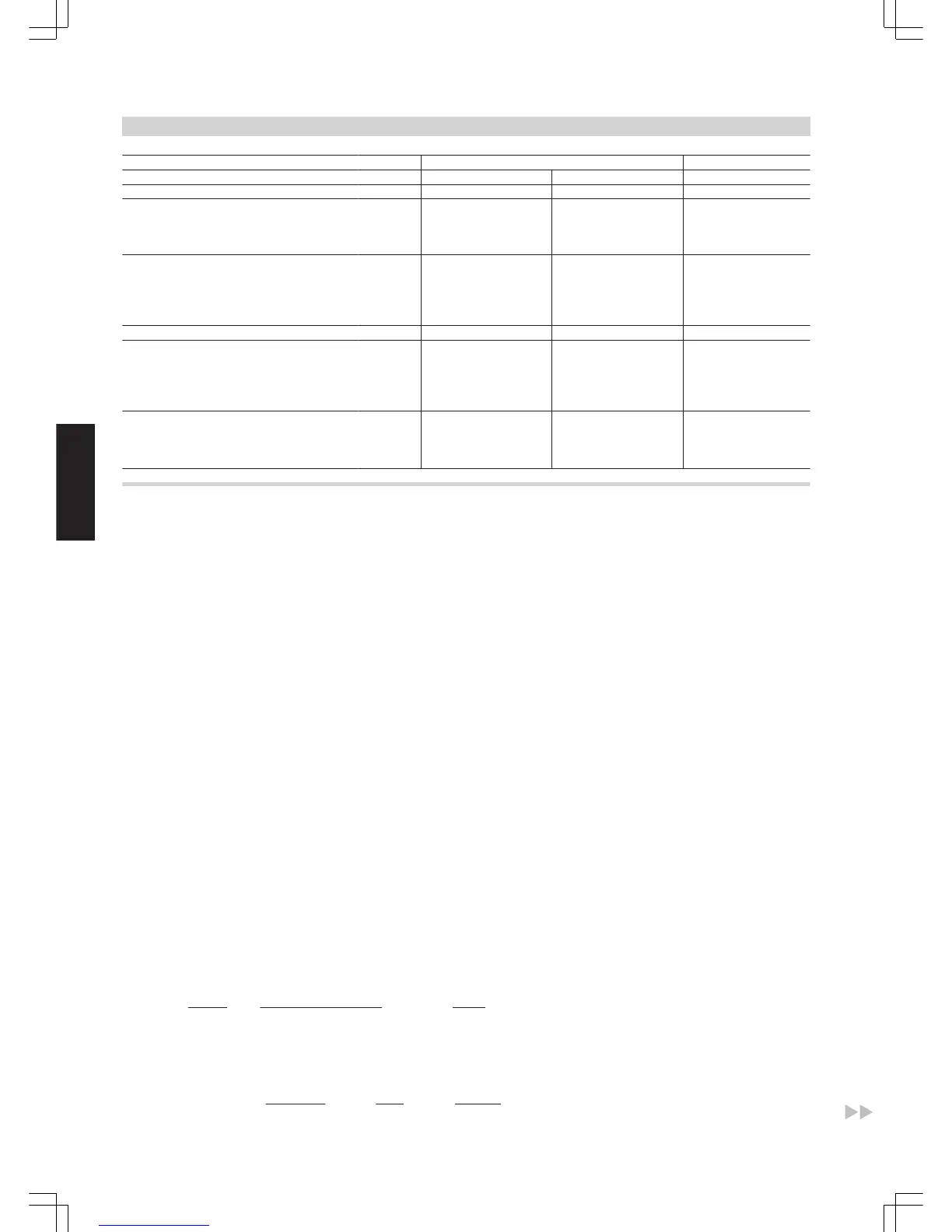
Low salt content With salt content
El. conductivity at 25 °C μS/cm 10 to 30 > 30 to 100 > 100 to 1500
General requirements clear, without sediments clear, without sediments clear, without sediments
pH value at 25 ºC 9 - 10 9 - 10.5 9 - 10.5
According to the Drinking Water Ordinance/
Drinking Water Treatment Ordinance [Germany]
≤ 9.5 ≤ 9.5 ≤ 9.5
Oxygen (O
2
)
Values for constant operation may be signifi-
cantly lower. The oxygen concentration in the re-
circulated water may be up to 0.1mg/litre, if suit-
able inorganic corrosion inhibitors are used.
mg/litre < 0.1 < 0.05 < 0.02
Alkaline earths (Ca + Mg) mmol/litre < 0.02 < 0.02 < 0.02
Phosphate (PO
4
) mg/litre < 5 < 10 < 15
According to the Drinking Water Ordinance/
Drinking Water Treatment Ordinance [Germany]
mg/litre
≤ 7 ≤ 7 ≤ 7
For Viessmann hot water boilers mg/litre < 2.5 < 5 < 15
When using oxygen binders:
Sodium sulphite (Na
2
SO
3
)
When using suitable products, observe the
guidelines issued by the respective supplier.
mg/litre – – < 10
Using antifreeze in boilers
Viessmann boilers are designed and built for water as a heat transfer
medium. To protect boiler systems from frost, it may be necessary to
treat the boiler or circuit water with antifreeze.
When doing so, observe the following:
■ The properties of antifreeze and water are very different.
■ The boiling point of pure antifreeze based on glycol is approx. 170
°C.
■ The temperature stability of the antifreeze must be sufficient for the
particular application.
■ Check the compatibility with sealing materials. If other sealing mate-
rials are used, take this into account when designing the system.
■ Antifreeze developed especially for heating systems contains inhib-
itors and buffer substances for corrosion protection as well as glycol.
When using antifreeze, always observe the manufacturer's instruc-
tions regarding minimum and maximum concentrations.
■ In a water/antifreeze mixture, the specific heat capacity of the heat
transfer medium changes. Take this factor into account when select-
ing the boilers and system components, such as heat exchanger and
pumps. Contact the antifreeze manufacturer to find out the relevant
values for the specific heat capacity. For an example calculation of
the output change, see below.
■ If the system is filled with antifreeze, it must be marked accordingly.
■ The quality of the boiler and feedwater must meet the requirements
of VDI guideline 2035.
■ The systems must be designed as sealed unvented systems, as the
antifreeze inhibitors decrease rapidly if airborne oxygen is allowed
to enter.
■ Diaphragm pressure compensation vessels must comply with DIN
4807.
■ Only use oxygen diffusion-resistant hoses or metal hoses for flexible
connections.
■ Never install zinc plated heat exchangers, tanks or pipes on the pri-
mary side of a system, as zinc can be stripped by glycol/water mix-
tures.
Due to the different physical characteristics of glycol and water, the boiler may suffer a loss of output. Below we have given an example for
calculating the output change for operation with antifreeze.
Target Maximum boiler output when using antifreeze Q
K glycol
Given Boiler output Q
K
= 2 MW
Antifreeze Tyfocor
Spec. heat capacity 3.78 kJ/kgK at 80°C
Mixing ratio Tyfocor/water 40/60
Calculation:
µ
=
²
=
2000 kW kg K•3600s
= 86000
kg
≙
86 t/h
c • Δt 4.187 kWs•20K •1h h
This results in the following:
´
≈
86 m
3
/h
²
K glycol
=
µ • c • Δt =
86000 kg
• 3.78
kJ
• 20K •
1h
h h 3600s
Design information
(cont.)
46
VIESMANN
OIL/GAS BOILERS
10
5822 426 GB







 To Next Page