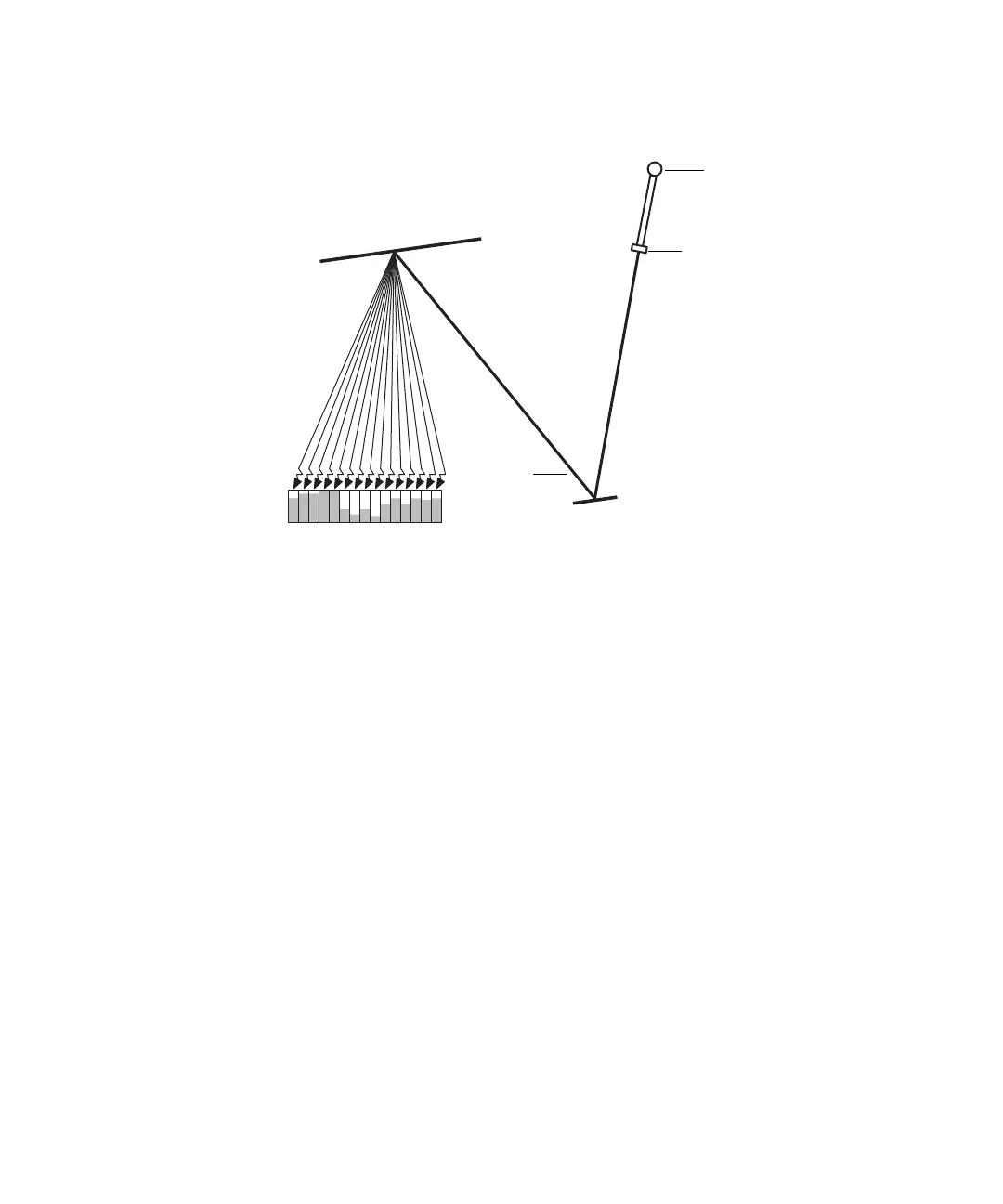
Measuring light at the photodiode array 1-7
Photodiodes discharged by light
The detector measures the amount of charge required to recharge each
photodiode. The charge is proportional to the amount of light transmitted
through the flow cell over the interval specified by the diode exposure time.
Optimizing the signal-to-noise ratio
To optimize signal-to-noise ratios, choose an acquisition wavelength range
that includes only the wavelengths of interest. Ensure that the range is one in
which the mobile phase absorbs only minimally (see Appendix C). You can
further improve the signal-to-noise ratio by increasing the bandwidth
parameter. For example, you can choose to operate at 3.6 nm instead of at
1.2 nm resolution. See page 1-10 for more information.
Optimizing filter constants
The filtering constant you select affects the peak intensity. To increase
sensitivity, decrease the filter time constant.
Selecting the appropriate sampling rate
A sufficient number of points must fall across a peak to define its shape. Thus,
the definition between peaks is lost at very low sampling rates. Empower uses
Mirror
Grating
Flow cell
Deuterium lamp
Light from grating
dispersed onto
diodes.
Sample in flow cell
absorbs at specific
wavelengths.
Slit


 To Next Page