61
8
8.3. Characteristics and Handling of the Nickel Metal
Hydride Battery (JWB2)
(1) Ambient temperatures
Depending on the ambient temperature, the distance that can be traveled becomes shortened.
In order to maximize the battery’s performance, it is recommended that you use the battery under the
following conditions.
When in use on the wheelchair:
Temperature range between 32 – 95°F (0 to
35°C)
When removed from wheelchair and stored:
Temperature range between 50 – 77°F (10
to 25°C)
When charging:
Temperature range between 50 – 77°F (10
to 25°C)
• Storing the battery in excessively high or low tem-
peratures will speed up its degradation, and its ca-
pacity will rapidly decrease.
• Using the wheelchair in excessively low tempera-
tures will cause the battery capacity to rapidly de-
crease. For information on degradation, see “Bat-
tery’s deterioration characteristics” on the next page.
(2) Memory eect and refresh charging
When a shallow discharging and charging cycle is per-
formed repeatedly on a nickel metal hydride battery,
a phenomenon called the memory effect occurs, in
which the actual usable capacity decreases.
The memory effect can be prevented and eliminated
by fully discharging the battery and then recharging
(refresh charging).
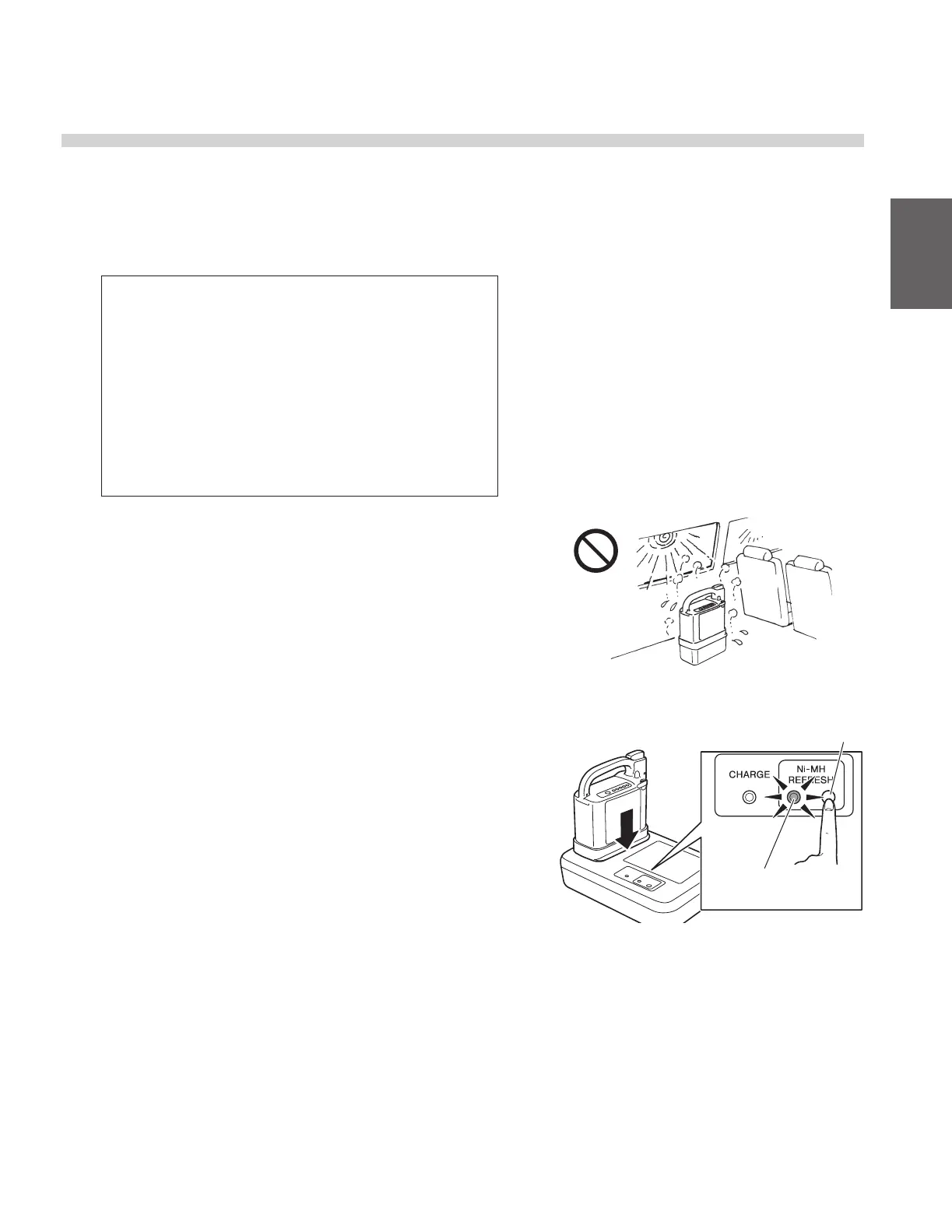
If refresh charging is necessary, the microcomputer in
the battery sends the information to the charger and
the refresh lamp on the charger ashes.
When recharging, if the refresh lamp on the charger
ashes, press the refresh switch to perform a refresh
charge cycle.
Refresh charging takes longer than normal charging.
For details on refresh charging, refer to “8.5. Refresh
Charging the Nickel Metal Hydride Battery (JWB2)”.
Refresh switch
Refresh lamp



 To Next Page