7
7-18
Periodic maintenance and adjustment
Tires
Tire air pressure
WARNING
Tire inspection
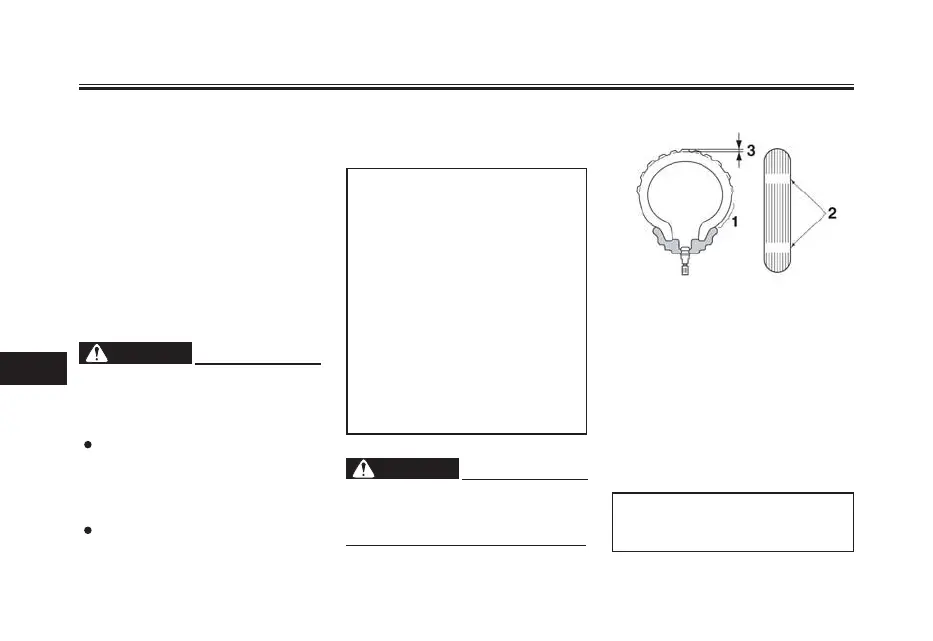
1. Tire sidewall
2. Tire wear indicator
3. Tire tread depth
Tires are the only contact between the
vehicle and the road. Safety in all con-
ditions of riding depends on a
relatively small area of road contact.
Therefore, it is essential to maintain
the tires in good condition at all times
and replace them at the appropriate
time with the specified tires.
The tire air pressure should be check-
ed and, if necessary, adjusted before
each ride.
Operation of this vehicle with im-
proper tire pressure may cause se-
vere injury or death from loss of
control.
The tire air pressure must be
checked and adjusted on cold
tires (i.e., when the temperature
of the tires equals the ambient
temperature).
The tire air pressure must be
adjusted in accordance with the
riding speed and with the total
WARNING
weight of rider, passenger, car-
go, and accessories approved
for this model.
Never overload your vehicle.
Operation of an overloaded vehicle
could cause an accident.
Tire air pressure (measured on cold
tires):
1 person:
Front:
150 kPa (1.50 kgf/cm , 22 psi)
Rear:
250 kPa (2.50 kgf/cm , 36 psi)
2 persons:
Front:
150 kPa (1.50 kgf/cm , 22 psi)
Rear:
250 kPa (2.50 kgf/cm , 36 psi)
Maximum load*:
168 kg (370 lb)
*Total weight of rider, passenger,
cargo and accessories
2
2
2
2
The tires must be checked before each
ride. If a tire tread shows crosswise
lines (minimum tread depth), if the tire
has a nail or glass fragments in it, or if
the sidewall is cracked, contact a
Yamaha dealer immediately and have
the tire replaced.
Minimum tire tread depth (front
and rear):
1.0 mm (0.04 in)





 To Next Page