Styles (Auto Accompaniment) and Patterns
PSR-E433 Owner’s Manual
44
Reference
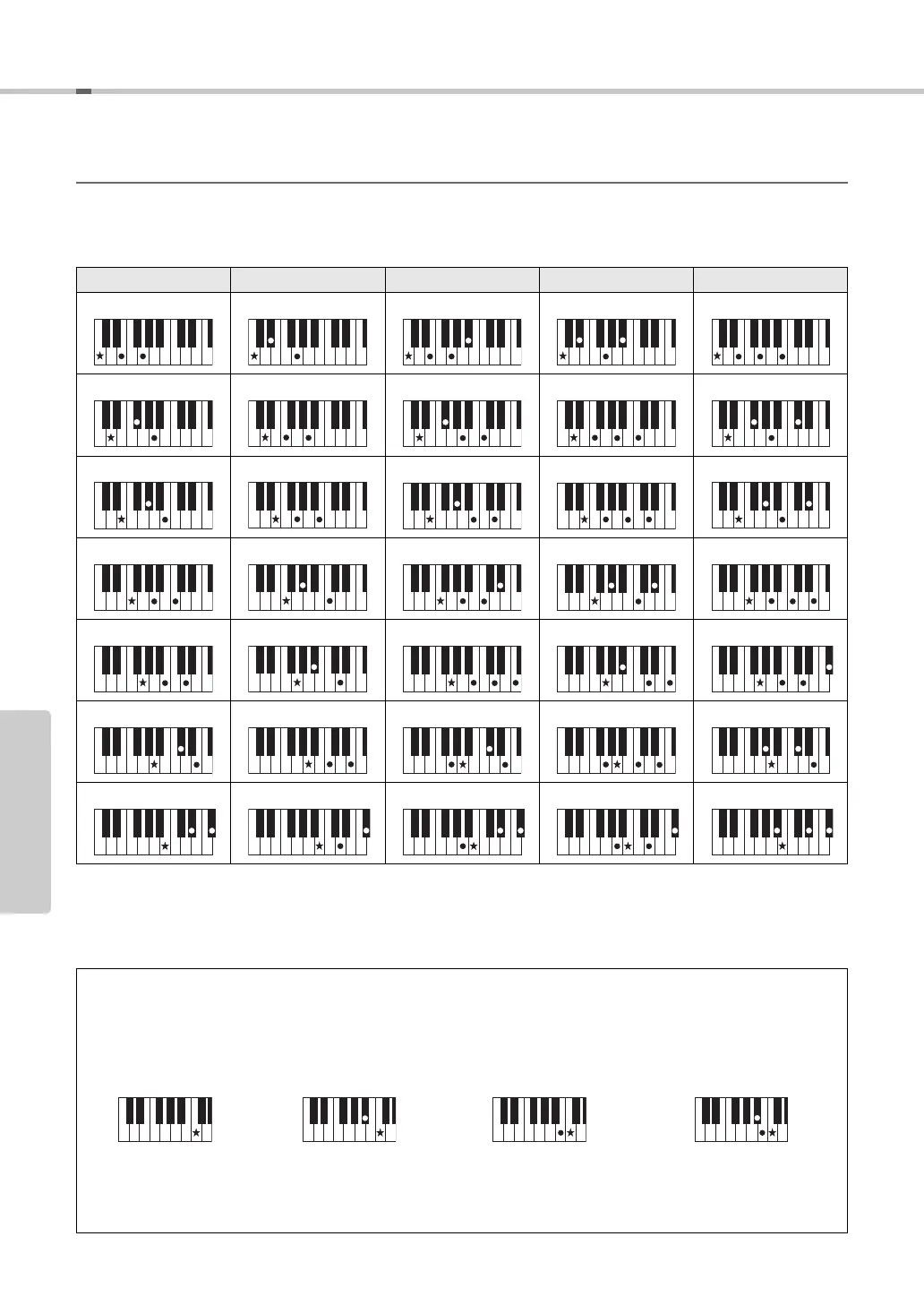
Chord Types for Style Playback
For users who are new to chords, this chart features common chords. Since there are many useful chords and
many different ways to use them musically, refer to commercially available chord books for further details.
indicates the root note.
• Inversions can be used as well as in “root” position—with the following exceptions:
m7, m7
b
5, 6, m6, sus4, aug, dim7, 7
b
5, 6(9), sus2
• Inversion of the 7sus4 and m7(11) chords are not recognized if the notes are omitted.
• When playing a chord which cannot be recognized by this instrument, nothing is shown
on the display. In such a case, only the rhythm and bass parts will be played.
Major Minor Seventh Minor Seventh Major Seventh
Easy Chords
This method lets you easily play chords in the accompaniment range of the keyboard using only one, two, or three
fingers.
For root “C”
To play a major chord
Press the root note ()
of the chord.
To play a minor chord
Press the root note
together with the nearest
black key to the left of it.
To play a seventh chord
Press the root note
together with the nearest
white key to the left of it.
To play a minor seventh chord
Press the root note together
with the nearest white and
black keys to the left of it (three
keys altogether).
C
Cm
7
CM
7
D
Dm
7
DM
7
E
Em
7
EM
7
C
F
Fm
7
FM
7
G
Gm
7
A
Am
7
AM
7
7
B
Bm
7


 To Next Page