PRE-OPERATION CHECKS
3-7
Front
250 kPa (2.5 kgf/cm²) (36 psi)
Rear
250 kPa (2.5 kgf/cm²) (36 psi)
Higher pressures and fast inflation may
cause a tire to burst. Inflate the tires very
slowly and carefully.
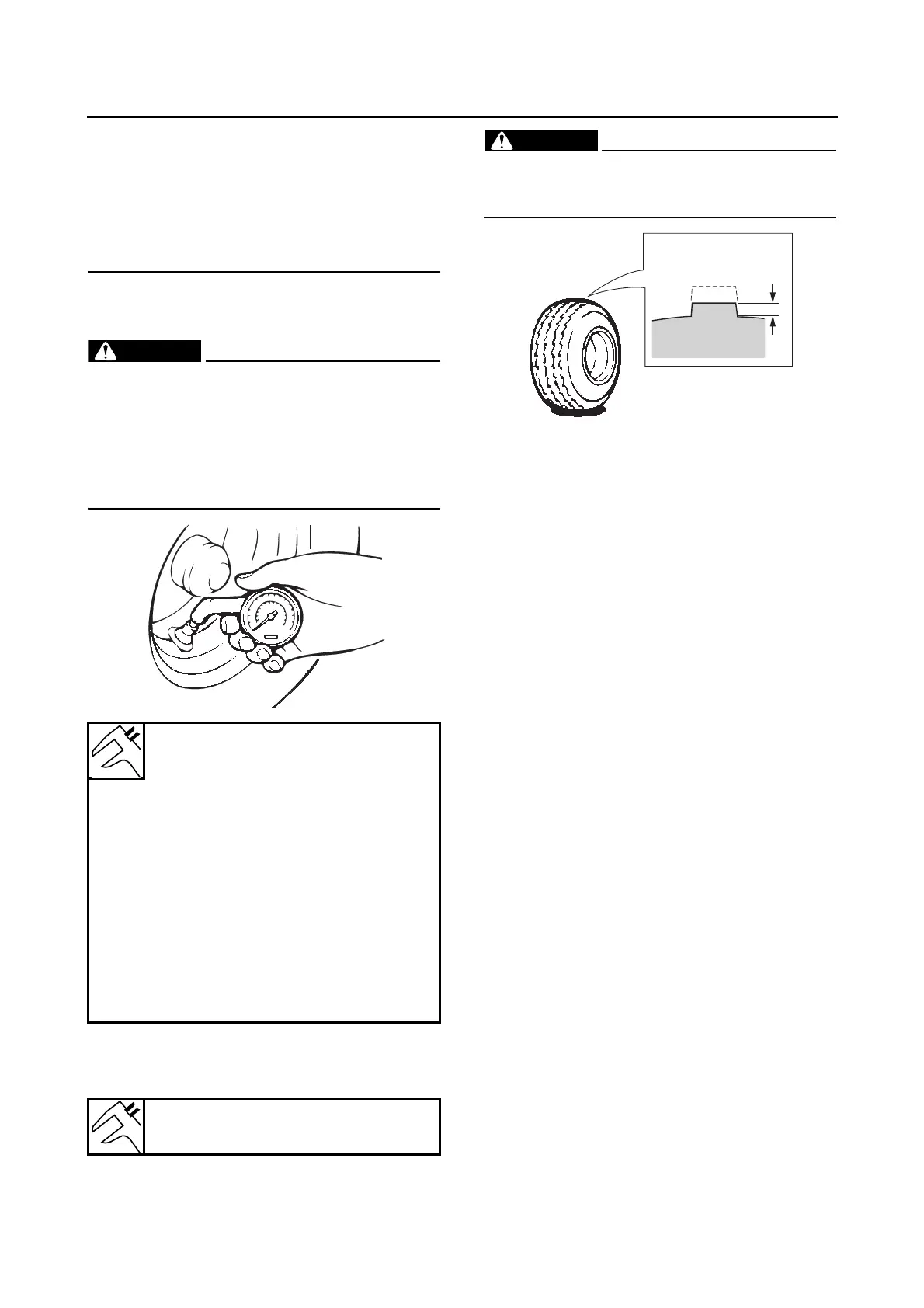
1. Measure:
• Tire pressure
Out of specification → Adjust.
Uneven or improper tire pressure may ad-
versely affect the handling of this vehicle
and may cause loss of control.
• Maintain proper tire pressures.
• Set tire pressures when the tires are cold.
• Tire pressures must be equal in both front
tires and equal in both rear tires.
2. Check:
• Tire surfaces
Wear/damage → Replace.
It is dangerous to ride with a worn-out tire.
When the tire tread reaches the wear limit, re-
place the tire immediately.
CHECKING THE BODY AND CHASSIS
1. Check:
• Body
• Chassis
Cracks/damage → Replace.
CHECKING THE FASTENERS
1. Check:
• Fasteners
Loosen → Tighten.
Damage/pitting → Replace.
Refer to “GENERAL CHASSIS (1)” on page
4-1, “GENERAL CHASSIS (2)” on page 4-3
and “GENERAL CHASSIS (3)” on page 4-6.
CHECKING THE REVERSE BUZZER
1. Check:
• Reverse buzzer operation
Dose not sound → Repair or replace.
Refer to “CHECKING THE REVERSE
BUZZER” on page 8-57 or “CHECKING THE
REVERSE BUZZER” on page 8-78.
Tire air pressure (measured on
cold tires)
Recommended
Front
137 kPa (1.37 kgf/cm², 20 psi)
Rear
151 kPa (1.51 kgf/cm², 22 psi)
Minimum
Front
124 kPa (1.24 kgf/cm², 18 psi)
Rear
137 kPa (1.37 kgf/cm², 20 psi)
(YUM1A)
151 kPa (1.51 kgf/cm², 22 psi)
(YUM2A/YUM2E)
Wear limit
1.0 mm (0.04 in)
a. Wear limit



 To Next Page