ANNUAL CHECKS
3-18
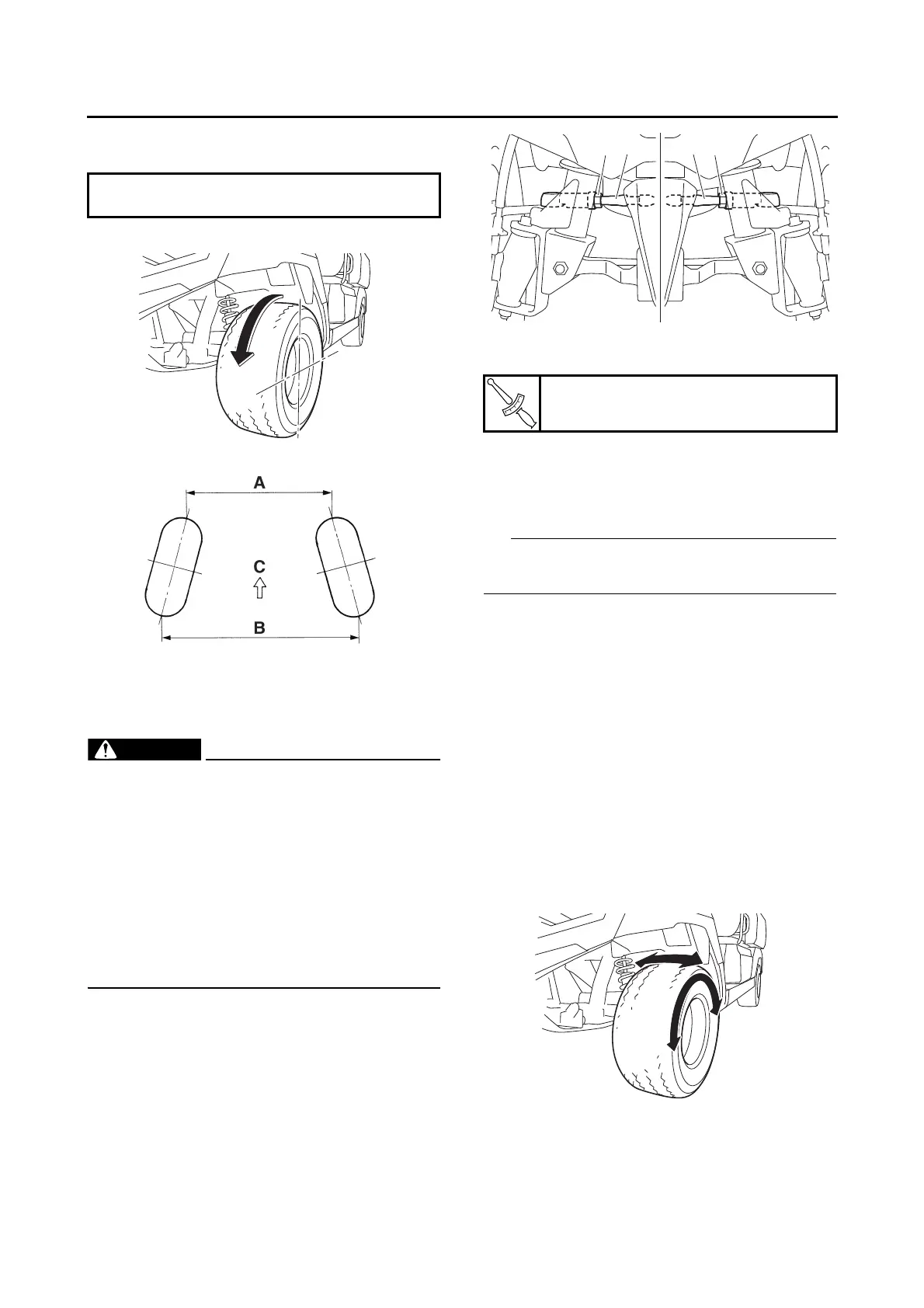
f. Calculate the toe-in using the formula giv-
en below.
g. If the toe-in is incorrect, adjust it.
3. Adjust:
• Toe-in
• Be sure that both tie-rods are turned the
same amount. If not, the vehicle will drift
right or left even though the steering wheel
is straight. This may lead to mishandling
and an accident.
• After setting the toe-in to specification, run
the vehicle slowly for some distance with
both hands lightly holding the steering
wheel and check that the steering wheel re-
sponds correctly. If not, turn either the right
or left tie-rod within the toe-in specification.
a. Mark both tie-rods ends.
This reference point will be needed during
adjustment.
b. Loosen the tie-rod end locknuts “1” of both
tie-rods.
c. The same number of turns should be giv-
en to both the right and left tie-rods “2” until
the specified toe-in is obtained. This is to
keep the length of the tie-rods the same.
d. Tighten the tie-rod end locknuts to specifi-
cation.
4. Check:
• Steering wheel
Refer to “INSTALLING THE STEERING
WHEEL” on page 4-14.
After adjusting the toe-in, the steering wheel
should be centered.
CHECKING THE FRONT WHEEL BEARING
The following procedure applies to both of the
front wheel bearings.
1. Park the vehicle on a level surface and apply
the parking brake.
2. Check:
• Front wheel bearing
Rattle/abnormal noises/turns roughly → Re-
place.
a. Raise the front end of the vehicle so that
there is no weight on the rear wheels.
b. Turn the front wheels.
c. Move the front wheels laterally back and
forth.
Toe-in = “B” – “A”
C. Forward
Tie-rod end locknut
45 N·m (4.5 kgf·m, 33 lb·ft)






 To Next Page