EasyManua.ls Logo

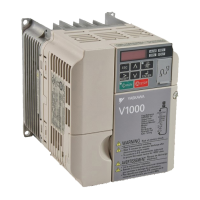
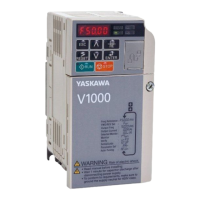
YASKAWA V1000 Series - User Manual

YASKAWA V1000 Series
152 pages
Go to English
Print Icon
To Next Page IconTo Next Page
Loading...
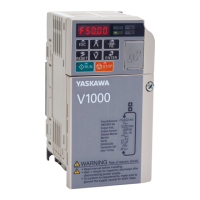
YASKAWA AC Drive V1000
IP66 Type
MANUAL NO. TOMP_C710606_75A
Type: CIMR-VCH-00
Models:
200 V Class, Single-Phase Input: 0.1 to 3.0 kW
400 V Class, Three-Phase Input: 0.2 to 18.5 kW
Kurzanleitung
Quick-Start-Guide
Guide de démarrage rapide
Manuale di avvio rapido
Guía de referencia rápida
TOMP_C710606_75A_0_0_prePrint.pdf 1 21.12.2010 13:52:13

Other manuals for YASKAWA V1000 Series

Questions and Answers

  • D
    david96Sep 23, 2025
    What to do if YASKAWA V1000 Controller motor noise is too loud or motor hunting and oscillation occur?
    • R
      Rachel MooreSep 23, 2025
      If your YASKAWA Controller's motor noise is too loud, try increasing the carrier frequency. If you observe motor hunting and oscillation at speeds up to 40 Hz, lower the carrier frequency.
  • J
    James HuntAug 23, 2025
    What to do if YASKAWA DC Drives display DC Overvoltage?
    • S
      Shawn ClarkAug 23, 2025
      If your YASKAWA DC Drives are showing a DC Overvoltage, it means the DC bus voltage is too high. This can be due to: * A deceleration time that is too short. * Stall prevention being disabled. * A broken braking chopper/resistor. * Unstable motor control in OLV. * Too high input voltage. To fix this, increase the deceleration time, enable stall prevention via parameter L3-04, ensure the braking resistor and chopper are working, check motor parameters and adjust torque/slip compensation, and verify the power supply voltage meets the drive's specifications.
  • C
    Carlos GallagherAug 25, 2025
    What causes a Ground Fault in YASKAWA DC Drives?
    • D
      Debbie RobinsonAug 26, 2025
      A ground fault in YASKAWA DC Drives indicates that the ground leakage current has exceeded 50% of the drive's rated output current. This may be due to broken cable or motor insulation, or excessive stray capacitance at the drive output. To address this, check the output wiring and motor for shorts or broken insulation, replacing any damaged parts, and reduce the carrier frequency.
  • B
    bassmichaelAug 27, 2025
    Why is my YASKAWA DC Drives showing a Motor Overload?
    • C
      Caleb SanfordAug 27, 2025
      A motor overload in YASKAWA DC Drives can be caused by: * The motor load being too heavy. * Operating the motor at low speed with a heavy load. * Cycle times of accel./decel. being too short. * An incorrect motor rated current setting. To resolve this, reduce the motor load, use a motor with external cooling and set the correct motor in parameter L1-01, check the sequence, and verify the rated current setting.
  • M
    Monica LawsonAug 27, 2025
    What causes YASKAWA DC Drives to display a Drive Overload?
    • L
      Laura RobersonAug 27, 2025
      A drive overload in YASKAWA DC Drives can occur because: * The load is too heavy. * The drive capacity is too small. * There is too much torque at low speed. To resolve this, check the load, ensure the drive is adequately sized for the load, and reduce the load or increase the drive size, as the overload capability is reduced at low speeds.
  • M
    Martha BrownSep 18, 2025
    How to improve speed precision on YASKAWA V1000 Controller?
    • M
      Michael WardSep 18, 2025
      To improve speed precision on your YASKAWA Controller, first ensure you've set the motor-rated torque (E2-01), motor-rated slip (E2-02), and motor no-load current (E2-03). After that, fine-tune the slip compensation gain (C3-01).
  • C
    Christopher MorganSep 15, 2025
    What to do if YASKAWA DC Drives show Controller Undervoltage?
    • D
      Deborah RiosSep 15, 2025
      If YASKAWA DC Drives display Controller Undervoltage, it indicates that the drive's controller power supply voltage is too low. Cycle power to the drive and check if the fault reoccurs. If it continues, replace the drive.
  • B
    Bethany HernandezSep 16, 2025
    What should I do if YASKAWA DC Drives display a DC Charge Circuit Fault?
    • R
      Richard BrownSep 16, 2025
      If YASKAWA DC Drives display a DC Charge Circuit Fault, it indicates that the charge circuit for the DC bus is broken. Cycle power to the drive and check if the fault reoccurs. If it does, replace the drive.
  • P
    Patricia LopezSep 6, 2025
    What does 'Drive Disable' mean on YASKAWA DC Drives?
    • R
      rwallSep 6, 2025
      If YASKAWA DC Drives show 'Drive Disable', it means both Drive Disable inputs are open, which safely disables the drive output, preventing the motor from starting. This could be because the upper controller's safety device disabled the drive. To fix this, determine why the upper controller disabled the drive, remove the cause, and restart. Also, check the wiring. If the Drive Disable function is not used for EN60204-1, terminals HC, H1, and H2 must be linked.
  • K
    Kara KramerSep 3, 2025
    How to troubleshoot Heatsink Overheat in YASKAWA DC Drives?
    • J
      Joshua NelsonSep 4, 2025
      A heatsink overheat in YASKAWA DC Drives can be caused by: * A high surrounding temperature. * A cooling fan that has stopped working. * A dirty heatsink. * Restricted airflow to the heatsink. To fix this, check the surrounding temperature and install cooling devices if needed, inspect the drive's cooling fan, clean the heatsink, and ensure there is adequate airflow around the heatsink.

Summary

General Information and Safety Instructions

General Warnings

Provides essential safety warnings and conventions for using the drive.

Safety Warnings

Highlights critical safety warnings, including electrical shock and hazard identification.

WARNING

Important warnings about handling the drive, including electrical hazards and sudden movement.

Mechanical Installation

Wiring Instructions

Provides critical warnings and steps for removing the front cover and wiring the drive.

Main Circuit and Control Circuit Wiring

Explains how to route cables through glands and connect power and control circuits.

Main Circuit Wiring

Details wire gauge, fuse recommendations, and tightening torques for main circuit connections.

Control Circuit Wiring

Specifies wire gauge, cable glands, and tightening torques for control circuit wiring.

Electrical Installation

Main and Control Circuit Wiring

Illustrates and explains the main and control circuit wiring diagrams for the drive.

Wiring Specification

Details fuse, wire gauge, and terminal size specifications for main circuit wiring.

Tightening Torque Values

Lists specific torque values for tightening main circuit terminals.

Control Circuit

Describes screwless terminals for control circuits and recommended wire types.

Wiring the Main Circuit Input

Precautions and recommendations for wiring the main circuit input of the drive.

Wiring the Main Circuit Output

Important precautions to consider when wiring the main circuit output of the drive.

Ground Connection

Guidelines and requirements for proper grounding of the drive to ensure safety and performance.

Control Circuit Wiring Precautions

Precautions for wiring control circuits, including separation, cable types, and operator connections.

Keypad Operation

LED Operator and Keys

Introduces the LED operator and keys, explaining their role in programming and status indication.

Start Up

Drive Setup Procedure

Outlines the basic step-by-step procedure for setting up and starting the drive.

Auto-Tuning (T1-0)

Details the Auto-Tuning function for automatically setting motor parameters and its different modes.

Parameter Table

Troubleshooting

General Fault and Alarms

Lists common faults and alarms, their causes, and corrective actions for drive troubleshooting.

Operator Programming Errors

Explains operator programming errors (OPE) and how to identify and correct them.

Auto-Tuning Errors

Lists potential errors encountered during Auto-Tuning and their corrective actions.

YASKAWA V1000 Series Specifications

General IconGeneral
ModelV1000 Series
SeriesV1000
Output Frequency0.1 to 400 Hz
Overload Capacity150% for 60 seconds
TypeAC Drive
Control MethodV/f Control
Input Voltage200-240V, 380-480V
Output Voltage0 to Input Voltage
Power Range0.1 to 18.5 kW
Horsepower0.2 to 25 HP
Protection FeaturesOvercurrent, Overvoltage, Undervoltage, Overheating, Short Circuit, Ground Fault
Communication InterfacesModbus RTU
EnclosureIP20
Ambient Temperature-10 to +50°C
Storage Temperature-20 to +60°C
Humidity5 to 95% RH (non-condensing)
Cooling MethodFan Cooled

Related product manuals