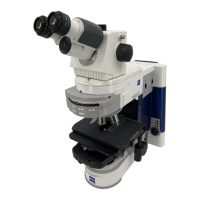
The Carl Zeiss Auto Focus equipment is designed for use with Axio Imager 2 and Axio Imager Vario stands that feature a motorized focus. It utilizes the left camera deflection port for coupling. The primary function of the Auto Focus is to automatically and rapidly locate and maintain the focal plane on sample surfaces. This is particularly useful when moving samples along the X or Y axis or when adjusting focus to align with surface structures. The focus adjustment is managed by a dedicated focus controller, which directly controls the microscope's motorized Z-axis drive.
Function Description:
The Auto Focus system operates by projecting structured light from an LED in its sensor module through the objective onto the sample. This light is then reflected from the sample's surface. The system automatically seeks the maximum reflection signal, thereby bringing the sample surface into sharp focus. Any deviations in the focus position are detected by the sensor and automatically compensated by the controller, which directly accesses the microscope's Z-drive.
The Auto Focus can operate in three different surface property modes: reflective, partially reflective, and diffuse. It also offers three levels of precision: exact, balanced, and fast. The "exact" mode provides 0.3 times the depth of field of the objective, "balanced" provides 1 time the depth of field, and "fast" provides 3 times the depth of field. The system is particularly recommended for reflective samples like semiconductors or metals, offering significantly shorter control times compared to software autofocus functions and a wide capture range of several hundred depths of field. Its suitability for other surface properties (partially reflective, diffuse) should be checked.
Important Technical Specifications:
- Dimensions and Weight:
- Sensor module: 130 mm (length) x 105 mm (width) x 116 mm (height), approx. 1300 g
- Controller: 220 mm (length) x 250 mm (width) x 158 mm (height), approx. 4800 g
- Ambient Conditions:
- Transportation (packed state): -40 °C to +70 °C
- Storage: +5 °C to +40 °C, max. 75% relative air humidity (no condensation)
- Operation: +10 °C to +40 °C, max. 75% relative air humidity (no condensation), max. altitude 2000 m, atmospheric pressure 800 hPa to 1060 hPa, degree of pollution 2.
- Operating Data (Sensor module with IR-LED):
- Internal LED: IRED 850 nm / max. 950 mW / LED class 3B (conforming to DIN EN 60825-1:2003), Free group conforming to DIN EN 62471:2009.
- Type of operation site: Closed room facilities
- Protection class: I
- Ingress protection rating: IP 20
- Electrical safety: Conforming to DIN EN 61010-1 (IEC 61010-1), CSA and UL regulations.
- Overvoltage category: II
- Radio interference suppression: EN 55011 Class A
- Noise immunity: DIN EN 61326-1
- Line input voltage: 100 V AC to 240 V AC (± 10%), 50/60 Hz (no voltage conversion required!)
- Power consumption: max. 80 VA
- Fuses (fc12 focus controller): T 2.0 A/H; 250 V; 5x20 mm
- Operating Data (Axio Imager 2 / Axio Imager Vario with external VP232-2 power supply pack):
- Type of operation site: Closed room facilities
- Protection class: I
- Ingress protection rating: IP 20
- Electrical safety: Conforming to DIN EN 61010-1 (IEC 61010-1), CSA and UL directives.
- Overvoltage category: II
- Radio interference suppression: EN 55011 Class B
- Noise immunity: DIN EN 61326-1
- Line input voltage: 100 V AC to 240 V ±10%, 50/60 Hz (no voltage conversion required!)
- Max. power consumption Axio Imager, motorized: max. 190 VA
- Focus Performance (highly reflective plain surface):
- Objective magnification 1.25x: >12000 µm capture range, ~170.00 µm precision, ~2000 µm min. object size
- Objective magnification 2.5x: >10000 µm capture range, ~42.00 µm precision, ~1000 µm min. object size
- Objective magnification 5x: >10000 µm capture range, ~8.90 µm precision, ~500 µm min. object size
- Objective magnification 10x: >8000 µm capture range, ~2.50 µm precision, ~250 µm min. object size
- Objective magnification 20x: >4000 µm capture range, ~0.60 µm precision, ~125 µm min. object size
- Objective magnification 50x: >700 µm capture range, ~0.25 µm precision, ~50 µm min. object size
- Objective magnification 100x: >150 µm capture range, ~0.20 µm precision, ~25 µm min. object size
Usage Features:
- Compatibility: Requires an Axio Imager 2 / Axio Imager Vario stand with motorized Z-axis drive and a focusing objective turret. Retrofitting to older stands must be done by Carl Zeiss service.
- Camera Deflection: Uses a left-side camera deflection (manual 425103-0000-000 or motorized 425104-0000-000). Using this port for Auto Focus prevents its use as a standard camera connection.
- Objectives: Compatible with specific EC Epiplan and EC Epiplan-Neofluar objectives (listed in the manual). Transmitted light objectives or objectives from other manufacturers are not supported. For samples with a cover slip, only EC Epiplan and EC Epiplan-Neofluar objectives with 10x magnification or less are suitable.
- IR Damping Filter: For some applications, a BG 39 or BG 40, d = 23.5 mm IR damping filter must be inserted into the camera adapter. Recalibration of focus reference values is necessary if this filter is added later.
- Operation Modes:
- On Status: Continuous operation of Auto Focus, with optional periodic focusing at set intervals. The LED is only active when the Auto Focus is actively working.
- Once Status: Performs a single Auto Focus search to find the focal plane.
- Standby Status: The system is ready but not actively focusing.
- Work / Load by AF: Supports automatic stage movement to a load position and then triggers Auto Focus to find the sample surface. This feature is fully functional with reflective samples up to 20x magnification; capture range is restricted for diffuse samples. High magnification objectives (40x-150x) are not supported for Work/Load by AF to prevent collisions.
- Focus Wheel Option: Allows disabling manual focus adjustment via the focus wheel to prevent inadvertent offsets.
- Offset Adjustment: A Z-offset can be manually set using the focus wheel, TFT display, or imaging software (AxioVision 4.9.1+).
- Objective Change: Auto Focus remains active in "On" status during objective changes, pausing its activity and resuming once the new objective is in place.
- TFT Display Control: Auto Focus settings and operating status can be viewed and changed via the TFT display on the microscope, including period, resolution/speed, surface type, and offset.
- Software Control: Can be activated/deactivated and configured via imaging software like AxioVision (version 4.9.1 or later).
- Restrictions: Not possible with C-DIC and fluorescence applications. Use with polarization and DIC applications may be limited, especially at higher magnifications. Use of a linear focus sensor in combination with Auto Focus is not possible.
Maintenance Features:
- Cleaning: The controller and sensor module should be cleaned with a slightly moist (not dripping wet) cloth. No moisture should enter the devices. The type plate and warning sticker should be cleaned with pure water. Always disconnect the power supply before cleaning.
- Fuse Replacement: The fc12 Auto Focus controller contains two T 2.0 A/H; 250 V; 5x20 mm fuses located in the power plug at the back. To replace, pull the mains plug, remove the fuse holder (using a small screwdriver if needed), replace the fuses, and reinsert the holder.
- Focus Reference Values: Objectives must be calibrated individually via the MTB 2011 (2.1.0.8+) configuration program or the microscope's TFT display (parfocality/parcentricity correction) using a mirror surface as a reference. These values are saved in a special user list and become the new reference. Recalibration is needed if an IR damping filter is retrofitted. A regular shutdown of the controller is required to permanently save these values.
- Troubleshooting: The manual provides a checklist for error situations, covering cabling, power-on sequence, beam splitter position, objective calibration, sample presence, sample surface properties, and Z-position. It also lists specific error messages (e.g., "Invalid Objective," "timeout," "Err: busy 0x0D," "Err: camera 0x64," "Err: external device 0x10," "Detecting Stand") with their possible causes and remedial actions.
- Service: Work requiring intervention into optical/mechanical components or the power supply must only be performed by authorized Zeiss Customer Service personnel. Contact information for service is provided.

 Need help?
 General



 To Next Page