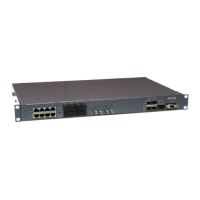
SW3
GIGABIT/FAST ETHERNET SWITCH TYPE SW3 (DIN) 49/122
USER GUIDE - M0SW3D1905Iv04 - V04 May 2019
The menu parameters are divided into two quite different blocks, which are:
Incoming bandwidth control to the port (Ingress Rate Control).
Outgoing bandwidth control from the port (Egress Rate Control).
The configuration parameters of each block are indicated below.
Ingress Rate Control:
• #. It identifies the port number, and it coincides with the equipment connector
number. Ports 9 and 10 are always associated with the SFP ports.
• Enable. This permits each port to be enabled or disabled individually, by ticking or
not ticking the respective Enable box.
• Traffic. It specifies the type of traffic: all, broadcast (b), broadcast and multicast
(bm) or broadcast, multicast and flooding (bmf).
Broadcast refers to the diffusion messages, that is, the information transmission
mode where an emitting node sends information to all the receivers simultaneously.
Multicast refers to the multi-diffusion messages, which are directed towards to the
members of a multi-diffusion group.
Flooding refers to the situation when there is a flood in a short time, usually due to
an incorrect topology, an inappropriate configuration, or a voluntary action by some
client equipment.
• Rate (bps). It sets the maximum incoming bandwidth to the port: 64000 bps
(64 kbps) to 250000000 bps (250 Mbps). The maximum data rate only affects the
Gigabit Ethernet ports.
Egress Rate Control:
• #. It identifies the port number, and it coincides with the equipment connector
number. Ports 9 and 10 are always associated with the SFP ports.
• Enable. This permits each port to be enabled or disabled individually, by ticking or
not ticking the respective Enable box.
• Rate (bps). It sets the maximum outgoing bandwidth from the port: 64000 bps
(64 kbps) to 250000000 bps (250 Mbps). The maximum data rate only affects the
Gigabit Ethernet ports.


 To Next Page