161
NOTE The car is able to automatically
recognise the maximum allowable
current intensity depending on the type
of domestic socket/public charging
stations used and the regulations in
force in the country in which you are
located (e.g. overloads). Reduce the
maximum charging current required
by using the "Charging settings"
item on the Uconnect™ system
display (for more information, refer
to the "Uconnect™" chapter in the
"Multimedia" section). Before charging
in your own home, or elsewhere, check
the allowable current intensity by
contacting a specialized technician: it
is advisable to contact a Dealership.
In case of problems (e.g. current
overloads) reduce the charge level.
TYPES OF CHARGING
CABLES
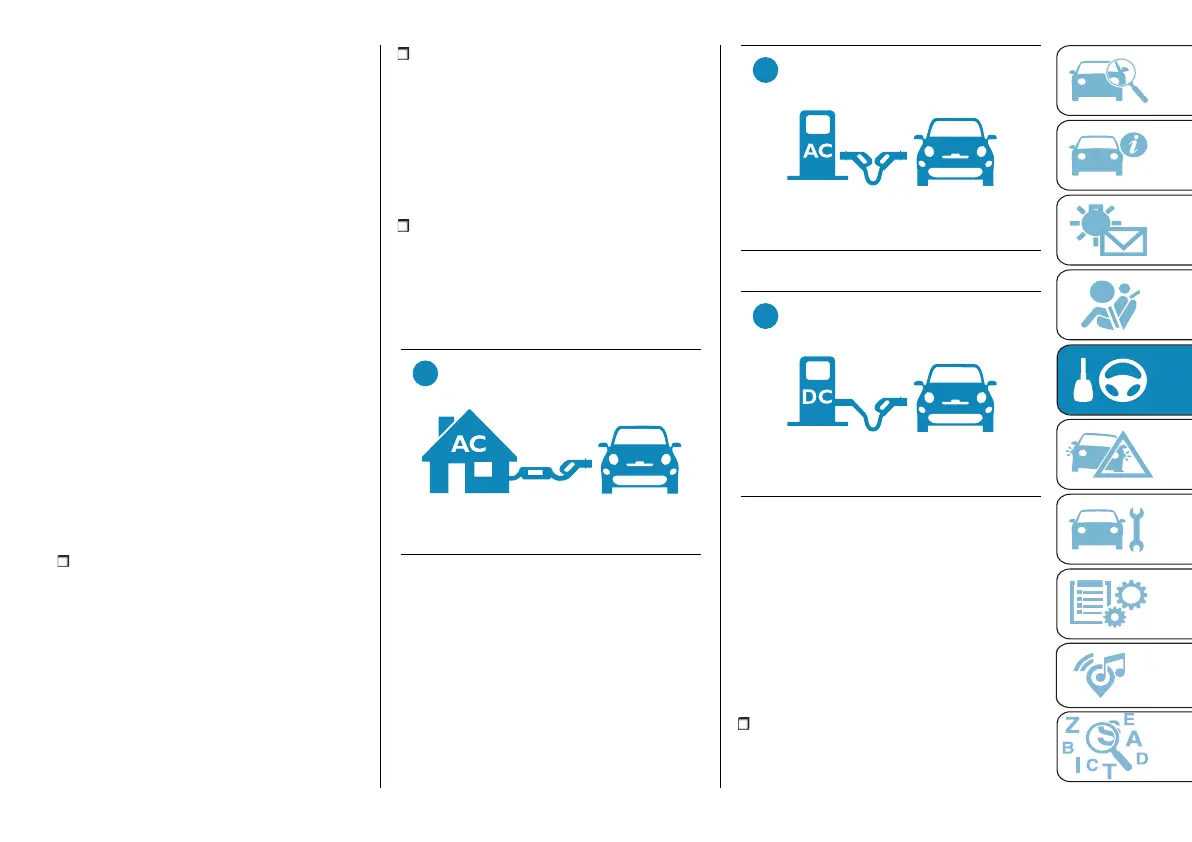
Three different types of cables can be
used for charging:
Mode 2 charge cable (A) fig. 156
(for versions/markets where provided):
allows charging from an earthed
domestic power socket. This type
of socket is used for charging with
alternating current. The "Mode 2"
charging cable complies with IEC
61851, IEC 62752 and SAE J1772
standards.
Mode 3 charge cable (B) fig. 157
(for versions/markets where provided):
allows charging from a public charging
station and a wallbox charging station
marked as AC stations (alternating
current). The charging speed may
be faster than charging through a
domestic power socket.
"Mode 4" – Fast Charge (C)
fig. 158Charging cable: this allows
charging from public charging sockets
marked as DC (direct current).
The charging cable is connected to the
charging station.
156 F0S1058
157 F0S1059
158 F0S1120
"MODE 2" CHARGE
CABLE
(for versions/markets where provided)
The car is equipped with a "Mode 2"
230 Volt AC charging cable (A) fig. 159
located inside a special bag in the boot
or inside the special container under
the boot floor. The cable consists of:
specific charging connector (B) for
connection to the car;



 To Next Page