• Arc protection
• Auto-reclosing
• Modbus TCP/IP or RTU/ASCII
• IEC 60870-5-103
• DNP 3.0 TCP/IP or serial
2.3 Physical hardware
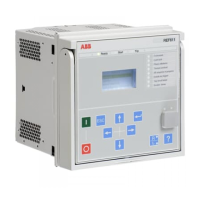
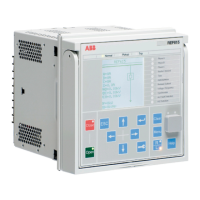
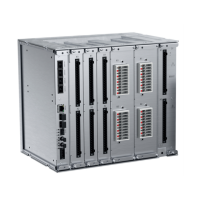
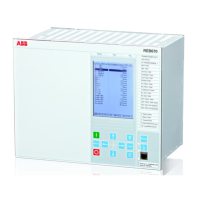
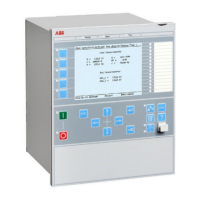
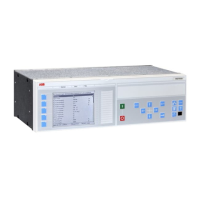
The IED consists of two main parts: plug-in unit and case. The plug-in unit content
depends on the ordered functionality.
Table 4: Plug-in unit and case
Main unit Slot ID Content options
Plug-in
unit
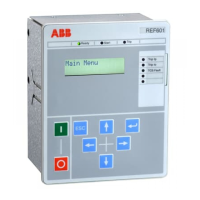
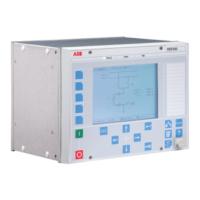
- HMI Small (4 lines, 16 characters)
Large (8 lines, 16 characters)
X100 Auxiliary power/BO
module
48-250 V DC/100-240 V AC; or 24-60 V DC
2 normally-open PO contacts
1 change-over SO contacts
1 normally open SO contact
2 double-pole PO contacts with TCS
1 dedicated internal fault output contact
X110 BI/O module Only with configurations B, D, E and F:
8 BIs
4 SO contacts
X120 AI/BI module Only with configurations A and B:
3 phase current inputs (1/5 A)
1 residual current input (1/5 A or 0.2/1 A)
1)
1 residual voltage input (100, 110, 115 or 120 V)
3 BIs
Only with configurations C, D, E and F:
3 phase current inputs (1/5 A)
1 residual current input (1/5 A or 0.2/1 A)
1)
4 BIs
Case X130 AI/BI module Only with configurations E and F:
3 phase voltage inputs (100, 110, 115 or 120 V)
1 residual voltage input (100, 110, 115 or 120 V)
4 BIs
Optional BI/O
module
Only with configurations B and D:
6 BIs
3 SO contacts
X90 Optional
communication
module
See technical manual for details about different type of
communication modules.
1) The 0.2/1 A input is normally used in applications requiring sensitive earth-fault protection and featuring
core-balance current transformers.
The rated input levels are selected in the IED software for phase current, residual
current and residual voltage. The binary input thresholds 18...176 V DC are selected
by adjusting the IED's parameter settings.
1MRS756378 D Section 2
REF615 overview
REF615 19
Application Manual


 To Next Page