Need help?
Do you have a question about the AgaMatrix Presto and is the answer not in the manual?
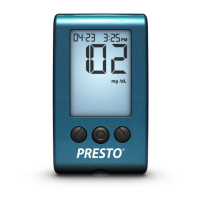
Describes the meter's display, buttons, and test strip port for basic operation.
Highlights the meter's key feature of not needing manual coding for tests.
Unpacking and initial verification of the glucose monitoring system.
Details on how the system should be used for accurate blood glucose monitoring.
Lists what not to do with the system and where to test for optimal results.
Specific conditions that make fingertip samples more reliable for accurate readings.
Explains test strip parts like contact bars and fill window, and the single-use policy.
Guidelines for storing strips, temperature requirements, and avoiding damage.
Explains symbols for Date/Time, Results, Battery, Temperature, Ketones, and Units.
Details symbols for volume, countdown, and graphing areas on the meter display.
Identifies and describes each part of the lancing device and its purpose.
Instructions on how to clean the meter and lancing device safely.
Steps for the initial system check and activating the meter.
Guides on accessing data and navigating meter settings.
How to move through meter settings and turn the device off.
Conditions affecting results and what low/high glucose levels mean.
Guidance on responding to unexpected glucose readings or symptoms.
Advice for error messages, symptoms, and test strip care.
Information on typical fasting glucose levels for context.
Explains why and how to use control solutions, including shelf life.
Situations that necessitate performing a control solution test.
Key advice for using control solutions correctly.
Detailed steps for running a control test, including sample application.
How to compare test results to the expected control range.
Lists factors leading to unexpected control test readings.
Key advice and precautions before and during a blood glucose test.
Steps for preparing the device, including cap and lancet insertion.
Instructions for adjusting the lancing depth and preparing the device.
Steps for inserting the strip and what the meter displays.
Guidance on lancing the skin and maintaining cleanliness.
How to lance the skin and obtain a blood droplet.
Correct method for applying the blood sample to the strip.
Explanation of how the strip fills and results are processed.
Final steps and confirmation of test result saving.
Instructions for removing used items and deactivating the meter.
Guidance on removing and discarding the used lancet properly.
Reminder for essential hand washing after handling supplies.
Explains advantages, risks, and when to use alternate sites.
Steps to prepare the lancing device for alternate site testing.
Instructions for preparing and lancing the palm or forearm.
How to get a sufficient blood drop from palm or forearm.
Overview of numerical averages and trend graphs.
Guides to navigate settings and use stored data appropriately.
Steps to view and interpret historical test results.
Explains graph elements and how to view comparison data.
How to check average glucose levels for different times of day.
Steps to scroll through saved individual test results.
Explains low and high glucose readings and recommended actions.
Explains alarms for hypo/hyperglycemia and ketone alerts.
Explains messages related to temperature and battery status.
How alarms work and how to enter the alarm configuration menu.
Steps to turn alarms on/off, set times, and adjust volumes.
How to change volume levels and enable/disable the backlight.
Steps to choose 12H/24H format and begin setting the time.
Instructions for configuring the meter's current time and date.
Steps to set the low glucose warning threshold.
Steps to set the high glucose warning threshold.
Explains common error messages and their potential causes.
Addresses issues preventing the meter from starting a test.
Addresses issues where the test doesn't begin after blood sample application.
Safety notes and steps to open the battery compartment.
Detailed steps for replacing batteries and closing the compartment.
Lists assay method, altitude, calibration, sample details, units, and alarms.
Details operating temperature, humidity, and measurement range.
Covers memory capacity, power source, dimensions, and safety notes.
Outlines the terms and coverage of the meter's warranty.
Details on how to get a replacement and warranty disclaimers.
 General
| Brand | AgaMatrix |
|---|---|
| Model | Presto |
| Category | Blood Glucose Meter |
| Language | English |

 To Next Page