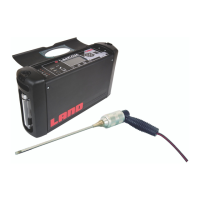
Portable Flue Gas Analyser
User Guide
Lancom 4
7 - 2
Automatic Data Logging
Automatic data logging allows you to specify the number of logs you need
and how often you make them. You can store the logs to the memory or
print them as they are made.
Example
Logging the gas readings every 10 seconds (LOG INTERVAL) for a
duration (LOG PERIOD) of 2 minutes generates 12 data logs.
Setting Up Automatic Data Logging
1) From the Main Menu, select the Settings option.
The Settings screen is displayed.
2) Select the Data Log option.
3) Select the required Log interval - the time between each data log.
This can be between 10 and 1800 seconds and determines the number
of data logs made.
4) Select the required Log period - the total time during which all the
data logs will be stored. This can be between 1 and 180 minutes.
5) Scroll to the Log type option, then use the left/right keys to select the
Automatic option.
6) Choose the required Log output option for the logged data:
File - data logs are stored in memory and can be retrieved later.
Printer - data logs are printed as they are made. Data logs are not
stored. The Log interval must be set 30 seconds or over when printing
directly.
Using Automatic Data Logging
1) Connect the probe.
2) Press one of the Measurement buttons
3) To start automatic data logging, press the enter key.
4) Data logging will stop automatically when the Log period has elapsed.
5) When automatic data logging is complete data logging returns to
manual operation.
7.2 Defining Data Log Locations
WhenyoudenedatalogLocationtags,aseparatedatalogleis
maintained for each location.
Locationtagsareuser-denednamesofmeasurementlocations.They
allow you to identify the place where a logged measurement was made (e.g.
“Stack#3”or“CokeOvenEastSide”).Youcandeneupto20locationtags.
or


 To Next Page
 Loading...