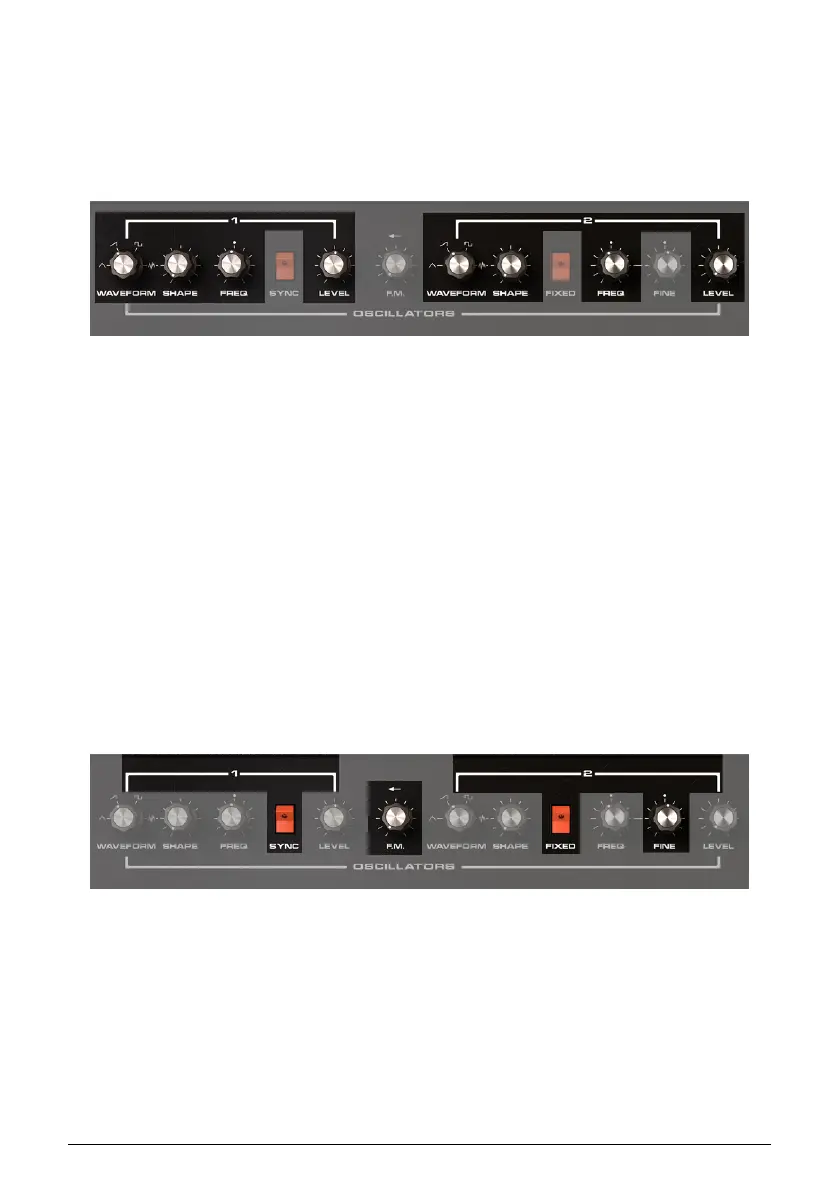
6.2. VCOs
The synthesizer architecture uses two VCOs. These are the sound generators that produce
the Carrier’s waveforms.
6.2.1. VCO 1 and VCO 2 Common Controls
Waveform chooses triangle, sawtooth, square, or white noise for the VCO. Waveforms with
more harmonics, like the sawtooth, provide the most intelligible vocal sounds. Modulating
noise sounds almost like a crowd shouting.
Shape changes function depending on the selected waveform.
• Square wave Changes the pulse width
• White noise Changes the sound’s color (tonality).
• Triangle and Sawtooth Applies Arturia’s wavefolding process, which folds the
peaks of the waveform downward to change the sound’s high-frequency
content. When fully counter-clockwise, each waveform has its most traditional
shape and sound. Turning Shape clockwise increases the perceived high-
frequency content.
• Freq transposes the oscillator frequency ±60 semitones. For example,
transposing Osc 2 +12 semitones gives a higher voice timbre, while -12 semitones
gives a deeper voice timbre.
• Level controls the VCO’s output amplitude.
6.2.2. VCO 1 and VCO 2 Unique Controls
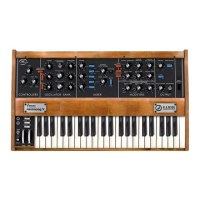
• Sync (VCO 1). Produces the “hard sync” effect associated with analog
synthesizers. When enabled, varying VCO 1 Freq does not change the pitch, but
only the timbre. VCO 2 Freq sets the master keyboard pitch.
• FM (VCO 1 and 2). VCO 2's output signal modulates VCO 1, which can produce
clangorous, dissonant effects when the two sounds interact.
• Fixed (VCO 2). Maintains a constant pitch for VCO 2 that does not change as you
play different keys.
• Fine (VCO 2). Tunes the oscillator pitch in cents, as opposed to the semitone
intervals implemented in the Freq control.
Arturia - User Manual Vocoder V - Carrier Synthesizer 43



 To Next Page