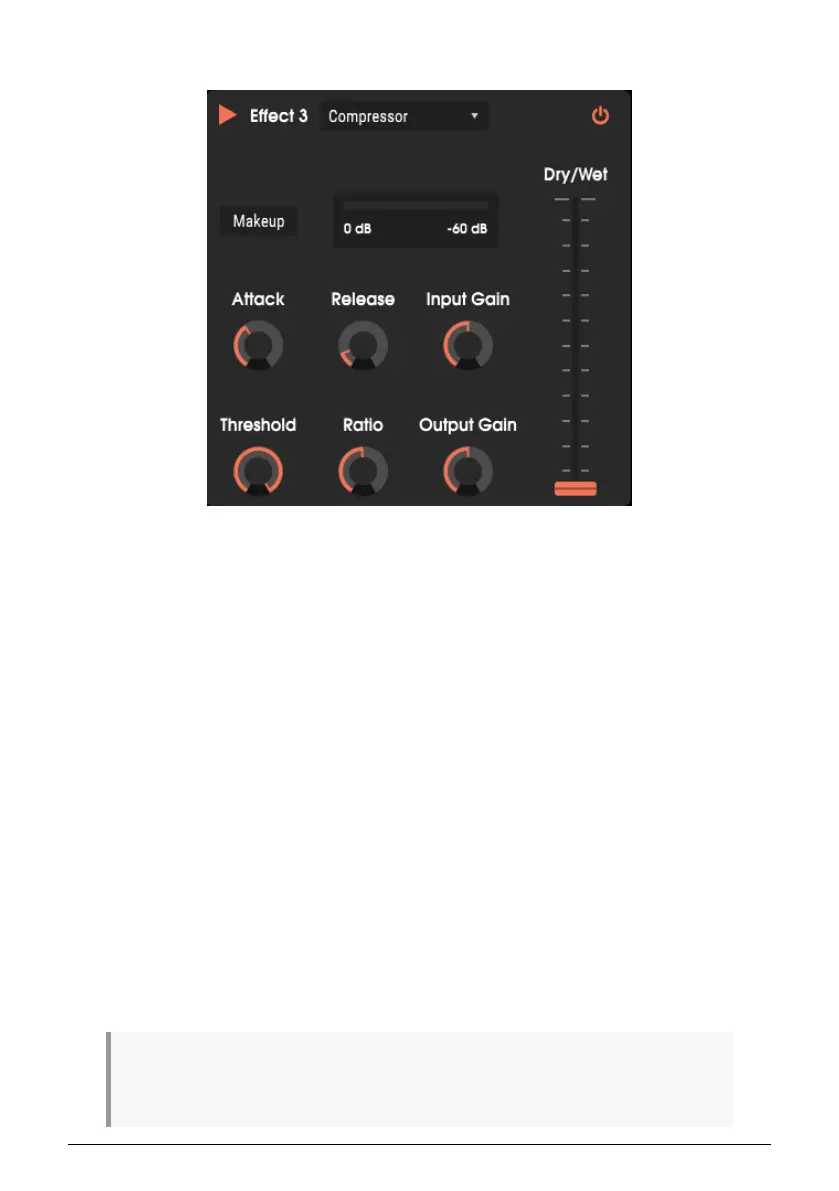
9.5.7. Compressor
A compressor narrows a signal’s dynamic range to even out level variations. You can think
of it as a very fast volume control that turns down the level when it’s too loud, and raises
the level back up when the signal level returns to normal. Although originally designed for
broadcasting, audio engineers have found many creative uses for compressors beyond
simply evening out loudness levels. For example, many mix engineers use compressors
to bring an increased sense of power and excitement to a single track or an overall mix,
guitarists use compression to increase sustain, and extreme settings cause “pumping”
effects that are common on EDM recordings.
When used as part of an effects chain, a compressor can keep a sound’s attack transients
from overloading the next effect’s input. It can also extend the duration of a sound’s
amplitude envelope that naturally decays quickly, thus creating a longer sustain. Drums are
often compressed to bring up room sound and add “punch.” Compression is also added to
radio and television audio levels to keep them within a certain volume range.
• Makeup Switches the compressor's automatic make-up gain on and off. This
feature compensates for the natural output level reduction that happens when
the compressor brings down peaks.
• Attack Specifies the time it takes for the compression to react to an incoming
signal. With short attack times, the compressor will start controlling level as soon
as the input signal passes over the Threshold (described below). Longer attack
times increase the amount of compression over the specified time until it reaches
the maximum set amount of compression. This allows momentary peaks to
pass through with little or no compression, which can preserve natural “attack”
transients. Note that if you use compression with Vocoder V, adding some attack
time will help preserve consonants at the beginnings of words, and create a
more intelligible effect.
♪: Using the Dry/Wet slider to add some dry sound in with the compressed sound can also
help preserve transients, while still giving a full, compressed sound. This technique is called parallel
compression.
70 Arturia - User Manual Vocoder V - The Effects




 To Next Page