54
400 Series
Inspections after you start the loader
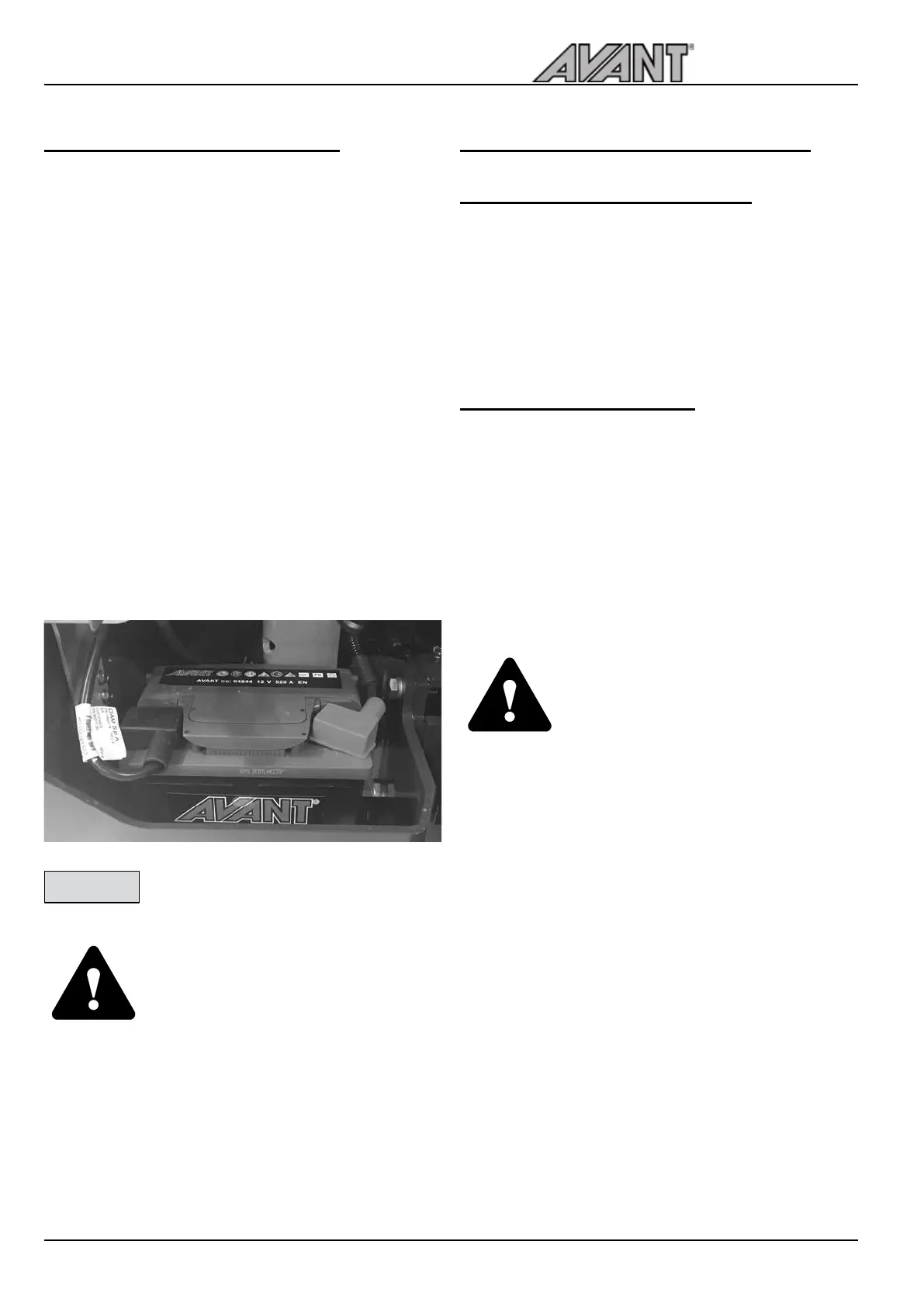
13. Battery and electric cables
The battery is located at the rear of the loader, on the
right side of the engine. You can do the routine battery
related checks by removing only the top panel of the rear
frame (engine cover). To fully access the battery, remove
the rear right panel of the loader.
Check the cleanliness, fastening, and condition of the
battery and electric cables.
• Check the battery cables, connectors, and terminals
visually. If a cable or its insulation has become brittle,
there is a risk of short-circuit. Replace the cables and
insulators, if necessary.
• Inspect and clean the battery terminals regularly. If the
terminals appear to be corroded, clean them.
• Make sure that the battery is correctly fastened and
secured against movement.
• Clean the surroundings of the battery carefully. Also
remove the dirt from under and around the battery.
• Make sure that the cables in the engine compartment
cannot chafe against any sharp edges.
• Check the condition and fastening of the battery
disconnect switch and its cables.
Disconnect (isolate) the battery rst
by using the the battery disconnect
switch.
Battery and its terminals contain lead.
Before handling the battery, see safety
instructions regarding handling of the
battery on page 9.
The battery is sealed and maintenance free, meaning that
it doesn’t need and can’t be relled with water during its
lifetime. Do not attempt to open the cover of the battery.
When necessary, replace battery with a battery that
meets the original specications. Always handle batteries
with care and recycle used batteries.
Inspections after starting the loader
14. Drive control and steering
• Check operation of pedals and steering. Pedals must
move freely and not get stuck or feel stiff
• Check that loader stops when not pressing the
drive pedals. Do not use the loader if the braking
performance is decreased, or if the loader creeps
• Allow the loader to warm up and check steering
15. Movements of boom
• The boom should move smoothly to all extreme
positions, when using it without an attachment.
• If an attachment is tted, check that the boom moves
smoothly within its normal operating range.
• Hydraulic hoses or electric cables must not get pinched
or stretched in any position of the boom
• If the boom starts to chatter under load, grease the
slide pads and wipe off the excess grease
Avoid moving the attachment to a
position where it can contact the
loader. Some attachments may reach
the front tires, boom, or structures of
the loader when moving the boom or
tilting to the extreme positions. Use
any attachment only for its intended
use.
WARNING
CAUTION
NOTICE


 To Next Page