P2 Service
If required, the user will provide invoices relating
to any engine maintenance work carried out.
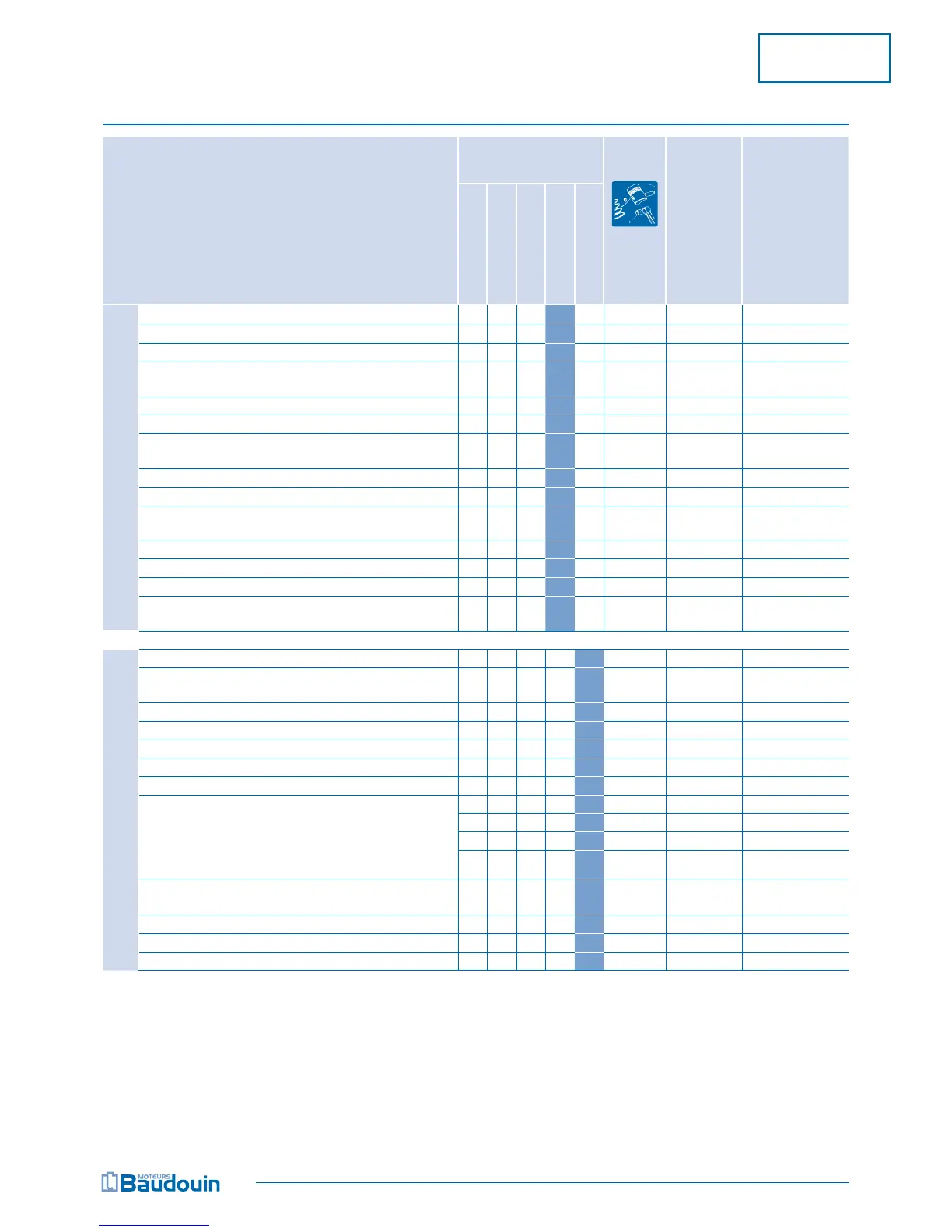
servicing frequency
(when the 1
st
servicing date
is reached)
PR
catalogue
Note Comments
1 year or 1,500 hrs
3 years or 3,000 hrs
5 years or 6,000 hrs
10 years or 12,000 hrs
15 years or 24,000 hrs
R4
Replacing the sleeves 01 3, 4 and 5
Replacing the rings 02 2, 3 and 4
Cleaning the pistons 02 3
Cleaning the greasing tubes (rocker arms,
injection pump, turbochargers)
04/05 4
Replacing the connecting rod bearing 02 4
Checking/replacing the control and safety valves 01/04 4
Having the injection pump checked by a diesel
engine mechanic
05 2, 3
Standard replacement of the turbochargers 10 3, 4
Checking the timing gear play 02 4
Replacing the front and rear seals on the
crankshaft
02 4
Replacing the priming pump 05
Replacing the damper 02
Servicing the fuel feed pump 05
Checking the camshaft and push rods 02 change if
necessary
General overhaul
R5
Replacing the injector nozzle holders 05 2
Replacing the bearing bushing and the thrust
bearing anges
02 3, 4
Replacing the pistons 02 2, 3, 4, 5
Replacing the camshaft bushings 01
Cleaning the water chambers
Replacing the oil jets 04
Cleaning the bored lines
Replacing:
- all seals
- timing gear, connecting rod, cylinder head and
counterweight screws
- damper fastening screws
Checking the crankshaft (straightness of the
surface, magnetic particle testing)
Servicing the oil pump 04
Metrology of all gears
Checking all rocker arm units 01
Factors that may require preventive maintenance cycles to be brought forward:
Note 1 - If raw water is heavy with deposits or
alluvium,
these maintenance operations must be brought
forward.
Note 2 - If fuel quality, ltration and injection
adjustments are not correct, these operations must be
brought forward.
Note 3 -
These operations are dependent on the
correct adjustment of the injection gear (lead, ow),
proper ventilation of the machine room and fuel quality.
Note 4 - Certain incidents such as crankcase blowing, random oil and air ltration,
poor maintenance or oxidising oil, will require these operations to be brought
forward.
Note 5 - Failure to use a corrosion-inhibiting coolant and a lack of coolant circuit
pressure can cause corrosion of the sleeves and scaling of the cores and will
therefore require maintenance.
Note 6 - Severe use of the engine (very low or very heavy load) will require more
frequent maintenance.


 To Next Page