Sewing test
66
2020-09 EN 5040064.00A.04
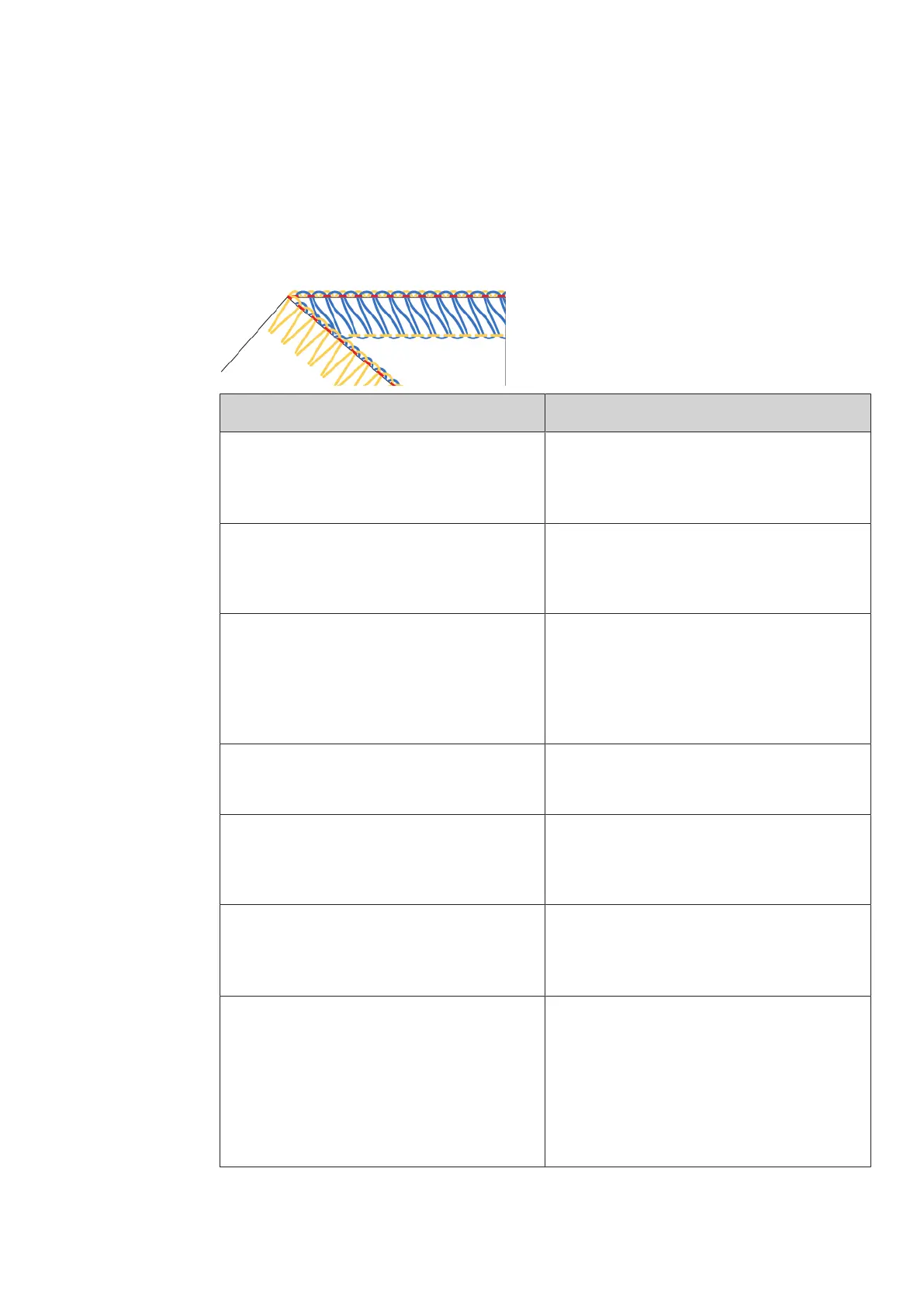
3-thread flatlock
With a balanced stitch formation, the upper thread (blue) is on the right side of the stitch related to the
insertion into the fabric edge.
The Lower Looper Thread (red) is parallel to the fabric edge.
The Needle Thread (yellow or green) forms a «V» on the wrong side of the stitch related to the insertion into
the fabric edge.
Stitch pattern Solution
The Lower Looper Thread overedges the
fabric edge towards the wrong side of the
fabric.
> Reduce the Needle Thread Tension (yellow or
green).
> Increase the Upper Looper Thread Tension
(blue).
The Upper Looper thread doesn't reach to the
fabric edge.
> Increase the Needle Thread Tension (yellow or
green).
> Reduce the Upper Looper Thread Tension
(blue).
The Lower Looper thread is not parallel to the
fabric edge.
> Increase the Lower Looper Thread Tension
(red).
> Reduce the Needle Thread Tension (yellow or
green).
> Reduce the Upper Looper Thread Tension
(blue).
The seam puckers, the Lower Looper Thread is
overstretched.
> Reduce the Lower Looper Thread Tension (red).
The Needle Thread doesn't reach to the fabric
edge.
> Reduce the Needle Thread Tension (yellow or
green).
> Increase the Upper Looper Thread Tension
(blue).
The Lower Looper Thread overedges the
fabric edge towards the wrong side of the
fabric.
> Increase the Needle Thread Tension (yellow or
green).
> Reduce the Upper Looper Thread Tension
(blue).
The fabric edge curls.
> Reduce the Needle Thread Tension (yellow or
green).
> Reduce the Upper Looper Thread Tension
(blue).
> Increase the mtc Mircro Thread Control.
> Reduce the Cutting Width «CW».
> Check the Rolled Hem Selection Lever position
«N».
Tab.4: Optimizing the stitch: 3-thread flatlock


 To Next Page