WWW.BIGASSSOLUTIONS.COM © 2016 DELTA T CORP. ALL RIGHTS RESERVED.
29
Delta secondary
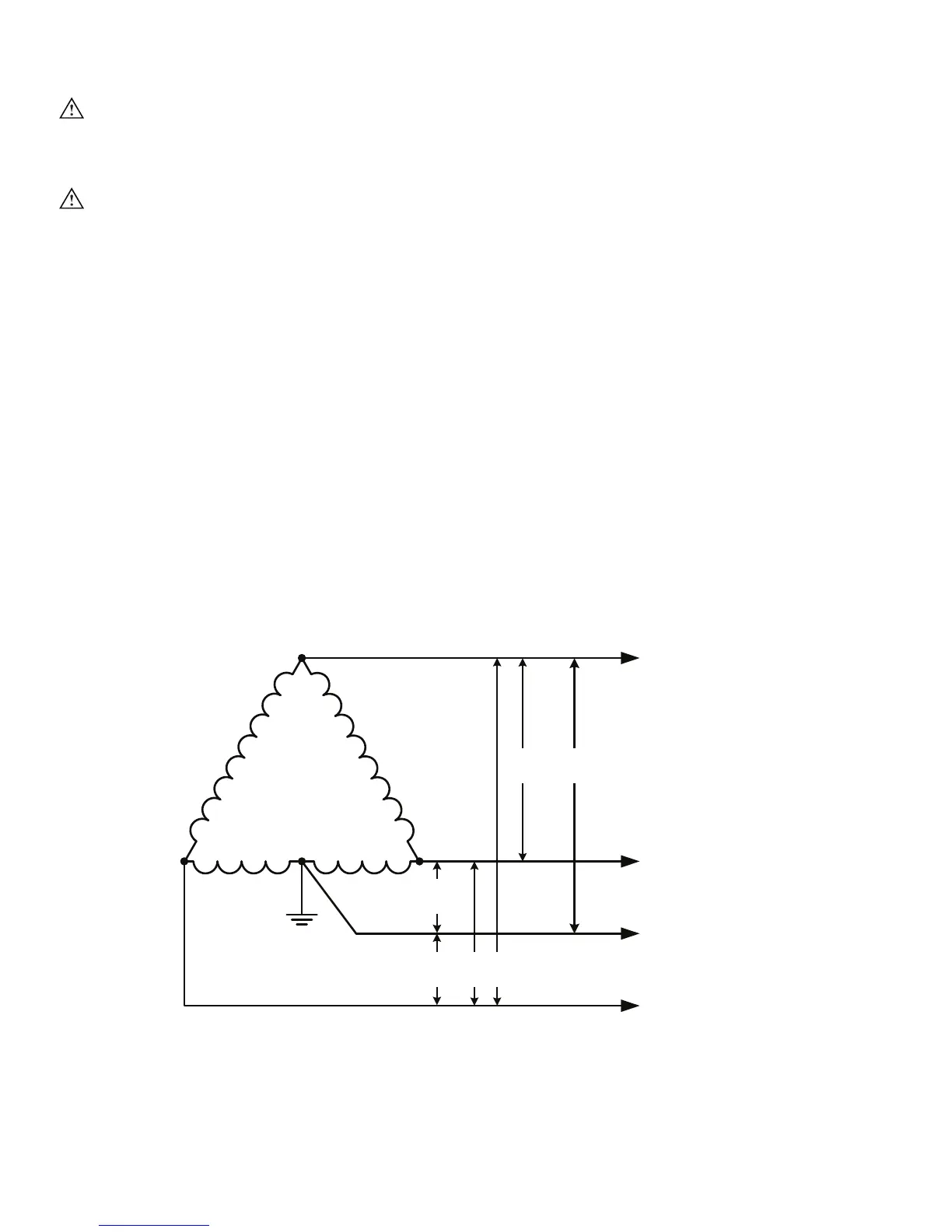
CAUTION: Care must be taken when connecting to a three-phase 240/120 V secondary as shown below.
All VFD models rely on internal references made between each incoming phase and ground. To prevent
nuisance tripping such as Overvoltage and Undervoltage faults, 200–240 V, three phase VFDs should
be connected so that the High leg, or “phase B,” terminates on “L2” of the VFD’s input power terminals.
CAUTION: Avoid installations utilizing supply transformers with a 480V delta secondary (ungrounded,
corner grounded, open). Proper fan operation cannot be guaranteed due to a lack of proper phase-to-
ground voltage references.
There are many dierent arrangements available for industrial and commercial power distribution in North America.
The most common are the following:
• 575 V/330 V Three-Phase (Wye Secondary). Provides 575 V between phases, and 330 V from each phase to
Neutral/Ground.
• 480 V/277 V Three-Phase (Wye Secondary). Provides 480 V between phases, and 277 V from each phase to
Neutral/Ground.
• 208 V/120 V Three-Phase (Wye Secondary). Provides 208 V between phases, and 120 V from each phase to
Neutral/Ground.
• 240 V/120 V Three-Phase (Delta Secondary). Provides 240 V between phases for three-phase loads, 120 V
from phase “A” and “C” to Neutral/Ground, and 208 V from phase “B” to Neutral/Ground as shown below. In this
transformer arrangement, phase “B” is commonly referred to as a “Wild Leg” or “High Leg,” and shall be marked
accordingly with an orange finish or other eective means per NEC 110.15.
“B” Phase
“C” Phase
Neutral / Ground
“A” Phase
120 V 120 V
240 V
240 V
240 V
208 V






 To Next Page