VD (E2.1) 10/2011 page 14/83
1.6 Intended use
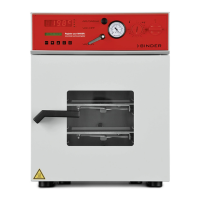
The VD vacuum drying ovens are suitable for drying and heat treatment of solid or pulverized charging
material, as well as bulk material, using the supply of heat under vacuum. The solvent content must not
be explosive or flammable. A mixture of any component of the charging material with air must NOT be
explosive. The drying temperature must lie below the flash point or below the sublimation point of the
charging material.
Observing the instructions in this operating manual and conducting regular maintenance
work (chap. 17) is part of the intended use.
2. Description of the equipment
Vacuum drying is used for special drying problems, for which conventional drying methods cannot offer a
solution due to physical limitations.
All functions of the multifunctional program control can be set simply and conveniently via the easy to
understand function keypad of the RD3 temperature program controller. This controller is equipped with
touch function keys and a digital display and permits exact temperature setting and programming
temperature cycles. The VD provides almost unlimited possibilities of adapting to individual customer
requirements based upon extensive programming options and on the week program timer and real time
clock of the controller.
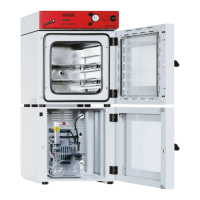
The electro-polished inner chamber, the rack holder, and all of the unit's vacuum connections and valves
are made of especially corrosion resistant stainless steel V4A (material no. 1.4571 in Germany). The
housing is RAL 7035 powder-coated. All corners and edges are also completely coated. When operating
the chamber at temperatures above 150 °C / 302°F, the impact of the oxygen in the air may cause
discoloration of the metallic surfaces (yellowish-brown or blue) by natural oxidation processes. These
colorations are harmless and will in no way impair the function or quality of the unit.
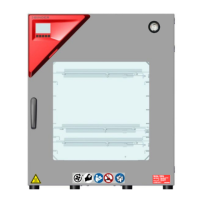
The vacuum drying ovens in the APT.line™ are jacket-heated. The APT.line™ preheating chamber
technique ensures a completely homogeneous jacket temperature, ensuring uniform heat transfer into
the inner chamber. The low-loss heat transfer to the material uses the patented aluminum vacuum
expansion racks (or optionally available in stainless steel). The elastic-mounted safety glass window
reliably compensates any overpressure or explosions that may occur. The additional polycarbonate panel
ensures proven and effective splinter protection in the event of an implosion.
All VD units provide an inert gas connection and a measuring connection serving to connect a vacuum
controller or a measuring access port.
The VD vacuum drying ovens are equipped as standard with a large-surface safety valve. The toughened
safety glass window is elastic-mounted and in the event of explosion serves as a safety valve. The
additional plastic panel provides splinter protection.
The VD vacuum drying oven is equipped with a serial interface RS 422 for computer communication, e.g.
via the communication software APT-COM™ 3 DataControlSystem (option, chap.16.8). For further
options, see chap. 20.3.
All installable items, such as racks and rack holders, can be easily removed. The completely smooth
inner chamber with its rounded corners and internally welded seams is easy to clean.
The minimum working temperature of the vacuum drying oven is approx. 15 °C / 27 °F above room
temperature. The maximum temperature is 200 °C / 392°F.
Vacuum
pumps with a suction capacity of 1 m
3
/h to 30 m
3
/h are suitable for the VD vacuum drying oven.
The permissible end vacuum is 10
-2
mbar / 0.0003 inHg.



 To Next Page