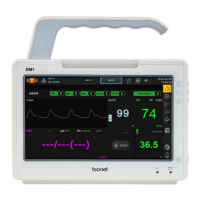
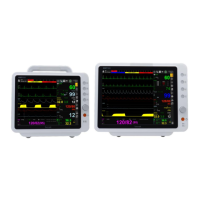
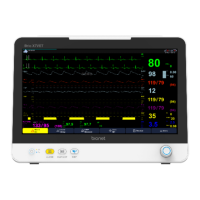
No modification of this equipment is allowed.
Do not modify this equipment without authorization of the manufacturer.
If this equipment is modified, appropriate inspection and testing must be conducted to
ensure continued safe use of equipment.
Network Connection
- No one other than service personnel can connect this device to the network.
Consult with hospital IT staff in advance. It is recommended to follow IEC 80001-1
(Risk management of IT networks connected to medical devices)
LAN Network
- LAN networks are usually configured through a star topology. Individual devices can be
grouped together via a layer-n-switch. Other data traffic is separated by a separate
VLAN network. Configure the device's network settings according to this user guide and
network specifications.
- LAN connection specifications are described in the following standard specifications.
⚫ Wired network: IEEE 802.3
⚫ Wireless network: IEEE 802.11 (a, b, g, n)
- If the device is used as a layer-2-switch or layer-3-switch, the port settings must be
configured on the network switch. “Bionet device” must be configured so that the
network settings are compatible with the specifications of the operating organization.
- These devices exchange data with other medical devices over a LAN network. The
network must support the following transports and protocols.
⚫ TCP/IP
⚫ BROADCAST
VLAN Network
- If data is exchanged within a single network, an independent VLAN network must be
established for clinical information systems, such as a network dedicated to medical
devices in hospitals. In addition, it is necessary to establish a network system that detects
and defends against denial-of-service attacks by installing dedicated DDos defense
system.



 To Next Page